Elna SP foot pedal went bang

Elna SP foot pedal to the metal

On the back of a previous article about a repair I did on the rather wonderful Elna SP sewing machine, a reader got in touch.  She was a genuine sewing aficionado and had several top of the range current machines, but she used the trusty Elna SP for many smaller jobs, where the other machines didn’t quite cut it.

All Elna SP machines are getting on a bit and parts are either re-manufactured, scarce or secondhand, if you can find them.  Having said all that, a well-maintained Elna will run for many years and last much longer than new metal on sale now.
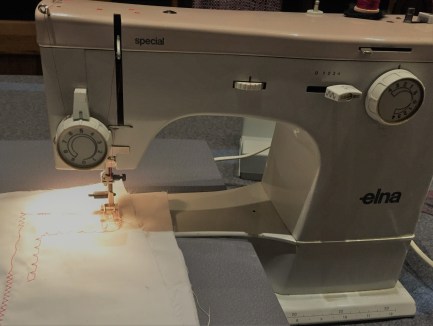
IMG-1971
FixItWorkshop, Worthing, November’18, Elna SP Special, in action

The foot pedal on this machine had gone pop, bang, finito.  It smelled terminal.

Knowing that parts for this machine are rarer than hens teeth and I do like a challenge, I took on the job.  I’m based in Worthing, West Sussex and the machine was located in Scotland, so after a short wait, the knackered pedal arrived in the post.

The pedal is held together with four small self-tapping screws and came apart easily.  The reason for failure was two-fold.  The copper leaf contacts had arced excessively and caused major pitting in the contact strip (see slide show) and the probably ensuing resistance had caused the main resistor to overheat, causing the winding to fail.

This slideshow requires JavaScript.

The contact surfaces were easy-ish to fix, or rather breathe new life into as all they needed was cleaning and re-shaping.  The resistor was a bit trickier to mend.  Getting hold of a replacement was going to be near impossible, so the only thing to do was to try and repair it.  Without that particular style of resistor, of that value, it wouldn’t work again.  Luckily, there was some excess resistance wire on the thing and I managed to twist it in to the broken section.  Soldering was not an option, since the wire was an alloy that wouldn’t take to solder and in any case, these things get hot in normal service.  I twisted both ends of the break to form a new section, while maintaining the same length of windings on the resistor, essential if I was to match or get close to the original specification.  Difficult.  Luckily, after a few goes, I managed it and the applied a little heat-conducting (and therefore dissipating) paste to the join.

With the pedal reassembled, I was only able to test it with my meter, since the sewing machine was far too heavy to post.  The pedal tested as a closed circuit (OK), which was a result.  I then had to wait for the pedal to be collected, taken back to Scotland and tested.  Fortunately, my fix worked and the machine sprang in to life, without a hitch or missed stitch.

Now, a word of caution with this one.  This is NOT the best way of mending something like this and all I’ve probably done is prolong it’s life a little longer.  There are generic sewing machine pedals that would work with this machine and will be fine, when this one fails in future, but that’s not the point.  The main thing is that something that was broken is now working and even if it’s not the best fix, at least it will run for a bit longer.  Happy days.

Cost of replacement: (generic part) £15-30.  Cost of repair, my time, a bit of solder and several cups of tea.

Alesis (DM Lite) Drum kit without kick

Alesis Drum Kit gets a cheap repair.

A neighbour of mine is a talented musician in a local band and also teaches school children various instruments.  Some of his students learn the drums, which is most parent’s nightmare as any notion of a peaceful evening is shattered.  Luckily, electronic drum kits are an excellent way to learn with headphones, while keeping happy parents and neighbours.

IMG_5963
FixItWorkshop, Worthing, November’18, Alesis DM Lite Electronic Drum Kit
IMG_5964
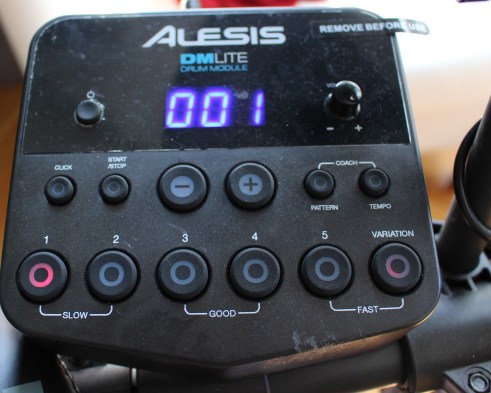
FixItWorkshop,  Worthing, November’18, Alexis DM Lite main drum module

This kit was missing several beats and was hampering learning, so time for a visit to the workshop.  I’m no musical instrument repair specialist, but I thought that the drum kit must use electrical contacts, switches and rudimentary electrical components and I was right.

Two faults were reported; The kick/ foot pedal was intermittently not working and one of the drum pads was hardly working at all, unless you hit it with a sledge-hammer.  Time to see what was going wrong.

First up was the faulty drum pad.  Opening up the back of the pad was simplicity itself, just a few screws held the back to the pad.  Sandwiched between two halves was a sensor, a bit like a piezo flat speaker, similar to the type found in many toys with sounds.  I guess the principle here is that vibration detected by the piezo sensor is converted to analogue variable voltages by the drum kit’s circuitry.  While apart, I noticed that some of the copper detail tracks on the printed circuit board which had a standard 3.5mm jack socket (to allow a connection back to the rest of the kit) had cracked.  Looking again through my magnifying glass revealed quite a bit of damage, probably as a result of many Keith Moon wannabes.  Testing these tracks with my meter confirmed an intermittent fault, so out with the soldering iron, to repair the connection.  Plugging the pad back in, it was ready once again for more drum solos.

This slideshow requires JavaScript.

Next up was the dodgy kick/foot pedal.  As the with the drum pad, the pedal would cut out intermittently.  A few screws held the pedal together, so only basic tools required.  See the slide show below for an idea of the construction.

This slideshow requires JavaScript.

The fault with the pedal was similar to the drum pad.  Some of the copper detailing around the 3.5mm jack socket had failed and required some careful soldering.  I say careful, as applying too much heat at once would, likely as not, melt the casing of the socket.  One had to take care.

Once soldered, the pedal was much better.  I didn’t get a full 10/10 repair with the pedal since I think there was wear on the kick sensor, but it was an improvement none the less.

Cost of replacement:  £lots.  Cost of repair, my time, two cups of tea and some solder.


Concord Transformer-T ‘Ejector’ Child Seat

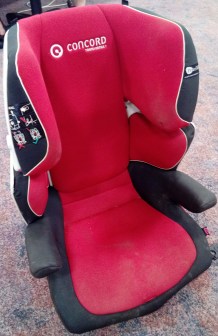
A Concord Transformer T Ejector Child Seat

It’s been a while since I wrote anything on my blog and for that I apologise.  The lack of writing doesn’t mean that the workshop has been gathering dust, far from it.

Ages ago, a former colleage of mine asked me to look at a Concorde Child Seat, which seemed to be automatically adjusting to it’s maxmimum height setting, in an ‘ejector’ seat style.  This kind of action is OK for 007, but no good for a family trip to the seaside.

Child seat repairs are not my usual thing, but since this one was unusable, what did I have to lose?  These seats are normally well over £140.00 too, so it seemed like a good idea to have a go.

The Concord Transformer-T features a neat trick in that it can adjust it’s height to suit the growing child, with the touch of a button.  This is especially handy when different children share the same seat.  Up and down height settings are achieved by a ‘Transformer’ (the toys) style of action, controlled by a gas damped srump strut, similar to that used on hatch back tail gates.

IMG_20180731_114735
FixItWorkshop, Worthing, November’18, Concord Transformer-T

This seat’s gas strut seemed to go to maximum height, without warning, extending seat in an ejector seat style.  Time to dig out some tools.

The seat’s cover came off easily, thanks to to some hook and loops around the plastic backing.  Lucky as the cover on this seat had some dubious stains.

Once off, several T20 Torx screws removed and a cable operated plunger to a button on a gas strut was revealed.  This seemed like a good place to start.  Despite the premium price tag, the inner workings of the seat seemed quite flimsy, I assume to minimise weight and to comply with safety standards.  The moving headrest, back support and centre arms all moved on a scissor action mechanism, which seemed to working fine.

Disconnecting the cable/ button/ lever involved a T20 Torx screwdriver and 10mm spanner.  Once removed, there was good access to the button on the end of the gas strut.  It appeared that the button was working just fine and one could manually adjust the size of the seat with a finger.  Interesting.  Time to inspect the adjustment of the cable and lever mechanism.  Luckily, there was adjustment on the cable and lever and after a little fetling, the mechanism was restored.


This slideshow requires JavaScript.

Price when new:  £140.00ish.  Cost to repair, 30 minutes tinker time, 1 cuppa and a ginger nut biscuit.

A flying barbecue problem

A rusty barbecue lives to cook another day.

My dad kindly donated an elderly Homebase Sorrento gas barbecue a few years ago and each summer since, it’s cooked a good few bangers and steaks in the garden.  Nice.  However, during the winter this year, the barbecue nearly met an unfortunate end.  The barbecue is always kept lightly sprayed with WD-40 when not in use and always covered with a generic tarpaulin, to keep the rain out.  However, one particularly windy day during the winter of 2018, the cover that was meant to protect the outdoor cooker turned in to a handy sail and briefly lifted it a few feet in to the air and then down again with a crash.  Oh dear.

IMG_5736
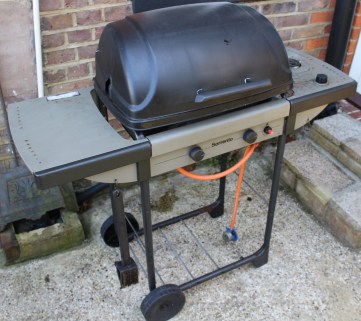
FixItWorkshop, May’18, Worthing, Homebase Sorrento/ Campingaz Eldorado.

At first glance, all appeared to be well but on further inspection it seemed that the gas burner within the main ‘charcoal’ area had taken quite a hit.  Years of use and damp storage had taken their toll and the rusty burner within had finally shattered and was no longer in good serviceable condition.  In fact, using the barbecue in this state could literally be explosive, since the gas would be flowing out all over the place, potentially un-burned.

Not holding out much hope for spares, I took to Google to see what parts were available for the nearly 20-year-old appliance.  It turns out that there are many spare parts available for gas barbecues, from spare handles to gas valves to replacement grilles, including burners of just about every variant.  With a bit more research, it appears that my Homebase Sorrento is in fact a re-badged Campingaz Eldorado.  As Campingaz is a well-known brand, the burner was readily available at a very reasonable £23.00, including delivery from Hamilton Gas Products www.gasproducts.co.uk.

Hamilton supplied the parts quickly and the part fitted as easily as the existing one, as it was a like for like spare part, more or less.  I had to cut-off the existing screw, as it was beyond help and replace it with something similar, once fitted and the height adjusted with a washer and nut or two, the burner was once again ready to cook.

This slideshow requires JavaScript.

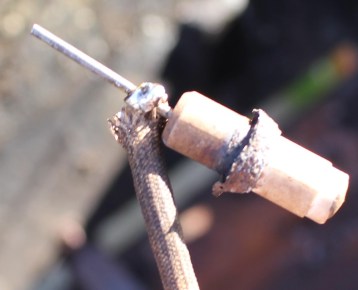
However, before I could sit back with a cool beer and admire my work, I decided to tackle the piezo push-button ignition, which had stopped working a while ago.  The wiring had broken away from the main spark anode and to be honest, even I nearly binned it.  I hate to be beaten by silly problems like this, so I soldered the wire to the base of the spark anode and then re-attached the bracket back to the barbecue.  After a little tinker time, the spark was close enough to light the gas, pretty much every time.  I was well pleased!

IMG_5743
FixItWorkshop, May’18, Worthing, Homebase Sorrento/ Campingaz Eldorado.  Re-attached wiring.

So, if your gas barbecue needs parts, don’t assume it’s not worth repairing.  There is a wealth of direct replacement and generic spares that will get yours working again, cost effectively.

Cost of a replacement barbecue:  £100 upwards (although the range could be as dramatic as £30- £5000).  Cost of repair:  £23.00 for the burner and £1.00 for the nuts, bolts and washers (which I had already).

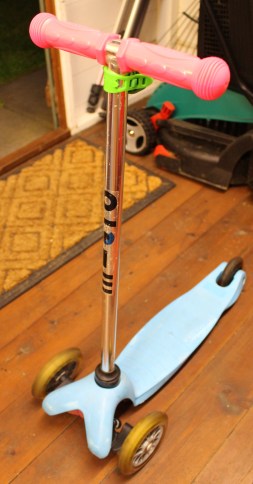
Re-vamped Micro Mini Scooter (just for fun).

A Micro Mini Scooter repair, just for fun!

I really had no idea that Micro Scooters have been a ‘thing’ for the last few years and as a result, there are lots to choose from on the second-hand market.  We picked up a ‘bargain’ for our oldest daughter for a princely sum of £5.00 via a local Facebook For Sale page.  With hindsight, it was overpriced.

Just about every part of the scooter was either nasty or plain broken.  The handle bar grips were missing, the wheel bearings were all shot to pieces, the steering mechanism seized and the rear brake was missing.  The back brake on this scooter type, I’ve since found out, have a habit of snapping off with hard use, so that should have been the clue to the low, low price.  But if you read these pages, you know me, I like a challenge.

First step was to address the static wheels.  An Allen key holds the wheels on to the stub-axels at the front of the scooter and there’s something similar on the trailing wheel.  The bearings on our wheels were beyond a re-grease as they’d appeared to have spent their entire life at the bottom of The Channel.

This slideshow requires JavaScript.

Luckily, the bearings are easy to replace and good-quality generic items are available on eBay for under £5.00 for a whole set (6 bearings, 2 per wheel).

Next came the handlebar grips.  Ours were missing and again, generic ‘copy’ grips are available on eBay which are perfect for the job and are half the price of the original equipment.  While I was shopping on eBay, I also found an original Micro Scooter bell.  Just the job.

IMG_5715
FixItWorkshop, May’18, Micro Mini Scooter, new handlebar grips and bell fitted, prior to painting.

The steering mechanism was next and all it needed was a good clean up and light lubrication with some plastic-friendly white PTFE grease, readily available from Toolstation.

This slideshow requires JavaScript.

The shabby foot plate area was once baby-blue but had since faded and had evidence of scrapes.  It looked a bit sorry for itself.  I decided to address this by giving surfaces a good clean up and then key with wire wool.  A couple of coats of good quality plastic primer and then a couple of coats of vinyl black paint, which now gave the scooter quite a ‘presence’.  I then decided to improve the foot plate ‘grippy-ness’ by applying a custom grip tape design.

This slideshow requires JavaScript.

Before re-attaching the foot plate back to the chassis, the brake needed to be replaced.  As with some of the other fixings on the scooter, the brake’s fixings were so rusty, they needed to be drilled out and replaced.  Luckily the new original equipment brake came with new improved fixings which fitted perfectly.

This slideshow requires JavaScript.

Thanks to the cool dudes at Alleyoops, Worthing for their help and advice www.alleyoopsskates.co.uk.  The UK Micro website is also very good as it lists spare parts www.micro-scooters.co.uk/spares-support.

Micro Mini Scooter (AKA ‘Triggers Broom’) renovation spend, May’18:

New good quality bearings                                                        eBay                      £4.15

Generic copy Micro Scooter handlebar grips                         eBay                      £9.75

Genuine Micro Scooter bell                                                        eBay                      £7.78

Paint and sundries                                                                        Shed                      £2.00 (approx.)

Grip Tape (customised to fit)                                                       Alleyoops            £8.00

Genuine Micro rear brake                                                            Alleyoops            £8.99


Total                      £40.67

I know what you’re thinking… for £40 more, I could have bought a brand-new scooter and saved myself the bother.  At times, I did question my own sanity.  But what we now have is a perfectly serviceable, one-off that no one else will have.  Can you put a price on that?!

Very quiet Bauhn DAB Radio from Aldi

A little DAB radio, repaired at the workshop.

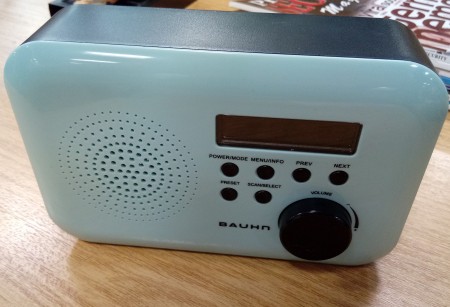
A colleague of mine brought this cool little DAB radio in to the workshop as it’s once crisp DAB tones were now no more and all life from the little device, had seemed to have ceased.  It was, very much, a dead radio.  When working, it picked up every station available, really clearly and seemed to out-perform the much more expensive devices my colleague also owned.  However, after a few months in the hands of his son, the radio would no longer turn on when plugged in.

IMG_20180515_153713.jpg
FixItWorkshop, May’18, Aldi Bauhn Radio, in for repair.

It was brought from Aldi for under £10, which seemed like a bit of a bargain to me.  It’s amazing just how much DAB radios have fallen in price in the last 5 years or so.

IMG_20180515_153836
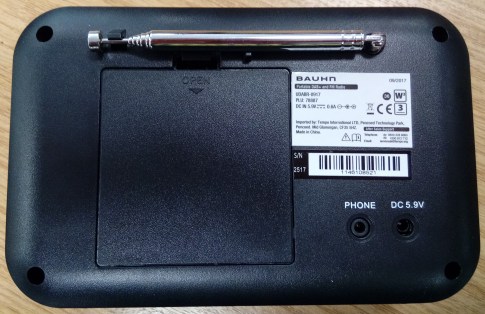
FixItWorkshop, May’18, Aldi Bauhn Radio, in for repair, back of the radio.

The Bauhn UDABR-0197 (catchy name) is a compact, portable radio and is capable of being used with either a plug-in adaptor (supplied) or 4 x ‘AA’ batteries.  When powering this radio using either plug-in adaptor or batteries, the little radio refused to do anything.  Very sad.

I always start with the basics, so I checked the power from the plug-in adaptor first, which seemed to be delivering its 5.9VDC, pretty much spot-on. As a side note, I always check the condition of plug-in adaptor leads and plugs as they seem to almost always be made of the thinnest wire available in the Far East and prone to cracking causing poor connections.  This one was fine.

Opening up the radio was really easy, just 4 cross-head screws and the two halves of the radio came apart without any major dramas.

The first thing you notice about (cheaper) small appliances like this, is the ‘lack’ of anything inside.  The circuit boards in new small devices can sometimes be multi layered affairs, using micro components, making repair with normal workshop tools very difficult or impossible.

Luckily for this little radio, the designers have had the foresight to keep the power distribution board separate from the main ‘radio’ gubbins and this seemed to be of conventional construction.

On closer inspection of the power distribution board, it revealed a break in two of the pins from the ‘power-in’ jack socket meaning that power would not get through to the main circuit board.  The two pins were also shorting together, causing a local loop connection.  This meant than neither mains adaptor supply nor battery would power the radio.  Problem realised.

I was then able re-make the connection using a soldering iron on the board, reconnecting the pins to a spare section of copper detail on the power distribution printed circuit board.  Very satisfying.

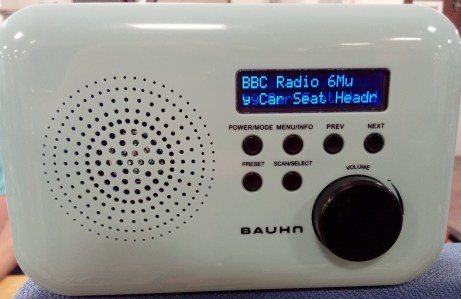
Once the radio was back together, all screws back in place, power supply connected, the radio burst in to life, just in time for me to listen to my favourite station.  Happy days.

IMG_20180515_155029
FixItWorkshop, May’18, Aldi Bauhn Radio, in for repair, all fixed.

Cost of a new radio; £10.  Cost of repair; A bit of soldering and a cuppa plus gingernut biscuit.

Unsteady Dyson DC24 Roller Ball

A neglected DC24 gets some badly needed maintenance…

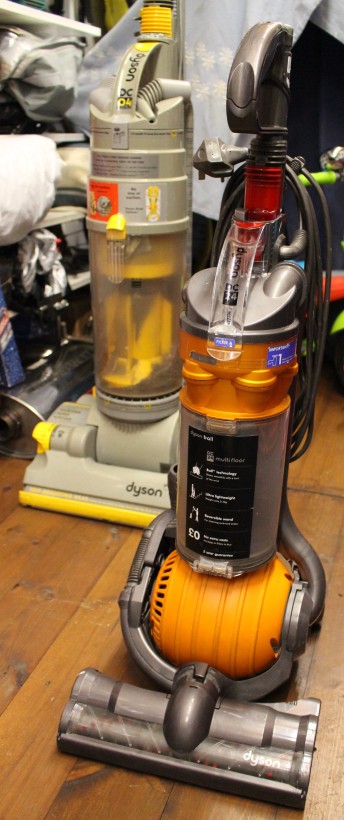
I really enjoy working on Dyson products as they’re so well thought out.  The designers seem to take great care factoring-in easy maintenance for longevity.  There’s also a great sense of theatre when using Dyson products.  Take the roller ball on this design for example, a throwback to the earlier Dyson Ball Barrow which allows better manoeuvrability when combined with an upright vacuum cleaner.  There’s also the exposed mechanism which automatically switches suction between the roller pick-up and hose when using the foot pedal to select the desired mode.  Genius.  All of these design touches encourage the user to care for and enjoy using the product.

IMG_5640
FixItWorkshop, April’18, Dyson DC24 (DC04 just in view too- how things have changed).

Sadly though, sometimes these touches are a bit lost on people and the design flares that appeal to some become misunderstood and neglected to others.

This DC24 had two problems.  It didn’t stand up properly when left and it didn’t really pick anything up that well either, failing as a vacuum cleaner on two fundamental points.

The first job was to find out why the DC24 was a little unsteady.  It seemed that all of the mechanism was intact and that nothing had snapped off.  Strange.  The red foot pedal operated lever that releases the latching system to move the main body from its locked position was stuck.  It seemed to be linked to a lever which operates the diverter valve, which switches suction from the roller beater foot to the flexible hose.  On closer inspection the lever on the diverter valve had come off its pin, probably by force.  The mechanism itself was also dirty which made operation rough.  The red lever is spring loaded with guides and pins which were also dirty and a little rusty.  I suspect this vacuum cleaner had been left somewhere damp.

After re-attaching the diverter valve leaver back on and giving all mechanisms a good clean-up with a light coating of silicone spray, it was as good as new again.

Once the mechanism was working, it was time to assess the vacuum’s performance.  It wasn’t that good.  As with most Dyson vacuum products, there are two filters.  One processes blow-by air from the motor and the other controls dust particles from the cylinder.  These filters can usually be cleaned with mild soap and water, but this set was well past it, requiring replacement and for under a tenner, it’s rude not to.  Dyson have made filter replacement very easy on the DC24 with good access to the motor filter via a small door on the roller ball itself and the lid on top of the cylinder.  I think there should be a massive sticker on these vacuum cleaners that says ‘don’t forget to clean the filters’ as I suspect that many of these products are chucked away by owners who forget to do the necessary.  Bag-less cleaner doesn’t mean maintenance-free!

With a couple of new filters, a clean-up of all of the rubber seals with silicone cleaner and this DC24 was fighting fit, ready to clean another carpet.

Cost of a replacement Dyson product:  £000’s.    Cost of new parts:  Under £10 plus my time.


Ultimate Speed Battery Charger from Lidl, on standby

Battery charger repaired at the workshop

My in-laws have an ornament on their drive, in the shape of a 2001 MGF roadster.  I say ornament because it’s fairly stationery, all of the time.  Even so, it’s battery gets topped up once in a while and the engine turned over when the urge presents itself.  Because the car isn’t used, the battery’s only means of charge is via a plug-in charger, my father-in-law occasionally hooks up.

IMG_5316.JPG
FixItWorkshop, March’18, Ultimate Speed (Lidl) Battery Charger.

The battery charger in question is an Ultimate Speed (Lidl brand) universal battery charger.  They’ve been on sale in the UK for a number of years at the £15 (approx.) mark.  They’re really good value as they allow ‘smart charging’ of car and motorcycle batteries without the risk of damage at a fraction of the price of the ‘big brands’ or a replacement battery.

However, this charger decided that it wasn’t playing anymore and refused to offer it’s charging services when recently connected to the MG’s flat battery.  On it’s way to the great bin in the sky, I managed to divert the charger via the workshop.

Once connected to the mains, the standby light illuminated, indicating something was actually happening, but upon connecting the low voltage side to a battery, making a charge selection via the single push-button switch, nothing changed and the whole unit remained on standby.  Pretty annoying.

Luckily, I have the triangular screwdriver required to undo the six screws that hold the (IP) ingress protected casing together.  Triangular screw heads are annoying and pointless as they prevent, in my opinion, people with a basic tool set having a go at a repair like this.  If you do fancy getting one of these tools, they are easily available on Amazon and eBay.

On with the fix.  With the casing opened up, my first port of call was with the switch itself.  Past experience has taught me to 1; start with the easy stuff and 2; these push to make switches fail all the time.  They’re in everything from door bells to cookers at the moment and when faulty, make the most expensive item and expensive paper weight in the blink of an eye.

To test the switch, I connected the charger to the mains and hooked up the low voltage end to a battery and simulated the button push switch by shorting out the switches connections on the circuit board.  Hey presto, the charger worked perfectly, every time.  The switch either needed repairing or replacing.

Because I’m a skin-flint, I opted to see what could be done with the present switch.  With care, these switches can be prised apart, using a sharp knife and the insides cleaned.  I took the switch apart which revealed nothing more than slightly corroded switch surfaces.  I can only assume that the product’s bold IP rated claim is a little over exaggerated and that some damp had wriggled its way to the switch and mucked it up.  With a cotton bud and switch cleaner, the switch surfaces scrubbed up like new and I re-assembled the switch lever and securing plat using a soldering iron to re-melt the plastic nubs holding the switch together.  No one would ever know it had been in bits.

With the circuit board returned to the housing, all six screws done up, the charger was back to rude health once more and ready to tend to the stranded MGF.

Hybrid Hoover-VAX vacuum cleaner combination experiment…

Recycling vacuum cleaner parts.

A slightly unusual workshop repair this time.

My brother-in-law popped in to see us for a cuppa recently and mentioned he was off to the tip with an old VAX cylinder style bag-less vacuum cleaner, in pieces, not the carpet washer type.  It was on its way to the great scrap yard in the sky.  Luckily, I was on hand to divert the sick VAX via the workshop.

It was being disposed of due to the flex having gone faulty together with the opinion that it wasn’t working that well before the mains cable failed.  Well, I hate to see good machinery go to waste.

On this VAX, the mains flex is stored within the vacuum cleaner housing and is wound up on a spring-loaded coil during storage.  When in use, the user can pull the mains plug until the desired cable flex length is reached.  When the user is finished cleaning their carpet, a foot operated button causes the flex to speedily disappear back in to the vacuum cleaner.  My brother-in-law had already looked at the spring-loaded mains flex winding mechanism, which had resulted in the bi-metallic coil spring escaping from the enclosure, freeing itself in to an orbit.  It’s quite a shock and sometimes dangerous when this happens!

What to do.  I was very nearly tempted to dump this vacuum cleaner too as the build quality of the whole thing reminded me of the plastic toys one gets in Christmas crackers, but that’s not really in the spirit of The Workshop.

Then I remembered I had a defunct Hoover Telios that was minus a motor, perhaps this would be a suitable parts donor?  I liked the idea of making one working vacuum cleaner from two unhappy ones.

The Telios had a working mains lead flex, but the automatic spring loaded mechanism on that was past its best, so I decided to use the working lead on the VAX.  The VAX would be without its flex winding mechanism, but at least it would work.  I adapted a cable tie to make a cable grip, to prevent a user from pulling the cable from the VAX, when in use.  The cable would have to be stored, wrapped around the vacuum cleaner, after use, a small price for working machine.

IMG_5022
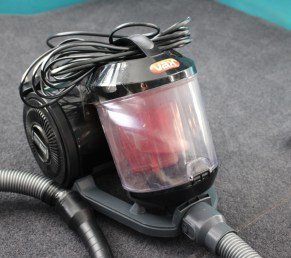
FixItWorkshop, Feb’18, VAX cylinder vacuum cleaner.

The other job was to address the poor performance.

This product is clearly an inferior Dyson rip-off and therefore has a couple of filters; one for the intake and one for the exhaust, like a Dyson.  As suspected, both of these were virtually blocked!  The filters on this model were not as easy to get at nor as easy to clean.  I’m not sure whether these filters are meant to be washed, but wash them I did and after 24 hours of drying on the radiator, they were as good as new.  Once refitted, full performance was restored, for the price of a bowl of warm water and Fairy liquid.

Finally, the VAX was missing its cleaning head for the hose, so I decided to use the Hoover one (which was quite a nice design) with the VAX’s hose.  After some jiggery pokery and some electrical tape, it fitted.

IMG_5023
FixItWorkshop, Feb’18, VAX cylinder vacuum cleaner- with Hoover parts.

What we’ve now ended up with is a working VAX vacuum cleaner, using some parts from a beyond economical to repair Hoover.  Whilst it’s not the most elegant repair I’ve ever completed, I now have  something working from two nearly condemned items and surely, that’s good thing?

Runaway Hillbilly Golf Trolley…

Golf trolley heads for the hills…

Readers of this blog (I know there are millions of you) will recognise this golf trolley and I’m pleased to report that my first repair, the one to the motor, is still working perfectly.  However, the owner of the trolley contacted me with a (funny) problem.  Whilst recently enjoying a round of golf on the local fairway, the trolley decided to, by itself, begin to edge away from the second tee and then with some speed, head off in to the distance, without any operation of the dial switch, situated on the handle.  Whilst this seemed funny at first, I remembered that the motor on this trolley had the kind of torque that, coupled to small gearbox and wheels on a heavy frame, could do some serious damage, left unchecked.

Original photo taken in Aug’17, below.

WP_20170803_14_08_27_Pro
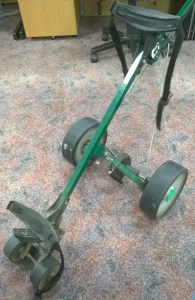
FixItWorkshop, Worthing, Aug’17 Hillbilly Compact Golf Trolley

Unlike many modern electric golf trolleys, it doesn’t feature GPS guidance, remote control or amazingly, a dead-man’s switch, which seems like a major safety oversight to me.  I’d have expected either a kill switch or dead-man’s switch* fitted to the handle on a trolley like this as the runaway scenario could never occur due to fail-safe nature of the switch being operated.  With one, the trolley would only run when the operators’ hand was on the handle or cut out when the kill switch is activated, as with the saftety cord mechanism, on a jet ski for example.  Perhaps the Mk2 Hillbilly Compact featured this.

*For example, a dead-man’s switch is usually fitted to something like an electric saw where the operator must old a handle-type switch to make it run.  Once the operator lets go of the handle, the motor automatically fails-safe and cuts-out.

On with the repair.  The trolley features some exposed connectors and cabling and it seemed sensible to check the continuity of the cables running up and down the handle shaft, as repeated trolley folding might have caused a problem with the wiring.  Fortunately, the cabling was OK.

The owner had mentioned that the handle, where the speed control switch is located, had got wet in the past, which made my alarm bells ring.

Opening up the handle, which only required a basic tool kit, revealed evidence of water damage and corrosion to the speed control terminals.  Luckily the owner of the trolley had stocked up on spare switches!

Removing the existing switch revealed intermittent continuity and varying amounts of resistance, which was not good.  A fault most likely to have been caused by water ingress or excessive shock.  The owner had supplied two ‘new old stock’ (NOS) switches.  Which one to fit?

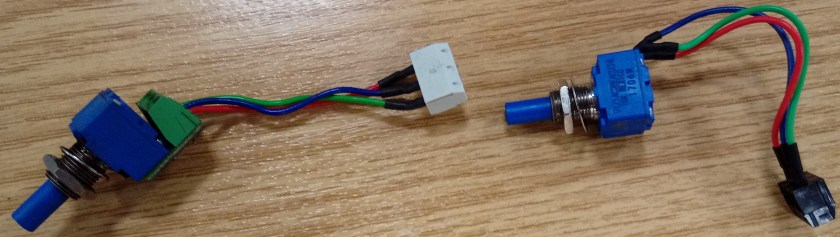
From time to time, it’s downright sensible to either fit NOS or second-parts as they’re usually cost-effective and are more likely to fit over pattern parts.  But time can also affect apparently shiny parts.  This was a case in point.  I knew that the switch should vary resistance from open circuit to 10KOhms in either direction from COMM.  The old one didn’t and one of the ‘new’ parts only went to 2KOhms, so was not in specification.  Luckily, the remaining NOS switch worked fine and once refitted, and the handle reassembled, the golf trolley was ready to make the job of carrying clubs easier, once again.

IMG_20180131_135745
FixItWorkshop, Feb’18, Hillbilly Compact speed control switch, new and old- test NOS parts before fitting.

Cost of replacement trolley:  ££££ Cost of repair; £10 plus time.  Moral of the story; don’t assume NOS parts will work.  Test them first.