That thing just eats money!

Tomy (UK) /Robie (US) Mr. Money repaired in the Workshop

I have a real soft spot for novelty toy robots that actually do something.  I think I’ll make a point of collecting more.
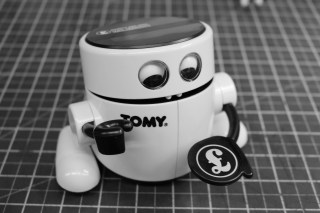
IMG_9795
FixItWorkshop, Worthing, August’19, Tomy/ Robie Mr. Money.

Make and model:  Tomy (Robie in U.S.) Mr. Money  children’s money box

Fault reported: Not eating money

Cost of replacement:  N/A

Cost of parts:  £0.00

Hours spent on repair:  About an hour

Tools needed:  Cleaning cloths

Sundry items: Contact cleaner

Repair difficulty:  3/10

A lady got in touch with me on the back of an article I wrote a while ago about a faulty Mr. Money toy robot money box.  My Mr. Money had gone wrong as I’d left an old battery inside which had then leaked.  A major clean-up and tinker was then required to get it working again.

This particular Mr Money belonged to the lady’s husband and was to be ‘given to him again’ as a 40th birthday present.  What a nice thought.  The only problem was that Mr. Money had stopped working long ago; put away and forgotten about.  He needed bringing back to life.  Perhaps there was a hidden message to the husband to save for something?  Who knows.
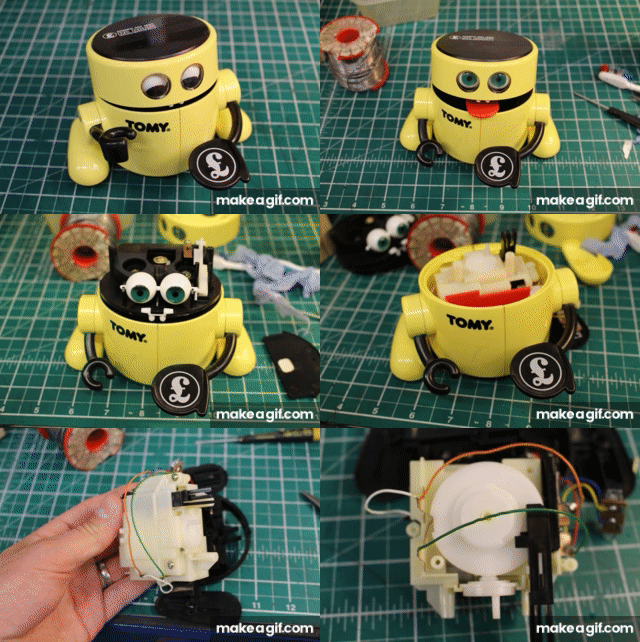
Mr_Money_Quick_Strip

Mr. Money arrived well packed at the workshop and I wasted no time in taking him apart.  There was no evidence of battery leakage or accidental Cadbury Button ingestion and he was generally in good condition with no bits broken off.  A good start.

Mr. Money is getting on a bit and when taking apart any toy, let alone one that’s over 30 years old, one must be careful not to accidently snap-off any lugs or tangs that hold things like casing and levers together.  Very tricky.  It’s not something I usually attempt after a day at work, when I’m shattered.

After some rooting around in the depths of the mechanism, I noticed that the ‘limit switch’ was a little dirty and that some of the contacts needed a little clean.  Using some fine cloth and switch cleaner, all metallic switch surfaces and battery connections were cleaned up and with a new AA battery installed, Mr. Money worked again.

Being 30 years old, there’s no silly use of electronics or other USB excesses which are, I think, ‘over used’ on modern toys.  It all adds up to something which can be repaired with basic tools and parts.

This slideshow requires JavaScript.

I carefully reassembled the workings, casing, switches, arms, head, eyes and lid.

Mr. Money was ready to feast.

After testing a couple of quid through the Mr.Money’s eating cycle, I was happy for him to start his journey home.  I hope he gets used regularly and never put away in a box again.


Small home improvements…

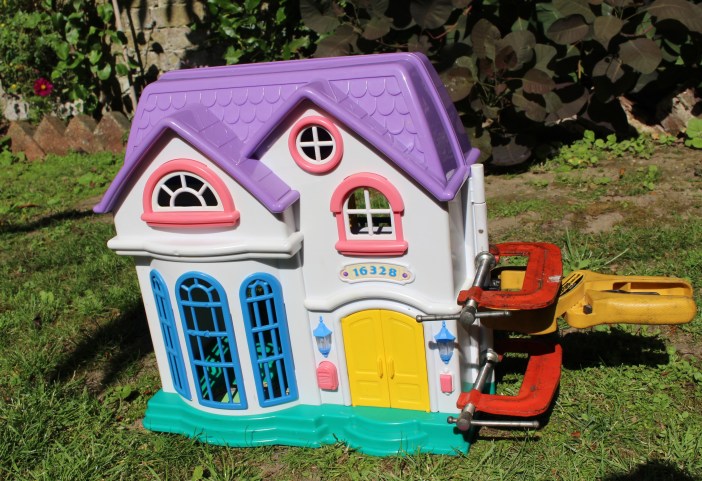
A loved children’s toy house with the longest house number ever, gets glued back together.

On the last weekend in June 2019, I decided to do some home improvements, on a small scale.

My kids are lucky; they have their own stash of toys to play with, at members of our family’s homes.  This means that we travel a little lighter when visiting.

My mum had reported that the toy house (pictured below) had developed a case of plastic wall subsidence and had started to literally, fall apart.  Time for site clearance or wall ties?  Nah, just a few drops of glue and a dose of patience.

Make and model:  Generic toy (there’s no maker’s mark on it, it’s that good)

Fault reported: Broken hinge

Cost of replacement:  £haven’t a clue

Cost of parts:  £0.00

Hours spent on repair:  About 10 minutes

Tools needed:  3 X clamps

Sundry items: Some Gorilla glue

Repair difficulty:  1/10

IMG_9665
FixItWorkshop, Worthing, June’19, Toy House

Kids toys usually lead a hard life and many, sadly, have short lives.  I see loads of dumped toys at our municipal tip which could, with a little love, be fixed-up to be enjoyed once again.

With so much in the media about our collective love affair with plastics and how long the material stays in our environment and food-chain, I think it’s important to preserve what has already been made for as long as possible, for its original purpose or to be re-purposed.  That way, plastic things will avoid being sent to landfill, for longer.

The toy house in question is not a high-end product and the materials and finish used are not the finest available, but that doesn’t mean it isn’t fun to enjoy.  I mean, most of the windows open, the front door has working lights and the whole thing opens up to reveal a two-floor mini wonderland.  I mean, what’s not to like?

The opening up bit was the problem.  The main hinge that holds both halves of the house together had become semi-detached.

It would have been easy to call it a day with this one, but as my youngest daughter had recently taken a shine to it, I decided that all the broken hinge needed was; glue, some clamps and patience.  Gluing plastic is tricky as some glues react badly, depending on the type of plastic, which unless you’re someone who has Masters in Plasticology, is hard to work out for most diy’ers.  It’s a bit of trial and error and with this repair I decided to use Gorilla glue, rather than a 2-part epoxy resin as I had a bottle of that open already.  I’m afraid, it wasn’t very scientific with this fix

With the two halves of the hinge lined up, a dab of glue in the right places, I used three clamps, spaced along the hinge to hold it in place while it glued.

Now, this toy will always be delicate and will never be quite as strong as it once was, but at least it can now be enjoyed once again and more importantly, it won’t be going in the bin.


Kenwood FP220 easy fix

An easy fix for a change

Every now and then an enquiry drops into my inbox where my heart sinks.  It sinks as I know that many products on sale are poorly supported for specific spares which means that when the product fails, it can be impossible to repair.  But sometimes, just sometimes, I’m surprised!

Make and model:  Kenwood FP220 Food Mixer

Fault reported: Mixer not working when main jug used

Cost of replacement:  £120.00 (equivalent new machine)

Cost of parts:  £17.69 (plus my time)

Hours spent on repair:  About 10 minutes (test and cleaning)

Tools needed:  None.

Sundry items: 1 X Grimex cloth

Repair difficulty:  1/10

IMG_9581
FixItWorkshop, Worthing, June’19, Kenwood FP220.

The mixer was a good quality item which had cost over £100 when new and upon inspection, the mixer has failed due to a single component, the main jug.  A little clue from the owner that the blender attachment (not pictured) worked, but the jug didn’t, set me off on the right track.

The mixer features a safety mechanism which is designed to prevent the main drive assembly spinning accidently, potentially with a cutting tool, if the switch is operated without the mixer jug attached.  Many mixers of this type feature such a device.

The FP220 features a double-armed safety mechanism which means that the jug must be fully engaged in the mixer base, with the lid in the correct position.  It’s an unobtrusive and fail-safe design.  A part of the jug’s base, made of a composite plastic, had sheared off, so the jug could not attach to the mixer properly.  The safety device had worked as it should.

At first, I thought that there was no chance of obtaining a spare jug, but after a bit of Googling, I found a brand-new replacement jug, in the right colour, from Sussex Spares (via eBay).  It soon arrived and fitted perfectly, which allowed the machine to work again, once more.  The old lid was still serviceable and fitted the new jug without problems.  I recommended that owner keep the old jug for spares as the handle and drive coupling were still servicable and might come in handy if the new handle gets broken.

After a quick clean up and test, the machine was ready to make Victoria Sponges again.  It just proves that with a bit of research, even seemingly unrepairable items can get a second chance.

Qualcast Hover Safe 25, left out in the cold

An old hover mower avoids the great lawn in the sky.

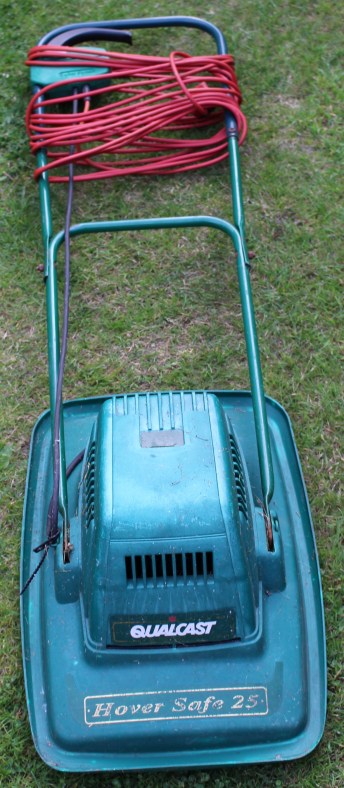
Another email popped in to my inbox asking if I would have a look at a Qualcast Hover Safe 25 which had stopped working.  It had been working intermittently for a while before giving up the ghost and now it had thrown in the towel.  Bad news.  It had literally been kicked into the long grass.

Make and model:  Qualcast Hover Safe 25

Cost of replacement:  £40.00 (ish)

Cost of parts:  £0.00 (plus my time)

Hours spent on repair:  1 (plus testing)

Tools needed:  Basic screw drivers, multimeter, pliers, hair dryer

Sundry items: WD40, silicone spray, wet and dry sanding cloth

Repair difficulty:  4/10

IMG_9652
FixItWorkshop, Worthing, June’19, Qualcast Hover Safe 25.

The owner of this mower had reported that the handle mouted switch (dead-mans handle) had been a ‘bit tricky’ to use and that it didn’t always work.  These kinds of statements make me wonder what kind of life a device has had.  Judging by the rust and discolouration on the metal and plastic parts, I think this mower had been left in a shed with a leaky roof!

This slideshow requires JavaScript.

The water had not been kind and the mechanism had seized.  The only thing to do was to open up the switch, clean up any moving parts, lubricate the switch with switch cleaner and lubricate the sliding plastic parts with a little silicone spray.  The small lever which actuates the main on/ off switch was also slightly bent, so after a little straightening, using a hair dryer, it was as good as new. After the switch was repaired, the lawnmower’s motor still wasn’t working.

The cable running from the switch to the motor housing appeared to be in good condition, so the only thing left was to remove the motor itself.  Removing the motor means removing the blade and 4 small screws (see photos).  Once exposed, the motor was revealed.  Power was indeed reaching the motor when the switch was operated, as confirmed with a quick dab of the multimeter.

The motor itself seemed to have little resistance when manually spun, which led me to suspect the motor brushes had worn out.  Doubting that brushes were available, I decided to remove them anyway for closer inspection.  This revealed seized motor brushes, which backed up my theory about the mower’s damp environment.  A quick bit of jiggery pokery and a clean up and the motor brushes were as good as new.  A quick clean up of the motor commutator, I refitted the brushes and the motor was ready to be refitted.

Now, this mower is not in the first flush of youth and the motor bearings were a little noisy, but after a quick spray of grease in the bearing area it sounded fine.  The mower will never be perfect, but at least it will work for a little longer, which has got to be the point, hasn’t it?

Dyson DC25 with various problems

Another Dyson dodges the dump

An email dropped into my inbox about a poorly Dyson DC25, that needed a bit of a clean up.  I said no problem, I’ll take a look.  What turned up was a vacuum cleaner that needed a bit more than a quick clean up with a J-Cloth.

Make and model:  Dyson DC25 (blue/ grey)

Cost of replacement:  £N/A, price when new £300

Cost of parts:  £6.89 (plus my time)

Hours spent on repair:  2.5 (plus testing)

Repair difficulty:  5/10

It soon became apparent, that the Dyson was quite ill.

Here’s a summary of the problems:

  1. The mains cable flex was split, exposing the internal cables risking electric shock
  2. The roller beaters would not spin
  3. Suction was limited

None of these features were useful in vacuum cleaner, so out came the screw drivers.

The mains flex damage was about 90 cms from the handle end, so rather than replacing the whole cable at about £30, I decided to shorten the one already fitted on the Dyson.  This involved removing three screws on the reverse of the handle to expose the wiring.  From there, the broken flex could be cut-out and the sound part of the flex, reattached to the Dyson’s wiring.  See below.

This slideshow requires JavaScript.

The DC25 features a roller-ball, enabling the beater head to twist and turn in to tight spots on the floor.  This means that mains power must navigate the various joints and hinges on the way from the main body to the roller beaters.  A quick test revealed that the power was not getting through.  After removing one of the side covers, there was evidence of a previous repair.  One of the mains cables had broken and had then been twisted back together.  Clearly, an improvement was needed.  Using a section of repair cable, a small joint was soldered back in to place with some mains-rated heat shrink around the connection for insulation and reinforcement.  See below.

This slideshow requires JavaScript.

The beater head also needed a good clean, which meant a strip-down and re-build.  All parts were cleaned, inspected and reassembled.  During that process, a small break in the beater head wiring was found, repaired and put back together.  See below.

This slideshow requires JavaScript.

Finally, the machine needed a good clean up.  The main cylinder was washed, the filters washed (although I later decided to replace these) and the main seals on the vacuum system, cleaned and silicone sealed.  See below.

This slideshow requires JavaScript.

During clean up, the spigot-yoke that holds the roller ball in place on one side was found to be missing.  Luckily the owner had kept this and dropped it back to me to re-fit.

This Dyson was on the brink, but with a little bit of spanner-time, it’s now ready to serve many more years.


Tommee Tippee Perfect Prep Problems

The right formula for a poorly Tommee Tippee Perfect Prep Machine

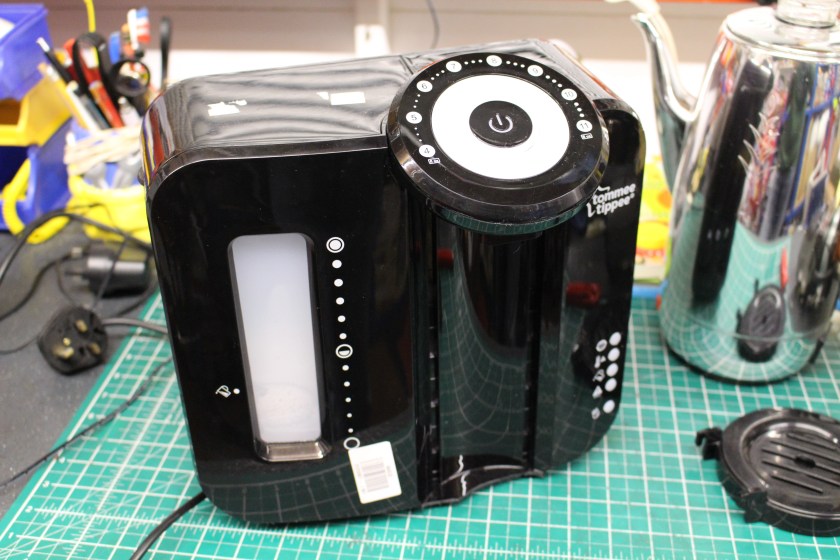
The owner of this Perfect Prep machine had reported that it had not been used for a while, then filled with water, powered up and … nothing.

Make and model:  Tommee Tippee Perfect Prep

Cost of replacement:  £70

Cost of parts:  £3.69 (plus my time)

Hours spent on repair:  1 (plus testing)

Repair difficulty:  6/10

IMG_8972
FixItWorkshop, Worthing, June’18, Tommee Tippee Perfect Prep.

I’ve repaired a machine like this before and I already had a theory about the problem, which went like this:

  • Machine not used for a while; watery scale deposits built-up in machine
  • Machine filled with water, with possible air-lock present
  • Air-lock causes bubble in heater, causing it to temporarily over-heat, safety thermal fuses blow

Dead machine.

At this stage, it was only a theory, so the only thing to do was to start wielding screwdrivers.

A few quick checks revealed that mains power was not getting to the main controller in the machine, which indicated that the safety thermal cut-out fuses had failed.  There are two on this machine.  A quick test with the multi-meter confirmed that both had failed.

After some dismantling, both fuses could be removed from the wiring harness.  Fuses like these are not available from the high street usually, but they are readily available online.  The manufacturer had used crimps to attach the fuses to the wiring, but I decided to solder the new ones back in place.  Care had to be taken as the melting point of solder is very close to the thermal rating of the fuses, so I came up with the idea of using a damp cloth wrapped around the fuse while doing the soldering.  A bit tricky!

Both fuses replaced meant that the unit powered-up and worked.  Great.

However, I wasn’t totally convinced that an air-lock wouldn’t happen again so I looked deeper at the machine’s plumbing.  There appeared to be a kink in one of the boiler tube feed pipes, so I decided to cut some material away, to prevent the pipe restricting water flow in future.

This slideshow requires JavaScript.

All back together, the machine worked well once again.


Gaggia Espresso Machine with a nasty blockage

A Gaggia Espresso machine gets a rebuild.

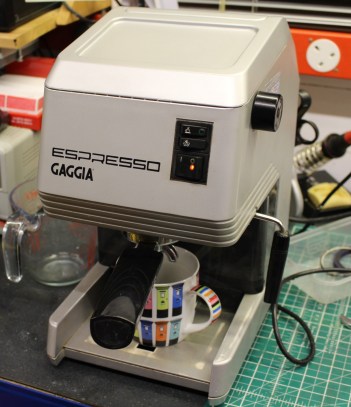
Home coffee machines are very cool.  Home espresso machines are even better as they’re the closest you can get to a coffee shop brew, in my opinion.  Due to heat, water and coffee mixing up on a regular basis, they need ownership with care for long life.

IMG_9039
FixItWorkshop, Worthing, May’19, Gaggia Espresso Machine.

Top tips for longer coffee machine life:

  • Use filtered water, especially if you live in a hard water area
  • Clean the tank regularly
  • Keep all rubber seals, especially those around the main coffee making area, clean with a damp cloth

Someone got in touch with a machine that was a few years old, but had once made a lovely cup of coffee.  The owner had used it daily but recently it had begun to leak and not perform at its best.  The machine had also been to a UK repair specialist, but sadly, they couldn’t solve the problems.  I always test appliances when they arrive to confirm the fault and as expected, water came out of places it wasn’t supposed to.

I’ve worked on a few of these machines, so I know the drill.  Remove the lid, make a note of the wiring connectors, the pipes and remove the bolts holding the main boiler in place.  I also ordered a service kit (new seals) for a reasonable £7.99.

The main boiler separates into two halves which reveals the main boiler chamber and exit for hot water.

This boiler was in poor condition and years of corrosion and scale had built up and was probably blocking the main group head, the bit where you attach the group handle/ filter bit to make coffee.

Time for more dismantling.  The group head is held in position with a couple of screws, but years of corrosion had taken their toll and this head was going nowhere.  Great care was needed as the soft metal is easily damaged.

Thinking about this a bit more, I decided to cut a screw thread into one of the water holes in the head and use a bolt to lever the group head apart.  It worked.  Once off the head revealed loads of debris and scale.

The next job was to give all parts a thorough clean, re-faced with wet and dry paper as needed and use new seals as part of the reassembly.

Once back together, the boiler was reinstalled and reconnected.  After a few blasts of fresh water through the machine, it was ready to make its first proper brew.

This slideshow requires JavaScript.

Cost of replacement:  £100-300.  Cost of repair:  £7.99, my time, one tin of elbow grease, one cup of coffee and a ginger nut.


Qualcast strimmer issues

Always keep your garden tidy.

Top tips for keeping your petrol strimmer running like a ‘Rolls Royce’

  • Make sure the fuel you have in the tank is fresh and not from three years ago (it goes off)
  • Keep the spark plug gap set within the manufacturer’s tolerances
  • Lubricate all moving parts lightly with a generic spray oil each time you use the strimmer
Strimmer
FixItWorkshop, Worthing, May’19, Qualcast Petrol Strimmer.

Someone got in touch with a strimmer that would not start.  Anything that involves moving parts and petrol always gets my attention, so I accepted the challenge.  Once in the workshop, I tried to start it using the pull cord and as predicted, it wouldn’t run, not even a cough.  A little bit of carb cleaner sprayed in to the barrel, a pull of the starter cord and the engine did fire, suggesting that the engine could run.  More analysis was required.

The strimmer had not been started for many years, so the first job was to remove the old fuel from the tank as old fuel goes off after a while. The engine on this strimmer is a two-stroke design, so the special two-stroke oil must be pre-mixed with the fuel in the right proportion before re-filling the tank.

While sorting the fuel out, I noticed the first fault.  Both flow and return fuel pipes were cracked and one had come apart in the fuel tank, meaning that no fuel would flow to the carburettor.  No fuel, no work.

To start most petrol strimmers, mowers and chainsaws from cold, a petrol primer pump is usually used to fill the carburettor with the right amount of fuel and this one was no different, but in this case, the pump was cracked.

After fitting some new fuel lines, a fuel filter and primer pump, the engine fired up and ran well again, ready for more garden work.  See slide show.

This slideshow requires JavaScript.

Cost of replacement:  £80 and up.  Cost of repair:  £7.53 plus my time and custard creams.


Dyson DC40 missing a beat

A small repair on a Dyson DC40 leads to a big improvement.

A powerful, easy to manoeuvre vacuum cleaner, that gets into every nook and cranny.  But not this one.

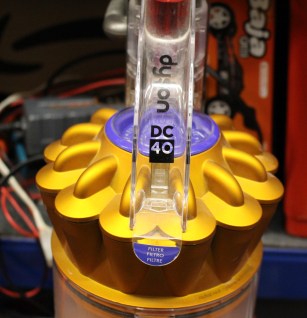
IMG_8891
FixItWorkshop, Worthing, May’19, Dyson DC40.

Three top tips for keeping your Dyson DC40 in rude health:

  • Keep all filters clean (wash or replace frequently)
  • Clean all rubber seals with a damp cloth to remove dust build-up
  • Occasionally lubricate moving parts of jockey wheel mechanism (springs and lever) with silicone spray

Do these things and your Dyson will love you forever.

I’m a bit of a sucker for Dyson products.  They are well engineered products from the school of function over form and in my opinion, objects of art.

This Dyson wasn’t very well when it was admitted to the workshop.  The owner had complained that the vacuum cleaner wasn’t picking up dirt and dust properly.  The beaters were not spinning either.

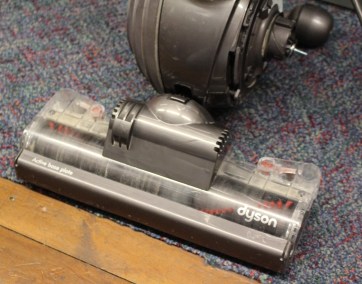
IMG_8890
FixItWorkshop, Worthing, May’19, Dyson DC40 beater head.

The beater ‘head’ is attached to the main body of the vacuum cleaner and is held in place with a sliding clip.  The head can rotate and move to allow maximum control.  The beater roller is driven not via a belt from the main motor, but from its own smaller motor in the head unit.  So, there is an electrical connector between the main body and head unit.  As the beaters were not spinning, it seemed sensible to test the electrical connection.  Upon testing, it was not working.

The mechanism on this vacuum cleaner is quite complicated and relies on levers and joints working in harmony.  Dismantling the wheels, filters, brackets and covers around the motor revealed the problem.  The supply that feeds power to the beater head is routed around the motor and sliding lever mechanism and a broken cable was to blame for the beaters not spinning.

Access was difficult due to the design so rather than completely tearing down the body to replace the supply loom, I reattached the broken wire with some soldering and heat shrink to make a robust repair.

After carefully rerouting the cables and reassembling the body, wheels and beater head, the beaters spun once more.  Result.

This slideshow requires JavaScript.

After a new set of filters were fitted and a light service, the machine was as good as new.

Cost of replacement machine:  £000’s.  Cost of repair parts: £11.69 plus my time and two teas.

Leave the light on…

A Philips outdoor wall lamp with a major case of built-in obsolescence, gets a cheap fix.

A mate of mine mentioned that his outdoor wall light had given-up-the-ghost, despite not being more than three years old.  He’d put them up around his house as part of an extension and exterior restoration project.  The trouble was that despite only being a few years old, the product now seemed to be discontinued.  This meant that, should the lamp need to be replaced, he would need to replace all of them (three in this case) to keep them matching.  Annoying quite frankly.

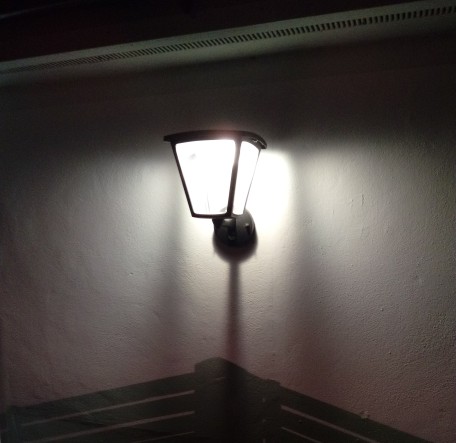
IMG_20181112_194358.jpg
FixItWorkshop, March’19, Philips outdoor wall light, working.

He’d read that the bulb within the Philips lamp was not replaceable, in which case a faulty lamp would render the whole thing broken, which seemed very daft to me.  Items made in such a way that prevents even the most basic of repair get me very annoyed.  Sometimes an item is developed in such a way for safety reasons but I suspect that most of the time, the motive is just pure greed.  It’s such a shame.

At my mate’s house, over a cup of tea, I removed the lamp from the wall to take back to the workshop, to see what Philips had been getting up to.

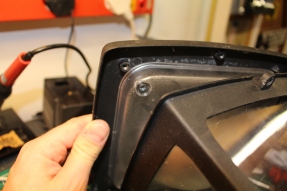
Opening up the casing was straightforward, just a few simple screws and retaining nuts holding the casing together, before finally revealing the bulb itself, under a lamp diffuser.

IMG_7609
FixItWorkshop, March’19, Philips outdoor wall light, lamp unit.

The bulb/ lamp unit itself appeared to be a custom/ bespoke disc light, that wasn’t user serviceable.  It had blown and there was evidence of scorching on a few of the LEDs, linked in series, indicating the failure of the entire circuit.

I couldn’t find any replacement disc LEDs suitable for the lamp from any of the usual sources, which I expected.  It could be that Philips can supply a replacement disc, but this was not evident on their website.

Not wanting to be beaten by a bespoke part, I thought about what else might work, within the lamp’s enclosure, to have the same effect.  I had a spare GU9 LED bulb, about the same brightness, sitting on the shelf, left over from another project which was going spare, so I set about fitting it in the space.

The generic GU9 bulb, available from most hardware shops, fitted in the existing disc mounting bracket, with a small modification and once connected to the lamp’s circuitry, worked well, albeit with a slightly warmer glow.

In case anyone else has the same problem, I made a little video of the repair.  I hope it gives others inspiration if faced with a similar problem.

Cost of replacement (with something similar): £50.00.  Cost of repair:  £1.50 for the bulb and a couple of Belgian beers for my time.