Small home improvements…

A loved children’s toy house with the longest house number ever, gets glued back together.

On the last weekend in June 2019, I decided to do some home improvements, on a small scale.

My kids are lucky; they have their own stash of toys to play with, at members of our family’s homes.  This means that we travel a little lighter when visiting.

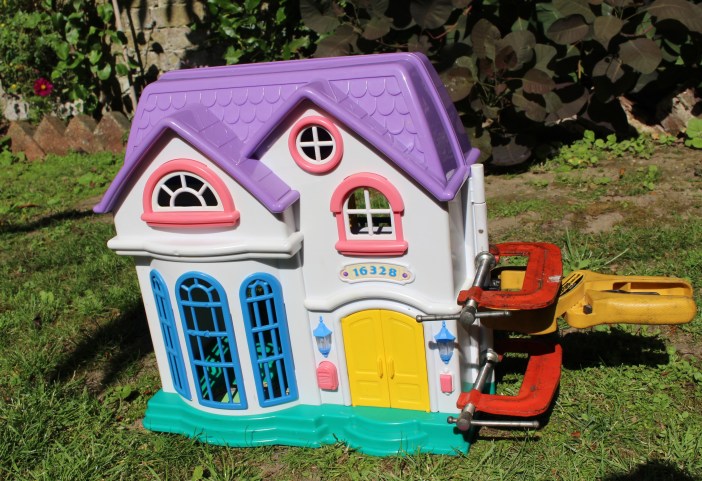
My mum had reported that the toy house (pictured below) had developed a case of plastic wall subsidence and had started to literally, fall apart.  Time for site clearance or wall ties?  Nah, just a few drops of glue and a dose of patience.

Make and model:  Generic toy (there’s no maker’s mark on it, it’s that good)

Fault reported: Broken hinge

Cost of replacement:  £haven’t a clue

Cost of parts:  £0.00

Hours spent on repair:  About 10 minutes

Tools needed:  3 X clamps

Sundry items: Some Gorilla glue

Repair difficulty:  1/10
IMG_9665
FixItWorkshop, Worthing, June’19, Toy House

Kids toys usually lead a hard life and many, sadly, have short lives.  I see loads of dumped toys at our municipal tip which could, with a little love, be fixed-up to be enjoyed once again.

With so much in the media about our collective love affair with plastics and how long the material stays in our environment and food-chain, I think it’s important to preserve what has already been made for as long as possible, for its original purpose or to be re-purposed.  That way, plastic things will avoid being sent to landfill, for longer.

The toy house in question is not a high-end product and the materials and finish used are not the finest available, but that doesn’t mean it isn’t fun to enjoy.  I mean, most of the windows open, the front door has working lights and the whole thing opens up to reveal a two-floor mini wonderland.  I mean, what’s not to like?

The opening up bit was the problem.  The main hinge that holds both halves of the house together had become semi-detached.

It would have been easy to call it a day with this one, but as my youngest daughter had recently taken a shine to it, I decided that all the broken hinge needed was; glue, some clamps and patience.  Gluing plastic is tricky as some glues react badly, depending on the type of plastic, which unless you’re someone who has Masters in Plasticology, is hard to work out for most diy’ers.  It’s a bit of trial and error and with this repair I decided to use Gorilla glue, rather than a 2-part epoxy resin as I had a bottle of that open already.  I’m afraid, it wasn’t very scientific with this fix

With the two halves of the hinge lined up, a dab of glue in the right places, I used three clamps, spaced along the hinge to hold it in place while it glued.

Now, this toy will always be delicate and will never be quite as strong as it once was, but at least it can now be enjoyed once again and more importantly, it won’t be going in the bin.


Kenwood FP220 easy fix

An easy fix for a change

Every now and then an enquiry drops into my inbox where my heart sinks.  It sinks as I know that many products on sale are poorly supported for specific spares which means that when the product fails, it can be impossible to repair.  But sometimes, just sometimes, I’m surprised!

Make and model:  Kenwood FP220 Food Mixer

Fault reported: Mixer not working when main jug used

Cost of replacement:  £120.00 (equivalent new machine)

Cost of parts:  £17.69 (plus my time)

Hours spent on repair:  About 10 minutes (test and cleaning)

Tools needed:  None.

Sundry items: 1 X Grimex cloth

Repair difficulty:  1/10

IMG_9581
FixItWorkshop, Worthing, June’19, Kenwood FP220.

The mixer was a good quality item which had cost over £100 when new and upon inspection, the mixer has failed due to a single component, the main jug.  A little clue from the owner that the blender attachment (not pictured) worked, but the jug didn’t, set me off on the right track.

The mixer features a safety mechanism which is designed to prevent the main drive assembly spinning accidently, potentially with a cutting tool, if the switch is operated without the mixer jug attached.  Many mixers of this type feature such a device.

The FP220 features a double-armed safety mechanism which means that the jug must be fully engaged in the mixer base, with the lid in the correct position.  It’s an unobtrusive and fail-safe design.  A part of the jug’s base, made of a composite plastic, had sheared off, so the jug could not attach to the mixer properly.  The safety device had worked as it should.

At first, I thought that there was no chance of obtaining a spare jug, but after a bit of Googling, I found a brand-new replacement jug, in the right colour, from Sussex Spares (via eBay).  It soon arrived and fitted perfectly, which allowed the machine to work again, once more.  The old lid was still serviceable and fitted the new jug without problems.  I recommended that owner keep the old jug for spares as the handle and drive coupling were still servicable and might come in handy if the new handle gets broken.

After a quick clean up and test, the machine was ready to make Victoria Sponges again.  It just proves that with a bit of research, even seemingly unrepairable items can get a second chance.

Dyson DC25 with various problems

Another Dyson dodges the dump

An email dropped into my inbox about a poorly Dyson DC25, that needed a bit of a clean up.  I said no problem, I’ll take a look.  What turned up was a vacuum cleaner that needed a bit more than a quick clean up with a J-Cloth.

Make and model:  Dyson DC25 (blue/ grey)

Cost of replacement:  £N/A, price when new £300

Cost of parts:  £6.89 (plus my time)

Hours spent on repair:  2.5 (plus testing)

Repair difficulty:  5/10

It soon became apparent, that the Dyson was quite ill.

Here’s a summary of the problems:

  1. The mains cable flex was split, exposing the internal cables risking electric shock
  2. The roller beaters would not spin
  3. Suction was limited

None of these features were useful in vacuum cleaner, so out came the screw drivers.

The mains flex damage was about 90 cms from the handle end, so rather than replacing the whole cable at about £30, I decided to shorten the one already fitted on the Dyson.  This involved removing three screws on the reverse of the handle to expose the wiring.  From there, the broken flex could be cut-out and the sound part of the flex, reattached to the Dyson’s wiring.  See below.

This slideshow requires JavaScript.

The DC25 features a roller-ball, enabling the beater head to twist and turn in to tight spots on the floor.  This means that mains power must navigate the various joints and hinges on the way from the main body to the roller beaters.  A quick test revealed that the power was not getting through.  After removing one of the side covers, there was evidence of a previous repair.  One of the mains cables had broken and had then been twisted back together.  Clearly, an improvement was needed.  Using a section of repair cable, a small joint was soldered back in to place with some mains-rated heat shrink around the connection for insulation and reinforcement.  See below.

This slideshow requires JavaScript.

The beater head also needed a good clean, which meant a strip-down and re-build.  All parts were cleaned, inspected and reassembled.  During that process, a small break in the beater head wiring was found, repaired and put back together.  See below.

This slideshow requires JavaScript.

Finally, the machine needed a good clean up.  The main cylinder was washed, the filters washed (although I later decided to replace these) and the main seals on the vacuum system, cleaned and silicone sealed.  See below.

This slideshow requires JavaScript.

During clean up, the spigot-yoke that holds the roller ball in place on one side was found to be missing.  Luckily the owner had kept this and dropped it back to me to re-fit.

This Dyson was on the brink, but with a little bit of spanner-time, it’s now ready to serve many more years.


Tommee Tippee Perfect Prep Problems

The right formula for a poorly Tommee Tippee Perfect Prep Machine

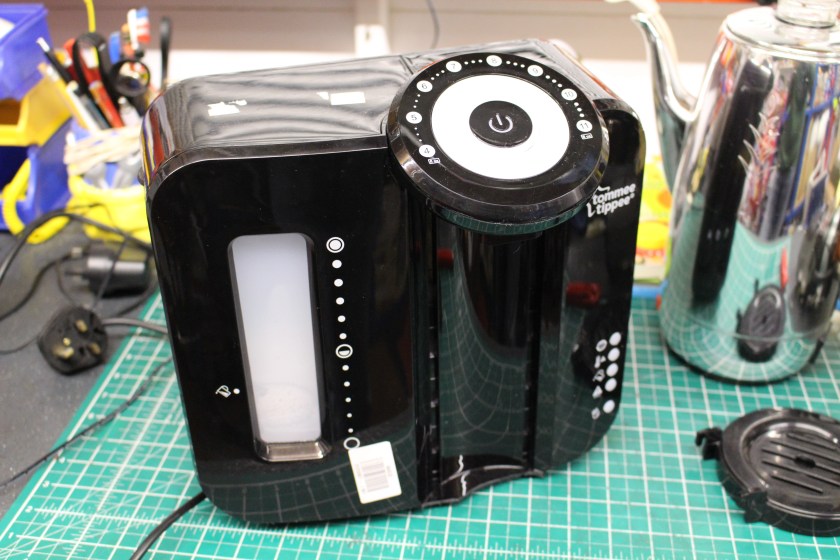
The owner of this Perfect Prep machine had reported that it had not been used for a while, then filled with water, powered up and … nothing.

Make and model:  Tommee Tippee Perfect Prep

Cost of replacement:  £70

Cost of parts:  £3.69 (plus my time)

Hours spent on repair:  1 (plus testing)

Repair difficulty:  6/10

IMG_8972
FixItWorkshop, Worthing, June’18, Tommee Tippee Perfect Prep.

I’ve repaired a machine like this before and I already had a theory about the problem, which went like this:

  • Machine not used for a while; watery scale deposits built-up in machine
  • Machine filled with water, with possible air-lock present
  • Air-lock causes bubble in heater, causing it to temporarily over-heat, safety thermal fuses blow

Dead machine.

At this stage, it was only a theory, so the only thing to do was to start wielding screwdrivers.

A few quick checks revealed that mains power was not getting to the main controller in the machine, which indicated that the safety thermal cut-out fuses had failed.  There are two on this machine.  A quick test with the multi-meter confirmed that both had failed.

After some dismantling, both fuses could be removed from the wiring harness.  Fuses like these are not available from the high street usually, but they are readily available online.  The manufacturer had used crimps to attach the fuses to the wiring, but I decided to solder the new ones back in place.  Care had to be taken as the melting point of solder is very close to the thermal rating of the fuses, so I came up with the idea of using a damp cloth wrapped around the fuse while doing the soldering.  A bit tricky!

Both fuses replaced meant that the unit powered-up and worked.  Great.

However, I wasn’t totally convinced that an air-lock wouldn’t happen again so I looked deeper at the machine’s plumbing.  There appeared to be a kink in one of the boiler tube feed pipes, so I decided to cut some material away, to prevent the pipe restricting water flow in future.

This slideshow requires JavaScript.

All back together, the machine worked well once again.


Three wheels on my wagon

A kids push-along toy gets a wheel repair.

Just a short write up today.

As my own children have begun to get a little older and have become more interested in, quite frankly more interesting toys, I’ve occasionally had to repair them as they’ve suffered the odd mishap.

IMG_20190527_093545
FixItWorkshop, Worthing, May’19, toy 4×4.

I enjoy repairing toys and sharing the repair experience with the owner.  Looking after things and learning how stuff works from a young age will help nurture the beginnings of the engineers and scientists of tomorrow, so it’s vital that children start wielding screwdrivers as soon as they show an interest.

Through a local Worthing-based dads and children’s play group called Dad La Soul/ Don’t Believe The Hype, I’ve recently begun offering a broken toy repair surgery.  Children can bring in broken toys and together we can work out what the problems are and how to fix them.

http://www.totrockinbeats.com/dad-la-soul

This 4×4 push-along toy had suffered a road traffic incident which had left it missing one of its front wheels.  With only three wheels, it wasn’t going far.

Luckily, the axel and wheel stub were only push fitted on, so after taking the axel off, it was just a matter of applying some strong glue to the broken parts and leaving the wheel somewhere still and safe, while the glue set.

For light ABS plastic like this, I like using Gorilla glue, which seems to work well.  It won’t work for all plastic types, but it’s non-toxic and will be safe and strong for this application.

After the glue was set and dry, the wheel just simply pushed back on, ready for more ‘ragging’ around the floor.

Cost of replacement:  £any.  Cost of repair:  1 x dab of glue.

Time taken to repair:  20 minutes (plus glueing time).

Dim Lumie Bedbug

Lumie bedbug glows once again.

A short repair tale about a little bedtime bug.

A friend mentioned that their son’s Lumie Bedbug lamp was intermittently working and that it was shortly going to be visiting the bin if it didn’t buck its ideas up.

Er, no I said.

IMG_20190524_142951
FixItWorkshop, Worthing, May’19, Lumie Bedbug.

The bug night light was meant to glow orange, once switched on, but it only lit up when the cable was wobbled about.

The power connection on this model is a standard USB (B) connector, the ones commonly used to charge Android phones.  If the power lead was faulty, it would be easy to find a suitable replacement.

The bug comes apart by removing the silicone outer layer and releasing the tangs holding the two halves of the bug together.  One screw holds the PCB in place and once removed, the whole thing comes to pieces.

The USB socket was a little out of shape, presumably from some rough handling.  A quick nip with a pair of pliers and it was back as it should be.

The plug was also a little out of shape, but with a bit of careful re-shaping, it fitted the socket perfectly.

This slideshow requires JavaScript.

Once reassembled, reconnected and powered up, the bug glowed without flickering.  Result.

Cost of replacement:  £50.  Cost of repair:  One tea and one custard cream, that I made myself.

Generic Battery Mantel Clock

A battery clock returns to the mantel.

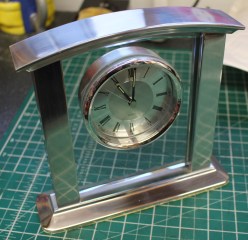
A friend of the family was very upset that her mantel clock had decided to stop and despite changing the battery, it refused to start ticking.

IMG_9122
FixItWorkshop, Worthing, May’19, Clock.

Now, this clock was not an expensive item, but it matched the décor of the room it was in and so the owner was very keen for it to be returned to its place above the fire.

Battery clocks like this are ubiquitous and often, like this one, don’t even carry a makers’ brand logo or name.  I was thinking; if the clock’s motor was unsavable, I would replace it using a generic replacement from eBay.

I’ve fixed many battery powered quartz clock motors.  They all work in a similar way.  An electromagnet which is pulsed using a simple circuit, regulated by a quartz crystal.  Add-in some gears and pointer hands and you’ve got yourself a clock.

After removing clock motor from the housing, just two screws, the motor comes apart by peeling back two plastic tangs.  Care should be taken not to force anything at this stage as the parts are very small and delicate.

The motor gears and electromagnet out of the way, the printed circuit board popped out and the fault became clear.  At some point in the past, I suspect that a battery had leaked just a little and the vapour from the leak had corroded the contacts.  A little dab of contact cleaner on an old toothbrush and a little bit of scrubbing and the corrosion was gone.

This slideshow requires JavaScript.

A little bit of jiggery pokery again and the motor was back together and refitted to the clock’s frame.  It just goes to show that something as simple as this can be fixed with basic tools and patience.

Job done!

Cost of replacement:  N/A.  Cost of repair:  Just 30 minutes tinker time and a cuppa.

Qualcast strimmer issues

Always keep your garden tidy.

Top tips for keeping your petrol strimmer running like a ‘Rolls Royce’

  • Make sure the fuel you have in the tank is fresh and not from three years ago (it goes off)
  • Keep the spark plug gap set within the manufacturer’s tolerances
  • Lubricate all moving parts lightly with a generic spray oil each time you use the strimmer
Strimmer
FixItWorkshop, Worthing, May’19, Qualcast Petrol Strimmer.

Someone got in touch with a strimmer that would not start.  Anything that involves moving parts and petrol always gets my attention, so I accepted the challenge.  Once in the workshop, I tried to start it using the pull cord and as predicted, it wouldn’t run, not even a cough.  A little bit of carb cleaner sprayed in to the barrel, a pull of the starter cord and the engine did fire, suggesting that the engine could run.  More analysis was required.

The strimmer had not been started for many years, so the first job was to remove the old fuel from the tank as old fuel goes off after a while. The engine on this strimmer is a two-stroke design, so the special two-stroke oil must be pre-mixed with the fuel in the right proportion before re-filling the tank.

While sorting the fuel out, I noticed the first fault.  Both flow and return fuel pipes were cracked and one had come apart in the fuel tank, meaning that no fuel would flow to the carburettor.  No fuel, no work.

To start most petrol strimmers, mowers and chainsaws from cold, a petrol primer pump is usually used to fill the carburettor with the right amount of fuel and this one was no different, but in this case, the pump was cracked.

After fitting some new fuel lines, a fuel filter and primer pump, the engine fired up and ran well again, ready for more garden work.  See slide show.

This slideshow requires JavaScript.

Cost of replacement:  £80 and up.  Cost of repair:  £7.53 plus my time and custard creams.


Smoky Kenwood Chef A901E

Another Chef enters the workshop with a smoking habit that’s hard to kick.

Top tips for keeping your Chef running smoothly, for longer:

  • Keep all moving parts free from dirt and old cake mix
  • If the feet are squashed, change them.  The gap allows airflow to the motor
  • Keep the hinge mechanism lightly lubricated
IMG_9144
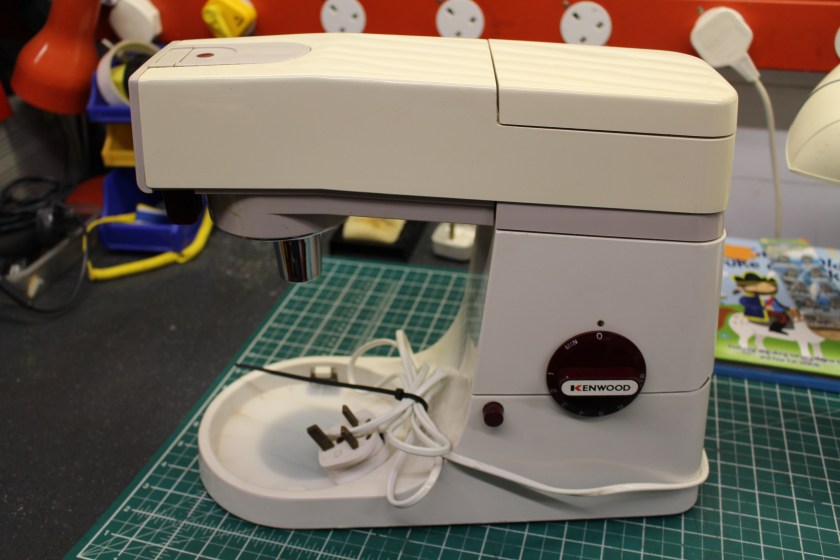
FixItWorkshop, Worthing, May’19.  Kenwood Chef A901E (1980’s model)

This A901E Chef had a developed a smoking habit.  Due to age, one of the capacitors had failed on the speed control circuitry making a lot of smoke while in use.  An adjacent resistor had also split in half during the failure.

Despite a smoky situation, there was hope for the Chef.

Removing the motor on these mixers is pretty straightforward.  Just remove the blender accessory power take off cover and remove some screws.  Lift up the top half of the mixer on the hinge and you’ll get access to the base of the motor area.  After you’ve removed the belt, the motor should come out.  There’s a bit more to it actually, but there isn’t much holding that motor in.

The later A901E features a better speed control circuit than the earlier A901 and it’s also made on proper circuit board, rather than just soldered-together components.

With this machine, the correct repair kit was obtained and fitted, so the circuit was as good as new and wouldn’t smoke anymore.

I treated this Chef’s motor to new motor brushes since the old ones were worn.  I also fitted new feet, as the existing ones were squashed and one was completely missing.

I was about to sign the job off , when I noticed a small tear in the outer cable flex.  I couldn’t let the Chef out of the workshop like that, so I had to replace it with a new piece.

This slideshow requires JavaScript.

After some fettling, the machine was running like clockwork, once again.

Cost of replacement:  £000s.  Cost of repair:  £12.74 plus my time and several ginger nut biscuits.

A bit of 70’s fun: Sona J996 Coffee Percolator

An office find, escapes the scrap yard.

Despite the 1970’s kitsch-ness of the electric percolator, they are very good at making coffee and the delightful coffee smell you get when brewing-up is sublime.  Here’s an advert from the time.

Top tips for keeping your coffee percolator in good order:

  • Descale using a kettle descaling solution as needed
  • Keep the coffee strainer clear of debris
  • Make sure the lid always fits between the strainer and the percolator body

A colleague found this percolator while clearing out an abandoned office cupboard.  I suspect that this one might have been bought as a wedding present way back and had ended up in the office when someone had decided play the role of barista at work.

It was missing its power lead and was headed for the recycle bin, when I intervened.

The power lead needed was an obsolete design used on British appliances of the era and was similar in design to the more modern and current, IEC C13 or ‘kettle lead’.  However, modern kettle leads did not fit this percolator.

More drastic action was needed.  Luckily, I had an old appliance I no longer needed, so I scavenged a board mounted IEC C13 socket from it and replaced the one originally fitted.

After some soldering and a bit of jiggery-pokery, this Sona Percolator now brews coffee using an up-to-date power lead.

This slideshow requires JavaScript.

Cost of replacement:  £40.  Cost of upgrade: £0.