
Inside The Real Repair Shop 13

This time, Matt discusses false-friend eco products…

One lives and learns and if there’s one thing I definitely know now, it’s that the good people of Worthing (at least) really do love their bread makers! 

Back in August, in the spirt of light-hearted environmental consumer advice, I offered my thoughts on what I deemed to be ‘pointless products’ and crumbs, did I rattle a few bread bins!   Almost 4 amiable souls took the time to share their thoughts on the subject too, extolling the virtues of their trusted kitchen friends. Some even shared a few photos of their finest loaf creations; the most exquisite that I have ever seen, it must be said.  At yeast, most of you saw the funny side I think, but others thought that I was being a little childish. So this article will be a little more proven, I hope.

To those who rose-up, a little browned-off by my distaste for these machines, I say this; it was only a bit of half-baked fun.  You’ve really got to roll with it!

Turning to more serious matters. When it comes to our current environmental issues it seems more than ever that some campaigns, propaganda, even official advice, must be taken with a pinch of salt.  Of course, I too am a consumer of online adverts, original articles and general broadcast media and I find myself increasingly starting to doubt that one can have one’s cake and eat it. Right, enough of the baking buns, sorry, puns.

Despite the typical British Summer we’ve been enjoying here in the UK, it’s been Armageddon on the continent.  And, if you’ve been watching any mainstream news these last few months, you would have seen European reports showing newly designed weather maps with splashes of ferocious oranges, blood-reds and deathly maroons, possibly designed by The Terminator, telling us the World is boiling.

Is it all part of a ‘big plan’ to discourage would-be travellers from taking polluting flights to far-away, warmer climes? Are all the ‘wild’ fires, naturally occurring? Whatever your views on climate change, it would seem that broadcast messaging is nudging us to stay home, stay indoors and don’t move. Remind you of anything? 

Anyway, assuming you’re still with me (thanks by the way), I certainly don’t claim to have expert knowledge on environmental change, CO2 emissions, the latest breakthroughs or Government policy. However, I do have a sprinkling of knowledge on most of these things, enough to say that we have a global population of over 8 billion humans (and rising), many living in or gaining ‘Western lifestyles’ (food production, transport, devices to state a few), so it doesn’t take the mind of Einstein to realise that we’ve had an effect on our environment since we began farming, and that effect is probably speeding up in a way that evolution hasn’t seen before. So, before you rush out to buy the latest energy saving, connected device made far, far away, I urge you to consider something else too.

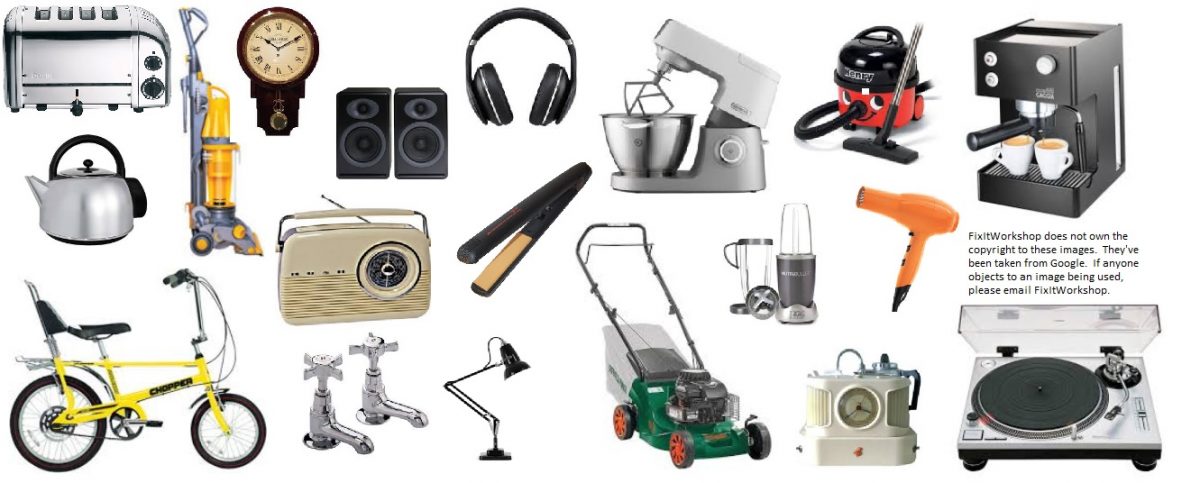
In The West, we import thousands of tons of electrical items, well anything with a plug on it, from The Far East.  Phones, tablets, toasters, kettles, pop-corn makers (to name a handful) are all made thousands of miles away, and are sold at affordable prices for us to enjoy, the very next day if you like! Also, you can’t seemingly buy any of these things without it being Internet connected, not even a bread maker! This is good news for retailers, but are items made at a price (not quality), in far-away, out-of-sight factories, shipped all around the world, really a good thing for us?  Is the latest ‘online ready’, eco-device, always better for the environment? Is it ever a smarter, greener choice to ditch what you have, in order to do the ‘right thing’ by our planet.

Combine the complicated product route to market ‘journey’ with a short life expectancy (or very planned obsolescence), with a lack of in-country repair support, and the whole thing starts to sound like an environmental disaster. Doesn’t it?  Some say that the average smartphone’s life is comparable to a pair of jeans, scary when you think about it. And what about the giant computing power; Petabytes of storage, precious metals, the air conditioning, and land that the data warehouses around the world use to make all the connectivity possible? It’s all starting to sound a bit bleak, really. 

Years ago, when I was a young BT apprentice, Dave, (a wise colleague and friend of mine) once said that the trouble with the world now is that it’s ‘gone global’. We all laughed at the time, but now I’m older (and maybe a little wiser), I actually see what he meant.

Our thirst for the latest and best has generated a throw-away culture for sure, and if we carry on, deep down, we all know where it’s headed.  But the tech stable door is well and truly open, and you, nor I, would favour heading back to 12th Century lifestyles. No one I know would want to turn off YouTube, Instagram, TikTok and Twitter (to name a few).

Social media is a great way to keep in touch, but don’t forget how the platforms pay the bills. As a brand, or if you have the cash, social media gives virtually instant connectivity to the minds of folk most likely to part with their hard-earned money. It’s a powerful conduit to nudge minds, to influence behaviours and to extract pound from your pocket. Judge me as you will, but I suspect that many people, with a specially targeted, guilt-inducing, tear-jerking, warm-hug, ‘we’ll make it all better again for you’, advert could be made to ‘do the right thing’ and buy just about anything today! Dial-in some world-poverty, environmental damage, and little war, and buyers are putty in the brand’s hands. As with all sales pitches, there’s always a catch… don’t believe the hype!

Back in workshop-land this month, it’s been a right-old assorted bag of customer requests!  I’ve had quite the mix of items in for repair. Lamps, toys, vacuum cleaners and a CD/ radio to name a few, but despite the variation, there are common themes that link all these items together, in a good way.

Spares were easily available, the item’s design allowed for disassembly and reassembly and I could see individual components with my own eyes! The technology was not out-of-date, it didn’t need an upgrade and it was all still as relevant today as it was at the time of purchase.

A good talking point with friends for sure, but a ‘connected toaster’ that links to your smartphone is probably not a good idea. The Internet bit inside will no doubt fail before the rest of the appliance, and how many WiFi devices do you think will exist in even 5 years? It’s therefore likely that something like this probably won’t last longer than a smartphone. And in my experience, these things are rarely supported by the manufacturer in terms of spare parts.  If they have any kind of post-guarantee support, it’s usually not economically viable to bring the item back from the brink.

How to wrap this up then? More than ever, it seems, we all lead busy lives and the vast majority of us are connected to various platforms via our phones, at some time. Indeed recently, on our family holiday this summer, I saw many people from all countries, busy on their phones, by the pool, at mealtimes and even in the sea, throughout the day. Now, I’m not saying that I don’t check my phone, but social media can be like a sugar-rush, addictive for many, and advertisers know this. This means that now, more than ever, it’s possible to link your likes, news, political interests, friends’ network and viewing habits to new products likely to match your spending profile. 

If you’ve watched environmental content on YouTube, or have bought solar energy for example, Google knows that you’re likely to be concerned about climate change. Many of us are.

I’m an aspiring optimist, and as a big believer in new technology and global, visionary projects, if delivered by our best engineers, I think we can at least help curb the negative effect we’re all having on the planet.

Eco-inspired, connected-products can make us feel like we’re doing our bit, but clickbait purchases of short-sighted lithium powered gadgets and cars, with limited or no support, can only be bad news.

If it works, and is useful, don’t chuck it out.  Maintain your stuff and enjoy all the life an item has to give.

The most environmentally sustainable and cheapest products out there, are probably the things you already have.

Matt.

PS, don’t forget to check out Retro Electro Workshop on UKTV Play.
Inside The Real Repair Shop 3

Save time and money with a multimeter and a quick look at alkaline versus rechargeable batteries.

Batteries are needed for all kinds of toys, remote controls and the latest gadgets. With a smattering of basic awareness, a tool like a multimeter can be used by anyone, saving one time, cash and help to save waste and who wouldn’t want to do that?

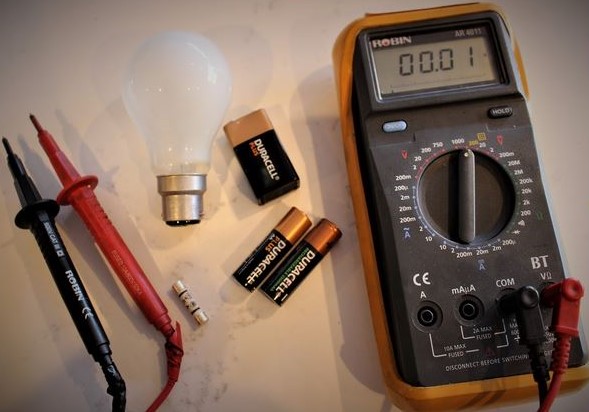
For under £10 (GBP), a decent multimeter can be bought online and, armed with a few YouTube videos on your phone, you’ll be able to test batteries to see if they’re still up to scratch, test domestic fuses in plugs when the lights go out and prove that power adaptors are OK before buying new.  And that’s just the start, exciting eh?

FixItWorkshop, Worthing, January’21, a basic multimeter, batteries, bulb and fuse. Many uses!

I’m not going explain every function on a general purpose multimeter, but I do want to dispel one myth: Multimeters are difficult to use. They simply are not. Assuming you can turn a dial and read a number display, then all you have to do is put the test probes on the right part and then voilà, you’ll be ready to measure things.

Take a standard 1.5V AA battery. It has a + (positive) end and a (negative) end. The red probe should touch the positive end and the black lead should touch the negative end, it’s that simple. Assuming that you’ve selected the DC voltage (10’s) range, a good AA (alkaline) battery will show between 1.5V and 1.68V when new. Anything less and the battery is starting to fade and may need to be replaced.

It’s worth noting at this point that some things are capable of running on less battery juice, for longer. Take a quartz clock with one AA battery. Chances are that it will run for years on a battery, even though over time, the voltage will fall below 1.5V. If you put that same aged battery from the clock into a toy car for example, the chances are that the toy wouldn’t work properly or even at all. To some things, battery voltage is critical, others not so much.

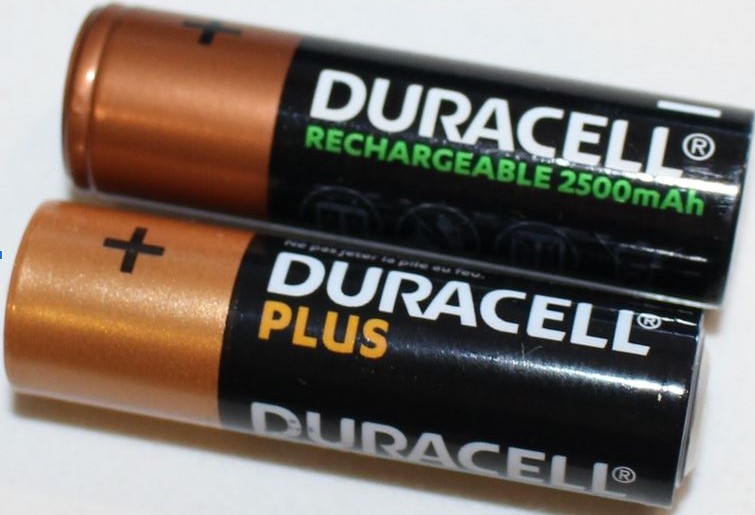
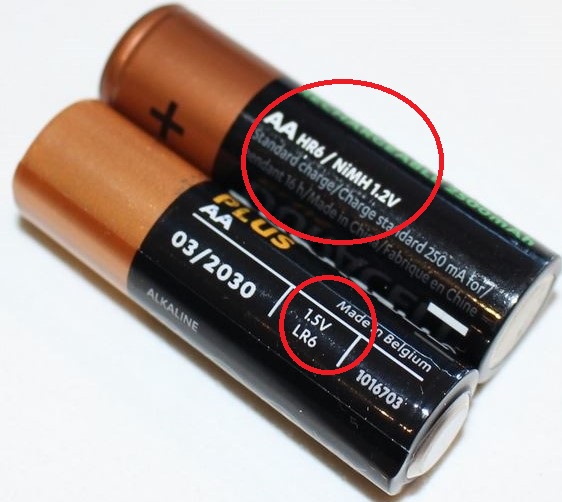
What about normal alkaline batteries versus rechargeable ones, I hear you say faintly, are they worth it?  As with all things, it depends.  Not all battery specifications are the same, so check details carefully when making a purchase.  It’s easier than you think.  Based on detailed shed-based experiments, I generally use rechargeable types in items that tend to use-up batteries quickly, such as radio control car toys and so on.  For something like a clock or a TV remote control handset, where batteries tend to last longer, I recommend conventional types as these items are sometimes more sensitive to voltage differences.  The aim overall is to buy fewer batteries and by using rechargeable ones, which are generally more expensive to get started with, in things that ‘eat batteries faster’, they begin to make economic sense.

Image left: Rechargeable batteries and conventional ones can look similar.  Image right:  Check battery specifications carefully, before deciding that something doesn’t work correctly.

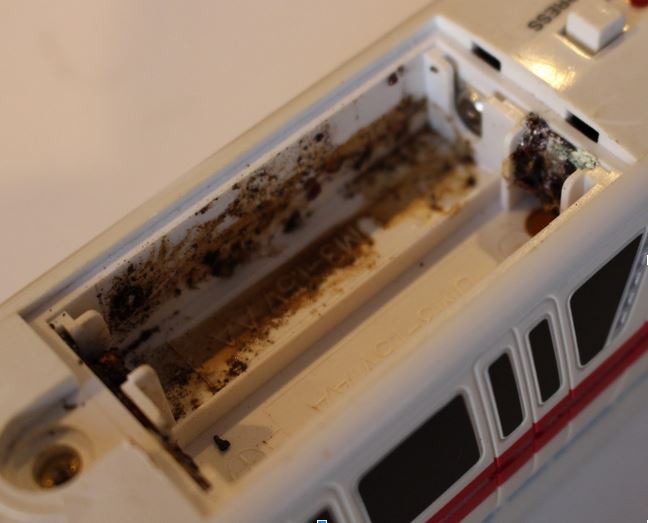
Here’s something you’ll be familiar with.  You go to use something that takes batteries that you haven’t used for ages, only to find that it won’t work.  Upon opening up the little battery door, you’re then greeted with an unpleasant mass of rusty, acidic battery leftovers which have been festering since last Christmas.  In situations like this, many will simply throw away, but often, all that’s required is light restoration with contact cleaner, maybe some wire wool and something like kitchen roll.  More serious battery contact damage can often be solved with new battery contacts, which are available on eBay for small change.  Remember, remove batteries when something’s not in use.

FixItWorkshop, Worthing, January’21, battery leakage has caused corrosion damage to the battery connections (repairable).

If you don’t already own one, make sure you add a digital multimeter to your birthday list this year. Now go and recharge your own batteries with a nice cup of tea.

Make it so, number one

A Star Trek Next Generation themed money box gets a light restoration

IMG_20200617_221628
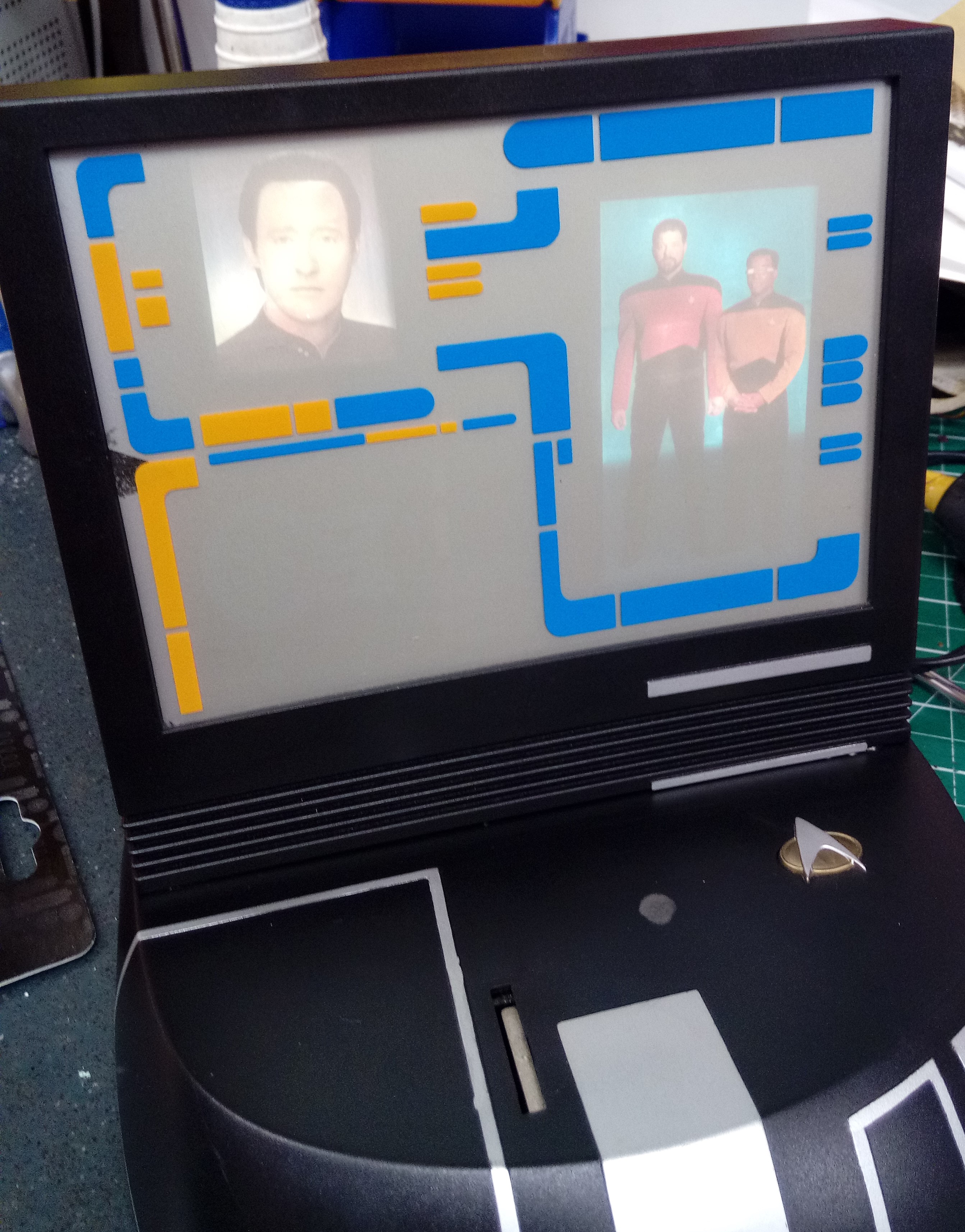
FixItWorkshop, Worthing, August’20, Star Trek money box.

Some things are just cool.  I mean look, if this money box doesn’t encourage prudent saving behaviour, then quite frankly, nothing will.

Spoiler alert:  Put money in, some of the Star Trek crew (Next Generation) light up, followed by speech and cool sound effects.  What’s not to like.  Pressing the Star Trek (Starfleet) button, simulates the effects too. What fun.

This money box had once been cherished by its owner, but had been left in the attic for a number of years, with the original batteries still fitted.  As anyone who’s done this before will know, old batteries leak in time.  If you’re lucky and catch the ensuing corrosion in time, you might get away with just battery removal and a light clean up. If you leave it long enough, like the owner of this toy had, you’ll end up with a lot of rusty mess and no chance of life (Jim, but not as we know it). Remember, take batteries out before putting your toys away, long term.

Make and model: Star Trek money box (make unknown)

Fault reported: Not working/ battery compartment heavily corroded

Cost of replacement: £ Irreplaceable

Manufacturer support:  0/10

Cost of parts: £4.00

Hours spent on repair: 1.5 hours

Tools needed: Screwdrivers, test meter, heat shrink, soldering iron etc

Sundry items: Cleaning materials, paint, contact cleaner

Repair difficulty: 3/10

Cups of tea: 1

Biscuits: none (1 jammy donut, slightly warmed, as they should be)


This slideshow requires JavaScript.

When I get an item like this, I tend to spend a bit of time researching it online, to see who knows anything about it.  It turns out, that this money box isn’t that well represented and after a few Google searches, I simply gave up and got on with the repair.

Parts for something like this are not available from the manufacturer, even if they are still around.  Presented with a situation like this, the only thing that can be done is to see if other parts can be bought off the shelf from component suppliers and be made to fit.  One simply has to be creative.

Good old eBay came up with the goods.  AA and C type battery terminals were available in single and double terminal variants and I ordered a couple of packs from a Chinese supplier, who delivered the bits I needed, within a week.  These things are reasonably cheap, so I ordered a pack, just in case I ruined a few, practicing first.

Just a few small screws hold the casing together and after de-soldering the wires going from the battery compartments to the main circuit, I was ready to start.  With battery corrosion as severe as this, all you can do is soak the parts in something like WD40 and attack the rusted parts with a small screwdriver and knife, taking time to avoid damaging the (aged) plastic casing..

After an hour, I’d removed 99% of the mess and fitted the new terminals.  The AA terminals went in OK, but the C type ones needed adapting with some metal I had lying about in the workshop.  A quick re-attachment of the wiring,  a quick clean with brake cleaner to de-grease and then touch up with some satin black paint and one would never know that batteries had ever wreaked such havoc.

Sometimes, I want to hang on to some of the things I repair.  This was one such item, but alas, I had to give it back.

Time for a brew.

More power please

Does your toy have enough energy?

IMG_20200304_211145
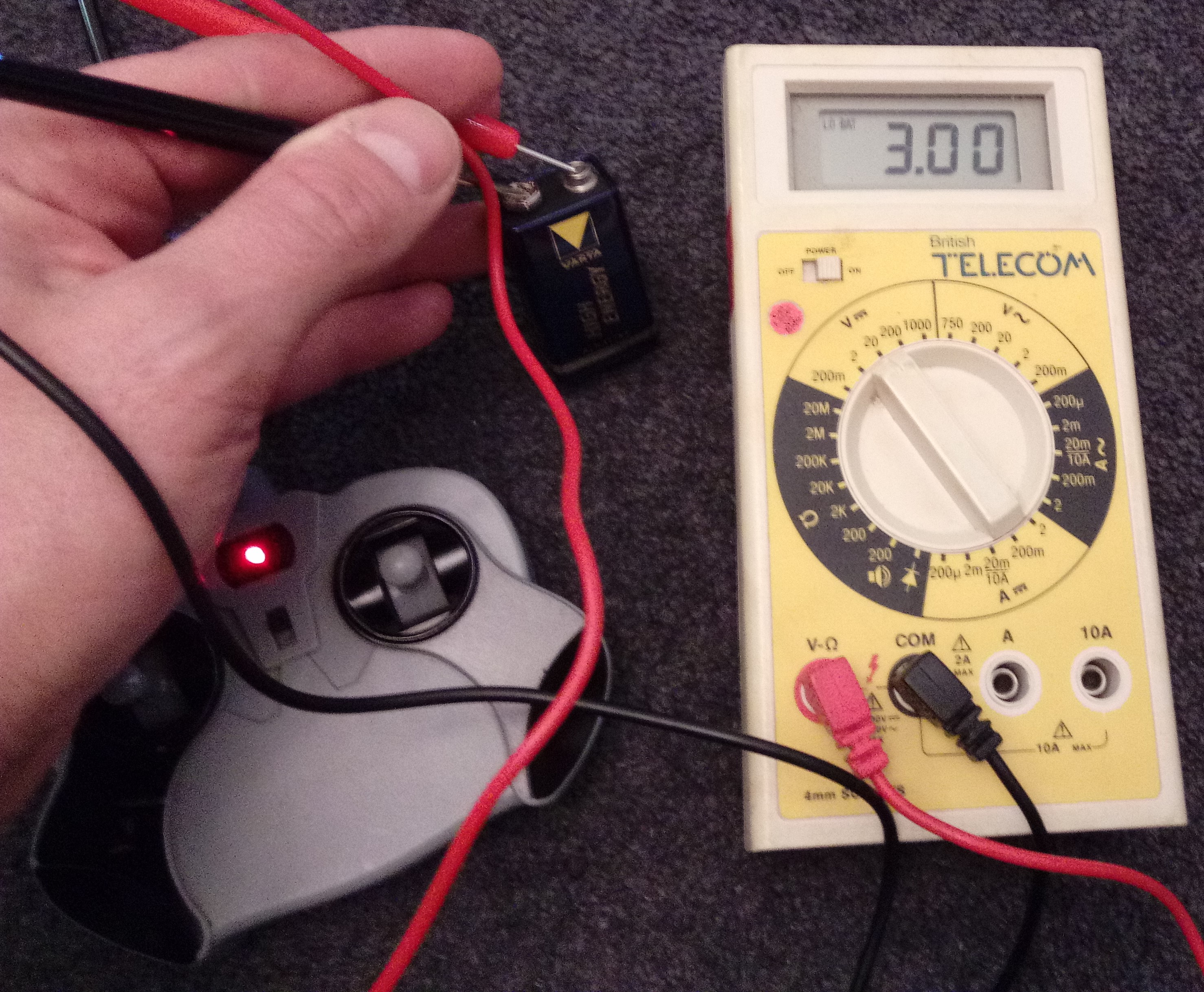
FixItWorkshop, Worthing, March’20, testing a battery (featuring my retro BT multimeter).

I’m not a fan of batteries. They run out and always when you least expect it.

You know that anything with a battery, will need attention at some point.

Batteries either need to be replaced or better, recharged.

But often, replacement batteries are the only option for toys, which can mean high running costs. Especially when the toy is played with continually by an enthusiastic child owner!

Trouble is, a mixture of built-in obsolescence and poor design means that it’s just not obvious how one replaces duff batteries meaning that, I suspect, lots of toys get thrown away needlessly, but it’s not the owners fault necessarily.

Sadly, some replacement batteries cost more than the toy itself, which is just mad.

Make and model: toy radio control car (no brand or model)

Fault reported: Not working

Cost of replacement: £10ish

Manufacturer support:  0/10

Cost of parts: £5 (batteries)

Hours spent on repair: 30 minutes

Tools needed: Screwdrivers, test meter etc

Sundry items: None

Repair difficulty: 0/10

Cups of tea: 1/2 cup

Biscuits: None

This slideshow requires JavaScript.

The owner of this toy had played with it non-stop wearing the batteries out.  Mum and dad had replaced some of the batteries in the car part of this toy, but still the toy didn’t work.  It wasn’t clear to the parents, which batteries in what part of the toy needed to be replaced, which meant that an email asking for help, popped in to my inbox.

At first glance, the car part of the toy had no battery cover or compartment, but on closer inspection, the car separated in to two halves, allowing access to the 4 X AA (1.5V) batteries.  Not a straightforward task for everyone.  Testing each battery revealed that they were all worn with an average of 1.3 volts (much lower under load) each.  I replaced these with fresh ones and put the car back together.  The car’s casing was simply held together with a clip and a couple of small screws.

However, the toy still wasn’t working, time to test the radio controller.  Again, a screwdriver was needed to open the battery compartment to access the battery.  Not all households have screwdrivers (even though I believe they should!).

Testing the 9V PP3/ 6LR61 battery revealed around 3 volts, 6 volts too low.  Again, a new battery got the radio controller working once more.

Doing this ‘repair’ got me thinking.  Batteries can be tricky things to manage.  New ones can go flat when not in use and old ones that have been kicking around in a drawer for a while can be fine to use.  One can replace batteries with ‘new’ ones which are no better than the ones fitted, leading a user to believe that the ‘thing’ must be faulty.  A false positive.

With a little basic training on multimeter use, hours and cash can be saved by testing pesky batteries.  At under £5 for a basic multimeter, it could be money well saved for any household.  Just a thought.

With both car and radio controller switched on, the toy sprung to life.  Of course, I had to test the car thoroughly before handing it back(!).


Janod Toy Phone repair/ Une réparation de Janod jouet téléphone

A Janod Toy Phone gets opened up and stuck back together.

There’s always a debate to be had on what age one should give a child a phone, but as a parent, groovy toys like this are hard to resist.  I mean, who doesn’t like a toy that makes cool noises, at the touch of a button.

I especially enjoyed the cuckoo noise (clock symbol).

Make and model: Janod toy phone

Fault reported: No sound, despite new batteries

Cost of replacement: About £10

Cost of parts: £0.00

Hours spent on repair: 0.5

Tools needed: Cutters, screwdriver and soldering iron

Sundry items: Glue

Repair difficulty: 2/10

Cups of tea: 1

Biscuits: 0

A friend of ours got in touch to ask if I could look at their daughter’s toy phone, which had stopped working after being dropped on a hard surface.  Despite the rubber outer cover fitted, after being dropped, the phone now rattled and made no sound.

The (adult) owners had changed the small coin cell batteries, but to no avail and were now wondering what to do, so I said I’d admit it to the workshop.

Janod.com are a French company specialising in making funky wooden toys with a retro warm vibe, while offering modern features.  I like their stuff.

However, on the repair side of things, the designer had not allowed me any service access to the rear of the phone.  It was glued.  The only way of getting in was to break the casing open to see what was going on.

Janod:  I like your products, but please consider changing your designs to allow repair.  Tamper proof screws and other child-resistant systems can be used so that only those with intent can open up the casing to perform a repair.

I used a small flat-bladed screwdriver to gently prise the casing apart and after some nail-biting moments, (I was worried I was going to snap something), the back came off.

The fault became apparent almost immediately.  The small speaker had become detached from the mounting and a wire from the circuit board to the speaker had snapped.  A little soldering and a bit of hot melt glue and the speaker was installed back where it was meant to go, ready to sound off again.

The last job was to repair the now broken case.  Since it was wooden, I used PVA wood glue on the mating surfaces and held the phone for 48 hours gently in my bench vice and now, no one would never know the repair ever happened.

This slideshow requires JavaScript.

The toy was returned to its owner ready to bring child happiness and parent irritation, once more.  I had to press the cuckoo noise button a few times before I gave it back.


Jonathan Deer the III

A Christmas novelty toy gets a new lease of life…

IMG_0509
FixItWorkshop, Worthing, December 2019, Jonathan Deer III.

I meet some really interesting people with this hobby of mine with some quirky things to fix, often with personal and meaningful backstories.  This repair is one such item.

Make and model: Jonathan Deer III rubber deer thingy

Fault reported: Not running

Cost of replacement: About £0

Cost of parts: £0.00

Hours spent on repair: 2

Tools needed: Cutters, screwdriver and soldering iron

Sundry items: Contact cleaner

Repair difficulty: 2/10

Cups of tea: 2

Biscuits: 0

Someone got in touch to see if I could repair a festive family favourite Christmas novelty, which was a big hit with the children, back in the day.  Jonathan Deer III has become a family legend and Christmas simply wouldn’t be complete without him.  Intrigued, I agreed to see the injured deer.

A few days later, a parcel arrived and upon opening, I was greeted with a deer’s head made of rubber.  Not one’s average delivery.

This slideshow requires JavaScript.

‘Jonathan Deer’ was available about 20 years ago in the UK and I suspect the US as a novelty singing Christmas toy, designed to hang on the wall, to bring festive joy when anyone walks past the deer’s motion sensor.

Sadly, or maybe fortuitously, depending on your perspective, Jonathan was now silent and despite new batteries, it was dead.

The thing about Christmas decorations is that they get used for about 4 weeks a year and then packed away, usually in a loft or alike where it’s not necessarily that warm or dry for the remaining 48 weeks.  Cold, damp and draughty conditions are not good for small electrical items.  Batteries left leak and metallic contacts corrode and these ailments had affected poor old Jonathan.

Repairs completed:

  • Battery terminals were corroded from battery leakage and therefore cleaned with a small toothbrush and protected with contact cleaner
  • Opening up the casing (several small screws) revealed a broken negative lead.  A Small re-soldering job fixed that

Still no action.

  • Lastly, the on/off switch didn’t seem to be working.  I was able to separate the small tangs holding the switch together and gently clean the switch wiper/ contacts with cleaning agent.  I didn’t replace the switch as it’s a bespoke item and getting a replacement would be difficult.  The repair I made seemed to work OK.

Once the switch was cleaned, Jonathan burst into life.  Upon switching him on in demo mode, he woke up by blaring out James Brown – I Feel Good.  Moving the switch to on mode, he worked as he should via the motion sensor.  Wonderful.

I was then able to return the deer to its owner to enjoy over the festive season.  Result.

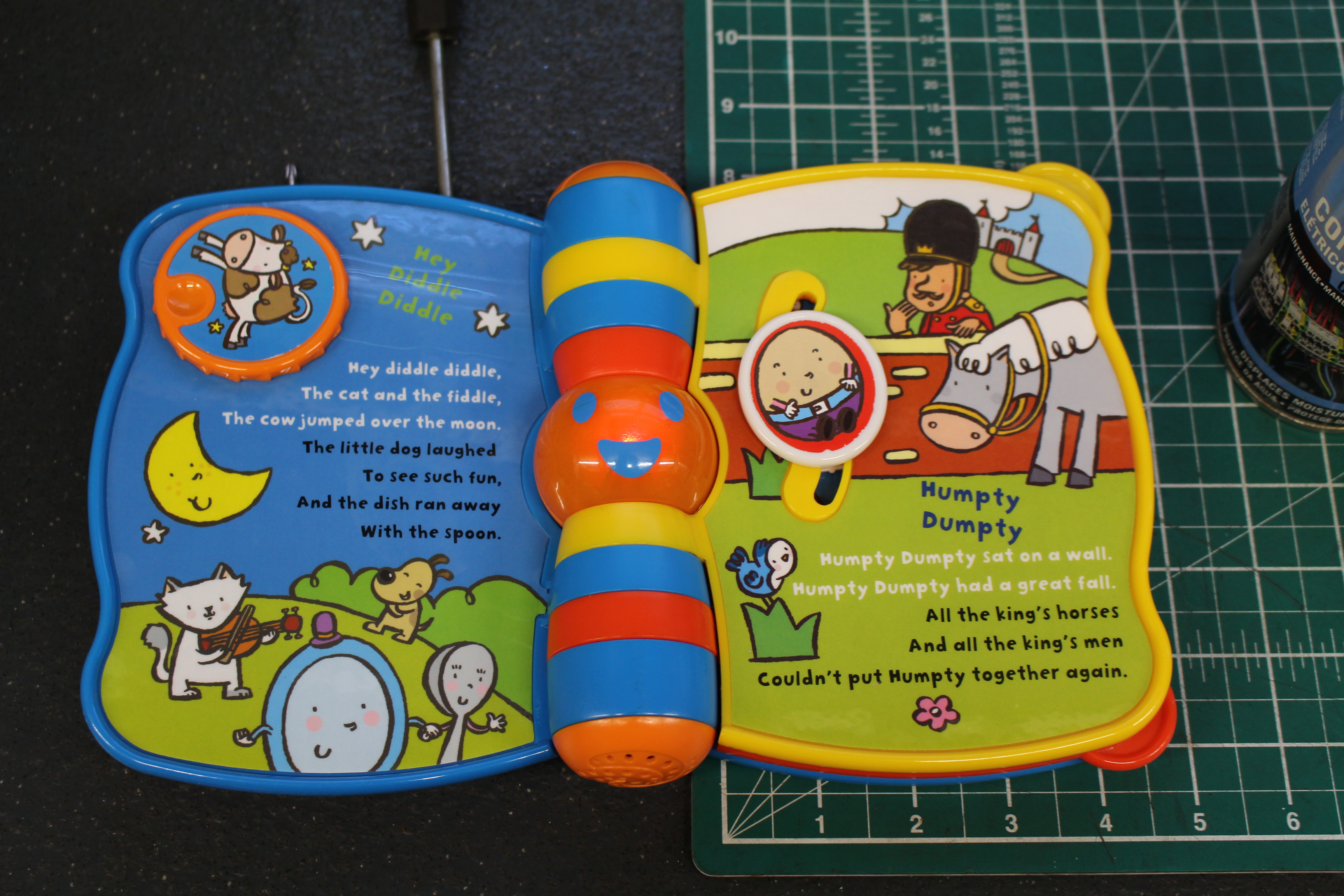
Tone-deaf VTECH Singing Nursery Rhyme Book

VTECH kids toy gets a little help.

We love a musical singing book toy, don’t we.  They’re great for encouraging children to form words, read and follow a narrative.  We have a few of these and they’re all great fun, all the time the batteries hold up.

We’re not so fond of musical books when they seemingly start by themselves, at one o’clock in the morning, when there’s no one else in the house.  Very creepy.

Make and model:  VTECH Electronics Singing Nursery Rhyme Book

Fault reported: Poor sound quality

Cost of replacement:  N/A

Cost of parts:  £0.00

Hours spent on repair:  About 10 minutes

Tools needed:  Small file, cleaning cloths

Sundry items: Contact cleaner

Repair difficulty:  1/10

IMG_9559
FixItWorkshop, Worthing, July’19, VTECH Singing Nursery Rhyme Book.

This toy was a hand-me-down and had enjoyed a few years of use already, before it came in to our household, but it was in good condition and still has many more years left in it yet.

Recently though the singing emanating from the book was becoming a bit off-key and to be frank, rather than bringing joy the noise coming from the toy was enough to induce nightmares.  I keep a ready supply of rechargeable ‘AA’ batteries in this house and after popping out the old ones, the new ones fitted, I assumed all would be well, but not so.

Despite fresh power, the singing was still horrible and wobbly.  A quick test of both sets of batteries (old and new) revealed that the original batteries were fine and that something else was at play.

Time to delve a little deeper.

Galvanic corrosion can occur when two different metals in close contact with each other, chemically react.  The corrosion forms a barrier, in this case between the electrical contacts of the toy and battery to form a resistance.  This means that the toy, with the corroded contacts, wouldn’t get the full power it needed.

There was some minor corrosion on the contacts that needed a quick clean with some cloth and contact cleaner, something I keep on the shelf for such an occasion.

This did the trick and with the original batteries fitted, the toy was back on song once more, ready for another performance.

Musical keys

A child’s set of keys gets repaired in the workshop

It makes a nice change to repair something like a childs’ toy.  I know that if the repair works out, it’ll usually make someone very happy.  However, having just said that, the repair I’m about to discuss, didn’t bring joy for all…

First off, I’ll get a moan out-of-the-way.  Too many kids toys take too many batteries – it’s been like that since I was a kid.  This does two things; makes the toy expensive to own and damaging for the environment when the batteries expire.  Now, I know there are some very cool kids toys that rely on sophisticated electronics to make them work, but manufacturers:  Please try to think harder about the toy’s overall impact on the environment and it’s in-life running costs.

OK, rant over.

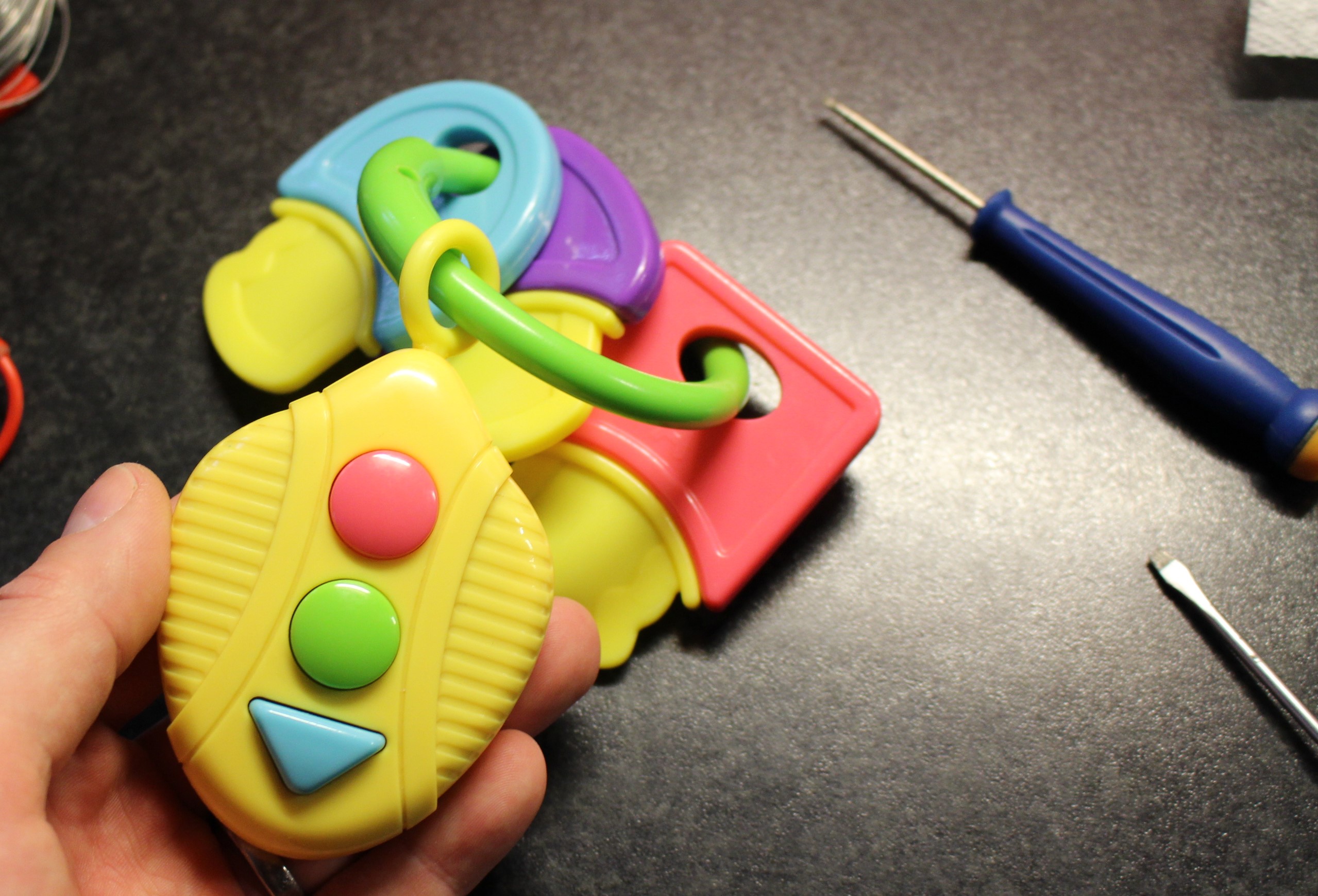
On with the repair.  This kids-chew-musical-keys is supposed to mimic an adults’ set of car keys.  It doubles up as a teething chewy thing as well as an imitation car alarm blipper remote fob thing, that plays a tune.  Delightful.

IMG_8377.JPG
FixItWorkshop, March’19, kids car keys.

This set of keys had stopped playing a tune, when any button was pressed.  To some, that might have been a good thing.

The battery compartment contained two LR44 coin batteries.  These are found in many items and are readily available, if you know where to look, but are not commonly stocked in supermarkets, where I suspect most people buy batteries.

Taking the batteries out revealed some light corrosion on one cell, but no dramas.  The other one was corrosion free.  However, a quick test with the multimeter revealed that both batteries were kaput.

I usually keep a pack of LR44s (as one does) in case of toy key emergencies like this and luckily on this occasion, I had two shiny new ones to fit.  But, upon installing them, replacing the cover and pressing one of the buttons for the first time there was still no sound.  How odd.  What I thought would be a quick battery change had escalated in to a full toolkit situation.

Whipping the back of the key fob apart revealed a simple integrated circuit with the battery terminals, all in good condition.  The small piezo speaker was held behind the main circuit board and on closer inspection, I saw that one of the soldered connections had broken away from the speaker.

Solder repair jobs like this are difficult as excess heat can quickly transfer from the joint being operated on, to the whole component, causing damage if too much heat is conducted.  I had to be careful.

This slideshow requires JavaScript.

After some careful soldering, the broken wire was reconnected, circuit board re-installed, casing screwed back together and batteries re-fitted.  A quick tap of one of the buttons then revealed musical joy.  After a couple of presses I then began to regret the repair…

Cost of replacement:  Not sure, £5 ish?  Cost of repair: A bit of soldering.

Aldi Bauhn Radio with no power

A cheap radio gets a cheap fix.

I love a good radio.  I used to collect them as a kid, working or not, do them up, get them working and I eventually ended up with, er… lots.  I’ve since scaled my collection back a bit these days to around 10 or so, quite frankly more than is healthy really.

So when someone got in touch recently with a broken DAB radio to fix, I got quite excited.

IMG_8145
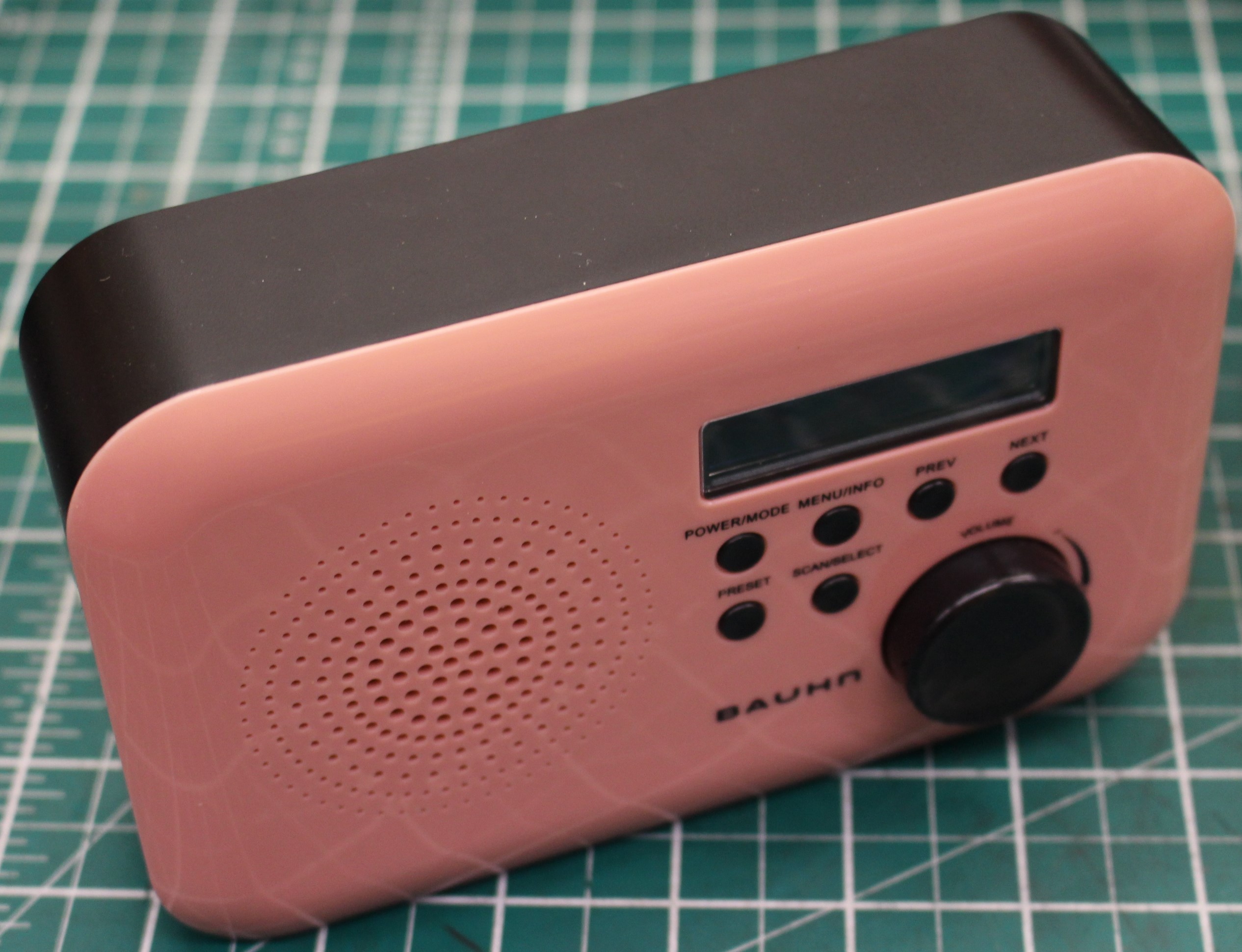
FixItWorkshop, Worthing, February’19, Bauhn DAB Radio.

These Bauhn DAB radios (available from Aldi or Lidl in the UK, I think) were on the market for about £10 and at that price they represent great value when compared to more expensive devices.

However, the one in the workshop appeared to have a problem power connector, which when wobbled, made the radio work intermittently.  Suspicious.

Having already repaired a similar radio with a similar fault before, I decided to video the repair to encourage others to check theirs, if something similar happens.  I hope you find it useful.


Happy fixing!

Cost of a new radio:  £10.  Cost of repair:  One cuppa and a bit of tinker time.