Beloved Yamaha XT600 Ténéré nearly goes up in smoke.
I’ve had my beloved Yamaha XT600 Ténéré for about 8 years and have deliberately kept it away from these pages as I’m always doing something to it. It could have its own website with the amount of time, not to mention money and effort I’ve spent on it.
FixItWorkshop, Jan’18, Yamaha XT600 Ténéré.
This story is note-worthy as it’s a lesson for me and others who ride and maintain old bikes!
I don’t use the bike that much at the moment, but I always keep it ready for the road, just in case I get a chance to take it out. Whilst doing a few checks recently, I decided to fire it up and get the oil pumping around the engine, so that things don’t seize up.
The tank was pretty full (over 20 litres) and upon opening up the manual fuel valves, giving it a bit of choke, the engine fired-up on the second crank. It sounded quite sweet.
However, after about 30 seconds, I heard ‘running liquid’ before smelling the intense scent of super unleaded. Looking down, I was standing in about 2 pints of fuel, on the wooden shed floor with a hot exhaust casually burning the fuel that was dripping on to it. Nasty.
I won’t repeat what I said, but suffice to say, I hit the bikes’ kill switch virtually instantly. I shut the flowing fuel off and wheeled the bike out in to the open air.
After several cups of tea, I found the cause of the problem. The small fuel feed pipe which runs from the float chamber to the main jet on the carburettor had failed causing the leak.
FixItWorkshop, Jan’18, Yamaha XT600 Ténéré, fuel leak, new pipe.
When I bought the bike, I thought I’d changed all the fuel lines, but I’d missed one, quite an important one as it turned out. It goes to show that even enthusiastic mechanics make mistakes.
The cost of the repair was £1 for a new piece of fuel hose, but the point of this story is: If you have any petrol-powered things, especially old motorbikes; don’t run them in an enclosed wooden space. Always run them outside.
A couple of years ago, I made a light for our porch. I wanted to ‘back-light’ the area under the porch with a subtle glow, when coming back home in the dark, handy when trying to find the front door keys. I used a clear section of hose pipe, several clips and a strip of LED tape, commonly available from lighting suppliers. I used a standard 12V power supply unit (PSU) from an electrical wholesalers’ and controlled the whole thing with a neat little PIR motion/ day-night detector. It all worked quite well until the other day.
FixItWorkshop, Jan’18, LED strip light outside light.
FixItWorkshop, Jan’18, LED strip light outside light/ PIR.
Whilst walking past the PIR detector the light came on in the usual way, but there was a strange ‘arcing’ noise, coming from the inspection panel, behind which I’d mounted the PSU. The PSU seemed a sensible place to begin investigation.
It’s really irritating when manufacturers’ chose to make it so that a casing for something does not come apart, without breaking in to it. This PSU was made this way and to gain access, I had to carefully lever the two halves of the glued casing apart with a screwdriver, breaking the glue holding it together. It wasn’t working anyway, so what did it matter.
Looking at the printed circuit board (PCB) within the plastic casing revealed that the mains feed, presented as an IEC Kettle type connector in this case, had a ‘dry-joint’ and had begun arcing (small sparks) which left unchecked, would have caused permanent damage to the PSU.
FixItWorkshop, Jan’18, LED strip light outside light, dry joint.
FixItWorkshop, Jan’18, LED strip light outside light, evidence of arcing.
With a small clean-up of the affected joint and a little soldering, the PSU was as good as new. Sadly, the casing won’t be the same again, but as it’s hidden out of sight, I decided that a good wrapping of electrical tape around the two halves of the PSU casing was all that was needed.
Cost of a replacement PSU: Circa £15. Cost of repair: A bit of solder and my time.
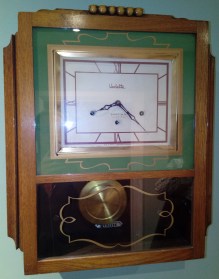
This lovely wall clock had been running perfectly fine until a friend of mine decided to move it temporarily from the wall, during a recent bout of home decorating. Now, I’m no expert on French wall clocks, but we think this one is circa 1920s or 30s, but either way, it’s a lovely thing to have in the house. This one is also fitted with Westminster chimes, so one assumes it was made for the English market as an export item, all those years ago.
Once the paint had dried, the owner decided to re-fit the clock to its hook on the wall, but it simply didn’t run, even when fully wound-up. Strange, what had happened?
Having a quick look at the front of the clock revealed nothing much. The pendulum was where it should be and appeared to swing freely, as a pendulum should, but there was a slightly strange ‘double-click’ tick-tock, indicating something wasn’t right. Clocks of this type should emit a definite even tick – tock -tick-tock. This one wasn’t. Hmm.
Before going to see the clock, I had already decided that the small spring that suspends the pendulum could have been broken, so I packed a few spares I happened to have, just in case. Opening up the mechanism revealed that the spring was actually intact, not bent or warped and therefore perfectly serviceable. It was fairly obvious almost immediately that the small clasp which secures the pendulum to the escapement lever was bent and the probably cause of the problem. All that was needed was a small amount of tinker-time to fix that with a small pair of pliers. However, that wasn’t the end of the story. Having undergone a ham-fisted removal from the wall, the escapement pendulum lever was now in a slightly different position and some more fettling was required to get the clock back ‘in-beat’, a common requirement on this mechanism type and often the reason why a clock won’t run, even when fully wound.
As the clock mechanism was out of the main casing (see photo) I decided to prop-up the mechanism on two tins of beans to allow the pendulum to hang over the side of a level table. This allowed me to access to the clock’s mechanism and hear what was going on clearly. A slight adjustment on the main pendulum lever to the right on this mechanism and the clock was back ‘in beat’, keeping good time.
After giving the case a general clean up and polish, I refitted the clock mechanism back inside it and hung the whole thing back on its hook, back where it belonged, on the wall.
Cost of a replacement: Sky’s the limit. Cost of repair; 1 cup of tea and 1 chocolate digestive.
Now, before I start the story, I have a confession. I technically stole this room fan. I didn’t pay for it, I just took it.
Just before Christmas 2017, I noticed that a room fan had been dumped in the small carpark at the end of my road. At first, I assumed that it was being left on a temporary basis, ready to be taken to the tip in a responsible manner, but as the days and weeks rolled on, it became clear that someone had carelessly left it there to turn to rust, which seemed a shame.
I did the only responsible thing; pick it up off the ground and take it back to the workshop in broad daylight.
Once I’d allowed it to dry out, I plugged it in and guess what, it powered up and ran on all three speeds without an issue. Its operation was very smooth and quiet. On closer inspection, it didn’t seem that old to me. How strange.
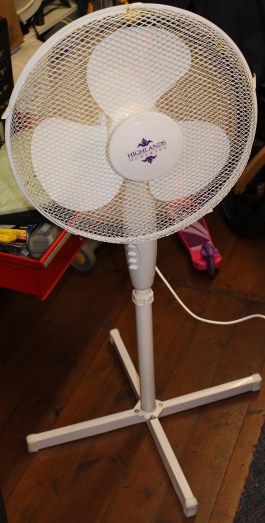
The major problem with the fan was that it didn’t stand up properly, in fact it would fall over easily. The fan’s base stand was a simple cross-section of metal feet, supporting the main pole which holds the fan itself. The whole assembly was loose and being held together with masking tape, which was far from ideal.
FixItWorkshop, Jan’18, fan repair, stand.
FixItWorkshop, Jan’18, fan repair, stand underneath.
Once I’d removed half-a-roll of masking tape from the stand, it revealed that one of the screws that holds the main pole to the stand was missing and the remaining three were loose. Could it really be that simple?
Once I’d straightened the slightly bent metal work in the vice, replaced the missing screw with one I already had in my nut and bolt pots, tightened the rest up, the stand performed as a stand once again and the whole thing worked without wobbling in a drunken manner.
FixItWorkshop, Jan’18, fan repair, stand repaired.
FixItWorkshop, Jan’18, fan repair, stand reassembled.
FixItWorkshop, Jan’18, fan repair, stand, missing screw.
Now, this probably wasn’t an expensive item. It’s not the finest example of good design or build quality. But it struck me then that the otherwise fine fan had been condemned on the one missing screw and the owners’ simple lack of screw driver aptitude. Crazy. I find it very sad that something with plenty of life left in it ends up dumped in a car park over one missing screw. Some people have a very disposable and wasteful view of everyday items.
FixItWorkshop, Jan’18, fan repaired.
I did repaint some of the rusty metal work after these photos were taken.
Cost of a new fan: £15 to over £100. Cost of repair; 5p.
Over a cuppa, my mother in law mentioned that she was chucking out a dehumidifer this weekend and had already replaced it. This was a shock to me since it hadn’t started it’s journey to Worthing tip via my shed yet. Time to intervene.
FixItWorkshop, Jan’18, GET Dehumidifier repair.
Aparently it had overflowed water all over the floor and had cut out and not restarted. It had probably been left to its own devices in their cellar, totally neglected in the run up to its demise.
Before worrying my toolbox, I usually plug things in and press buttons to see what happens. When connecting this dehumidifier to the mains, it fired-up and seemed to run perfectly. Strange.
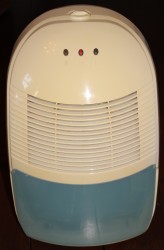
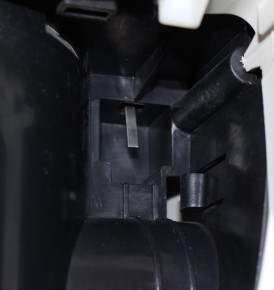
Looking at the device in more detail revealed three tell-tale LED lights (cooling, empty the tank and running). The tank was removable from the front and featured a small float operated level which married up to a small microswitch. The idea being that when the water rose to the top, the switch would be activated by the float and the machine would cut out safely, all being well.
The lever mechanism on the float seemed to be stiff and all that was required to restore service was a good clean with a brush and Fairy liquid and some silicone spray, once dried.
FixItWorkshop, Jan’18, GET Dehumidifier repair, microswitch.
While giving the unit a general inspection, I noticed dirt in the units’ grille. Fortunately, the grille had a removable filter which had clearly never been cleaned, so in effect had been chocking the dehumidifer in normal operation. Bad news.
FixItWorkshop, Jan’18, GET Dehumidifier repair, dirty filter.
FixItWorkshop, Jan’18, GET Dehumidifier repair, clean filter.
Piecing the evidence together in my mind surrounding the causes of failure, I came up with the following theory. The float had failed, causing the unit to leak. The unit had then run hot, probably for a while and had probably tripped a thermal protection fuse. I have no evidence for the latter idea as I never opened up the unit fully, but the theory fits the sequence of events.
In any case, the dehimidifier now switches on and switches off when full and doesn’t seem to run hot. I was pleased with that. I wasn’t so pleased that my in-laws wanted the unit back.
Cost of replacement: Circa £100. Cost of repair; cleaning stuff.
A Fender Precision style Satellite P Bass guitar repair…
A friend of mine, who plays in a Portsmouth-based Psychedelic Garage Rock & Roll band, brought in a Satellite Bass Guitar with a few issues. Firstly the volume control was noisy and crackly and secondly, it was a little quiet. Not good for those moments where you need to go one higher, to eleven.
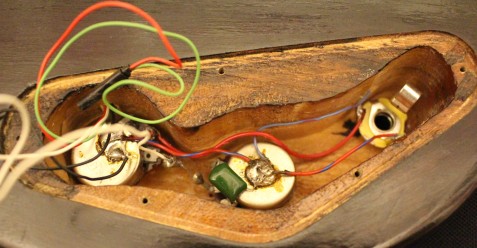
Opening up the compartment behind volume, tone and jack plug socket revealed messy wiring and dodgy connections. The owner had already supplied a replacement potentiometer for the volume control, so all I had to do was replace the one fitted, re-make the poor connections and give the wiring a general tidy-up.
FixItWorkshop Jan’18, Fender Precision style, Satellite P-Bass, wiring before work.
The guitar has Dimarzio ‘Model P’ pick-ups which can be wired many different ways, depending on the application and musical taste. This particular guitar, circa 1976, is a Fender Precision style Satellite bass (P-Bass) and has a modified ‘through neck’.
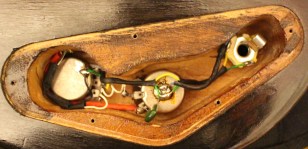
FixItWorkshop Jan’18, Fender Precision style, Satellite P-Bass, volume (top) and tone (bottom) controls.
Testing the guitar before commencing work revealed a slightly quiet, but mainly crackly output from the amplifier, the tone control was fine. The owner had also complained that the bass sometimes cut-out, mid song. Not ideal.
Removing the volume control was straightforward and only required a spanner to remove the nut, after pulling off the volume knob. The rest of the job just involved careful de-soldering, cutting out the poor wiring and replacing it with new wiring where needed and some heat shrink to tidy things up. Having not repaired an electric guitar before, I did make a quick wiring diagram for reference!
Once completed, I hooked it up to the amplifier again which revealed a much cleaner, crackle free note. Sadly, I can’t play the guitar, so I wasn’t able to test it properly!
Scalextric C8215 lap counter repaired in the workshop…
First off, I must confess, that this is part of my own Scalextric collection, not part of someone else’s. I’ve always enjoyed slot car racing and a lap counter is an essential addition to anyone who wants to prove that they’re the fastest around the track! Trust me, it can be very addictive, especially when racing against one’s better half.
FixItWorkshop, Dec’17, Scalextric Lap Counter C8215
Anyway, I wanted to share this little repair in the hope that others might benefit.
My once reliable lap counter started to miss laps on lane two at very crucial stages of a race. It started by only happening occasionally before completely missing several laps in a row, forcing a stewards’ enquiry to settle the race finish times. Lane one was fine.
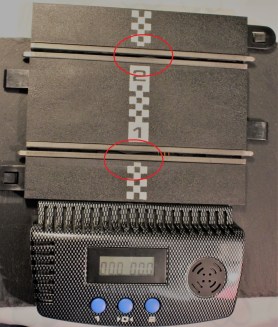
Time to get out the screw driver and delve in to the workings of the timer. Once removed from the main track layout, the back of the unit has a cover which is held in place with six small self-tapping screws. These come undone easily and removing the back reveals two sets of electrical switch contacts, operated by a lever on each track, just under the slot car rails. The idea here is that the slot on the slot car operates the lever as the car passes the lap counter track piece, operating the switches contacts, completing a circuit, thus counting the laps.
FixItWorkshop, Dec’17, Scalextric Lap Counter C8215, gap to big.
FixItWorkshop, Dec’17, Scalextric Lap Counter C8215, gap closed.
FixItWorkshop, Dec’17, Scalextric Lap Counter C8215, screws on back.
Comparing the switch contact clearances, lane one’s was considerably closer than lane two’s. This means that the ‘dwell’ time on lane two’s switch would be less that the switch on lane one, which was working ok, meaning a possible cause of the problem. To anyone who’s adjusted contact breaker points on an old car, you’ll know what I mean here.
I had no idea what the correct clearance should be, so took an educated guess and closed the gap to about 0.5mm, done by eyesight alone. I made sure that both sets of switches were the same (see photos). While I had the counter in pieces, I cleaned the contact surfaces with a little electrical contact cleaner, just for good measure.
After re-assembly and re-fitting to the track, a few test laps with my fastest race Mini, proved that the counter was working as it should once again.
Cost of a replacement counter (second hand) circa £12. Cost of the repair; 10 minutes tinker-time.
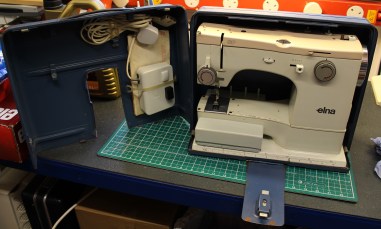
On first impressions, this machine didn’t have a lot going for it. It had been stored in a garden shed, never the best place to store a sewing machine, it was dirty, neglected and broken. However, the weight of it indicated that this was a quality item and worth investigating.
FixItWorkshop, Nov’17, Elna SP Sewing Machine in case.
This machine comes from a different time in manufacturing where the focus was on quality rather than on price-point in the market and as a result, it’s made to outlive most people. In fact, many electric sewing machines made by Elna, Singer, Toyota, Janome, Brother and so on, built until the 1980s, are items of sheer mechanical excellence inside and should be cherished. Anyway, on with the problem and repair.
The owner had stashed the machine away many years ago and as a result, it had seized. Details of the fault were scant, I was just told that it didn’t work! Upon powering it up and operating the foot pedal, the hand wheel turned slightly before making a horrible mains AC hum. It was time to un-plug, rapidly.
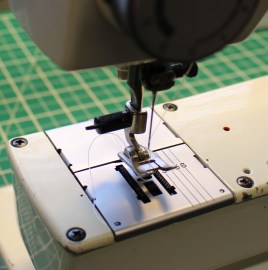
FixItWorkshop, Nov’17, Elna SP.
There are exposed oiling points on the Elna SP, a nice maintenance touch, but clearly these hadn’t been used in many a year. Opening up the machine’s lid on top of the motor and bobbin transmission cover below revealed a lot of dirt and neglect which I first cleaned and then oiled lightly with special oil, in to all the moving parts. Automotive brake cleaner was used to remove old dirt and grease from the needle area and gears. New grease was then applied to the parts that needed it and more oil to other ‘metal on metal’ parts. The trick here is to not apply so much oil that it ends up on the fabric being stitched.
Once the machine was running smoothly again, I noticed that the bobbin shuttle wasn’t turning, not even a little bit. Not ideal. Time to delve a little deeper and on this machine, it meant complete disassembly of the bobbin shuttle assembly, which then revealed a stripped worm-drive hook gear (part 403030). This seems to be a fairly common issue on these machines as they get older.
FixItWorkshop, Nov’17, part 403030 for Elna SP.
Obtaining a new hook gear was quite easy via eBay; BSK (Bedford Sewing Knitting Machines) supplied the part for a reasonable £15.99 including P&P within 24 hours. Once fitted, it was a case of fine-tuning the bobbin/ hook timing to suit the needle. It’s a similar principle to valve and ignition timing on a petrol engine car, a process that will be familiar to anyone who’s ever done any spannering on an old Mini or Escort for example.
With the timing complete, a few tests using old material revealed that the machine was working once again with no missed stitches. I gave the machine a final polish with car wax before handing it back to the owner for my own satisfaction.
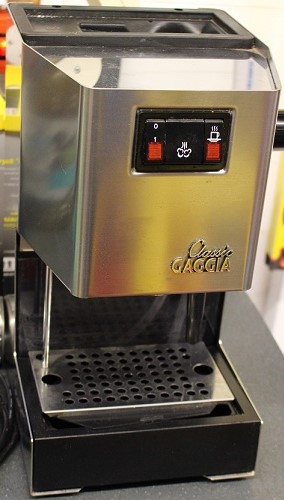
A simple repair…. That’s what I thought when a friend asked if I could look at his Gaggia Classic Coffee Machine, which had developed a nasty little leak when in use. The coffee wasn’t all that good either, due to the lack of pressure available, caused by the leak. In short, it needed attention.
FixItWorkshop, Oct’17, Gaggia Classic Coffee Machine, with a leak.
The owner had already bought a repair kit consisting of the main seals/ gaskets that commonly fail, so I thought no problem, take to pieces, replace seals, happy days. Er, not quite.
Once I’d stripped the machine down, pretty straightforward on these machines, the bare parts were exposed, which revealed the problem. After being fired up briefly, not to make coffee I’d like to point out, water could be seen escaping from the boiler unit, a alloy bodied lump of metal, split in two halves, held together by 4 screws. The boiler, as the name suggests, heats the water up with one heating element and creates steam for the steam wand, with another element, all part of the same module.
After separating the boiler halves, I traced the leak to a faulty gasket, but crucially, one side of the mating faces was heavily corroded and unlikely to re-seal with a new part fitted on its own. Remedial action was required.
This model is a few years old and a replacement boiler is still available on a few websites and prices vary from £40 to £60 at the time of writing, so at that price, starts to make the cost of repair unviable.
I decided that the face with the corrosion had enough material to withstand loosing some, so went about sanding the worst of the corrosion away before gradually moving on to smoother and smoother sandpaper.
Because Gaggia Classics are fairly common, I decided to video this repair process as I suspect the corrosion affects many machines with age and just fitting a repair kit won’t cure the problem on its own. See below. I hope it helps anyone else with the same machine facing the same problem.
Once I was happy with the new finish, I fitted a new gasket and reassembled the boiler. After putting it all back together, I purged several tanks of water through the system to remove debris, before attempting a cup of coffee. Once filled up with my favourite Lidl coffee, the machine performed well once again with no leaks and the end product tasted great.
Cost of a new machine: £249.00. Cost of repair: £4.50, plus time.
A noisy Kenwood Chef A701a gets a gearbox rebuild.
This Chef had been sleeping quietly in a kitchen cupboard for some time before being woken up to make cake mixtures once again. The owner had owned the mixer for many years from new and was sentimentally attached to it. I fully sympathise, they’re great machines. It had been used many times in the past and then packed away as new machines came and went. Having decided that there was still a place for the A701a, it was fired up.
The owner didn’t remember it being quite as noisy and wondered if something was wrong with it. She got in touch and brought it in to the workshop. After listening to the mixer at varying speeds, we agreed that perhaps it was a bit noisy and that further investigation was required.
At this stage I must confess at this repair has been on the bench for a long while..!
I think the A701 is my favourite Kenwood Chef product as it’s very elegant, beautifully proportioned and almost over-engineered. It comes from a time where built-in obsolescence was a swear word.
FixItWorkshop, Oct’17, Kenwood Chef, A701a.
On with the problem. After disconnecting the gearbox by removing the drive belt, I checked the motor for general wear and tear, the brushes and speed control mechanism and I concluded that it all seemed OK and working smoothly. The gearbox however did seem a bit noisy when turned manually, nothing hideously graunchy, but a little rough. To be honest, it would have probably survived, but I wanted to open up the gearbox to make sure that it was as it should be.
Whilst removing the Chef’s casing around the gearbox, I’d noticed traces of grease around the joints and various power take-offs. All models seem to do this to an extent, but this one seemed to be quite bad. Closer inspection revealed that some of the grease had escaped out of the seal between the two halves of the gearbox casing. Opening up the casing revealed that the grease that was left had been pushed to the corners of the space within the gearbox and that the gears were a bit dry, this was probably the root cause of the noise. The planet wheel that drives the beater was also bone dry.
FixItWorkshop, Oct’17, Kenwood Chef A701a, gearbox before cleaning.
FixItWorkshop, Oct’17, Kenwood Chef A701a, before cleaning- dirty sticky grease.
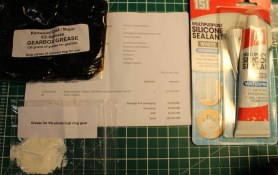
Luckily, there are plenty of suppliers who can supply rebuild kits for Kenwood Chef gearboxes, including new gears and grease. The gears in this seemed serviceable, but it seemed very sensible to replace the lubricant with the correct 130g of Kenwood gearbox grease, which is food safe. I used ‘Kenwood Chef Restore’, an eBay seller and the kit was a reasonable £10.99, including P&P. The kit included the main gearbox grease, white grease for the planet gear and sealant for the gearbox casing.
FixItWorkshop, Oct’17, Kenwood Chef A701a, repair kit from Kenwood Chef Restore, eBay.
Before replacing anything, the first job was to clean out all traces of the original grease which had gone very sticky and was contaminated with general wear. The first pass clean involved using paper toweling, followed by water and detergent, before a final clean with brake cleaner, which removed the last few traces of grease and dirt.
FixItWorkshop, Oct’17, Kenwood Chef A701a, adding new gearbox grease.
FixItWorkshop, Oct’17, Kenwood Chef A701a, adding new gearbox grease- note spacers.
FixItWorkshop, Oct’17, Kenwood Chef A701a, showing idle gear.
FixItWorkshop, Oct’17, Kenwood Chef A701a, new grease.
FixItWorkshop, Oct’17, Kenwood Chef A701a, before grease.
FixItWorkshop, Oct’17, Kenwood Chef A701a, planet wheel grease.
FixItWorkshop, Oct’17, Kenwood Chef A701a, parts before reassembly to the main body.
With the gearbox refilled and resealed making sure the spacers were re-fitted to the correct parts, the drive belt re-fitted with just enough slack, the gears sounded much sweeter with the final parts of the casing reassembled. One last point to note is that I used silicone sealant on the blender attachment power take-off plate in replacement to the one fitted, since the original seal was well past it (see below).
FixItWorkshop, Oct’17, Kenwood Chef A701a, belt in situ.
FixItWorkshop, Oct’17, Kenwood Chef A701a, adjustment.
FixItWorkshop, Oct’17, Kenwood Chef A701a, cover fitted.
FixItWorkshop, Oct’17, Kenwood Chef A701a, silicone sealant.
As a finishing touch, I replaced the existing machine feet which had turned to mush with replacements from Sussex Spares (eBay shop) for a very reasonable £2.70, delivered.
The Chef was now ready to prepare cake mixtures again.
Cost of new machine: £300 and up. Cost of replacement parts: £13.69 (plus my time).



















 Fix It Workshop