Keeping a light on the subject

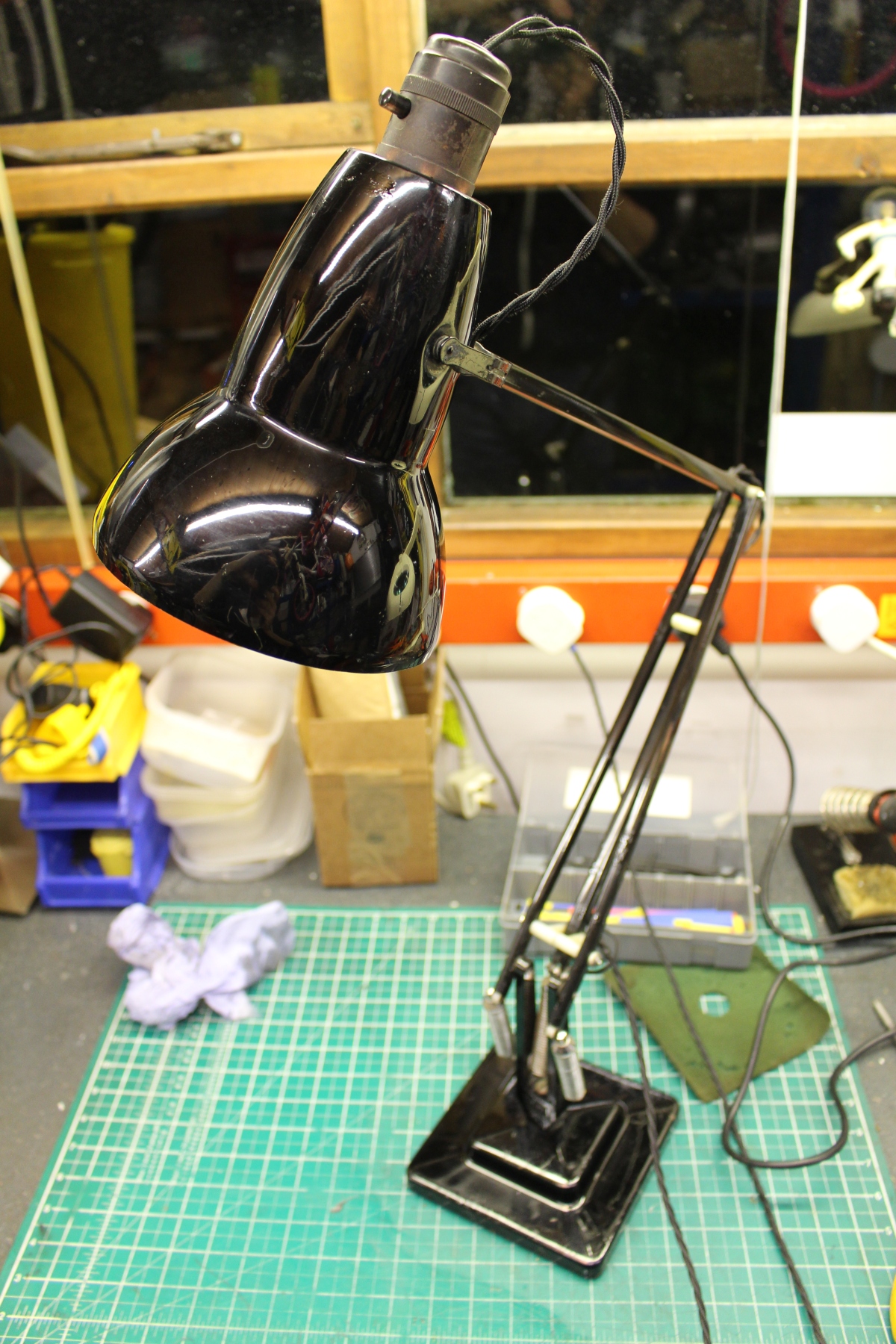
A Herbert Terry 1227 lamp gets a light make over in the workshop.

This lamp needs no introduction.  Herbert Terry Ltd first produced ‘Anglepoise’ lamps in England from 1934 and this 1227 model is instantly recognisable, with its art-deco characteristics and perfect proportions. Some of those early examples have survived to today and are now very collectable.

Make and model: Herbert Terry 1227 ‘Anglepoise’ lamp

Fault reported: Wiring requires replacement

Cost of replacement machine: £80.00 -£300.00 for an equivalent

Manufacturer support (in the UK): 8/10

Cost of parts (for this repair): £20.00

My time spent on the repair: 1.5 hours

Tools needed: Small knife, pliers, small screwdrivers, soldering iron, cutters, scissors

Sundry items: Cable, heat shrink, impact adhesive

Cleaning materials: Silicone spray, contact cleaner, wipes

Repair difficulty: 5/10 (fiddly)

Beverages: 2 teas

Biscuits: 2 chocolate digestives

Bad language: 4/10

My customer contacted me to ask if I could overhaul his family’s Anglepoise lamp and had told me that it was in daily use, but they all felt that the wiring was getting on a bit, and therefore they’d lost confidence in it. In other words, they were worried about a small fire or electrocution.

That’s the trouble with old, well-made stuff like this. Often, on the outside, it all looks fine and sturdy with a quick clean up, and it’s easy to forget that some things are as old as they are. But, one has to bear in mind that after all that time here on earth, things like plastics, rubber grommets and wire insulation break down with age and can be damn right dangerous. 

At 70 years old, this lamp was not in mint condition, but had been well looked after. It was still complete, with its original Bakelite bayonet bulb holder and switch, which is a rarity as they often crack. Over time, they get replaced with ‘B&Q special’ items, which never look right. Sadly, the original lamp holders are no longer available, but there are good alternatives out there, which will do the match well, if you know where to look. No issues with this one as it was all in very good order.

So to the brief; give it clean up, remove some rust, replace the worn-out felt base and re-wire, without over-restoring it. After all, it was wearing its age well, and a total re-spray would have removed all the ‘patina’.

Only a basic tool kit was required with this job, nothing fancy but with things like this, I tend to use a penetrating oil on all metal moving parts as rust and fatigue can make some fixings fragile. After all, I don’t want to add unnecessary cost to the job and while the oil is doing its thing, I can always have another brew, so there’s really no excuse not to do this. Only fools rush in and all that.

After I stripped all the old wire out, paying attention to the correct cable routes, I cleaned up anything previously covered up by the old cable. New modern fabric-covered plastic flex is available at a reasonable price, so that’s what I used and while there, I took the time to earth the frame of the lamp as a ‘Class One’ device. Technically, with a plastic/ Bakelite bulb holder, this isn’t required, but as I had some three cored cable, I decided to earth the metal base as a precaution. It couldn’t do any harm.

Normally I like to preserve as much as I can of the original parts, but in the case of the felt base, it was knackered. I could have just glued it back on, but that wouldn’t have done it justice. So, after a little raid of my daughter’s craft kit (which is full of off-cuts and felt) I had the perfect green felt, ready to be cut to size and glued in place. No one wants a scratchy base and once set, no one would ever know that the thing I’d just made, wasn’t a stock item. I was quite pleased with it.

A new LED bayonet 40W (equivalent), some light polishing, and a PAT (test) and this lamp was ready to be used daily, once again.

Until the next time…
Old vs new, which is best?

Having repaired more than 100 Kenwood Chefs, I compare newish and older machines. Which is best?

IMG_2724

Believe it or not, people do ask me which is best: New or old machines?

There is of course, no right or wrong answer and the answer will vary, depending on the product and application.

But since the question comes up from time-to-time, I thought I’d give my opinion on the matter and have a bit of fun with the subject, a kind of shoot-out if you will.

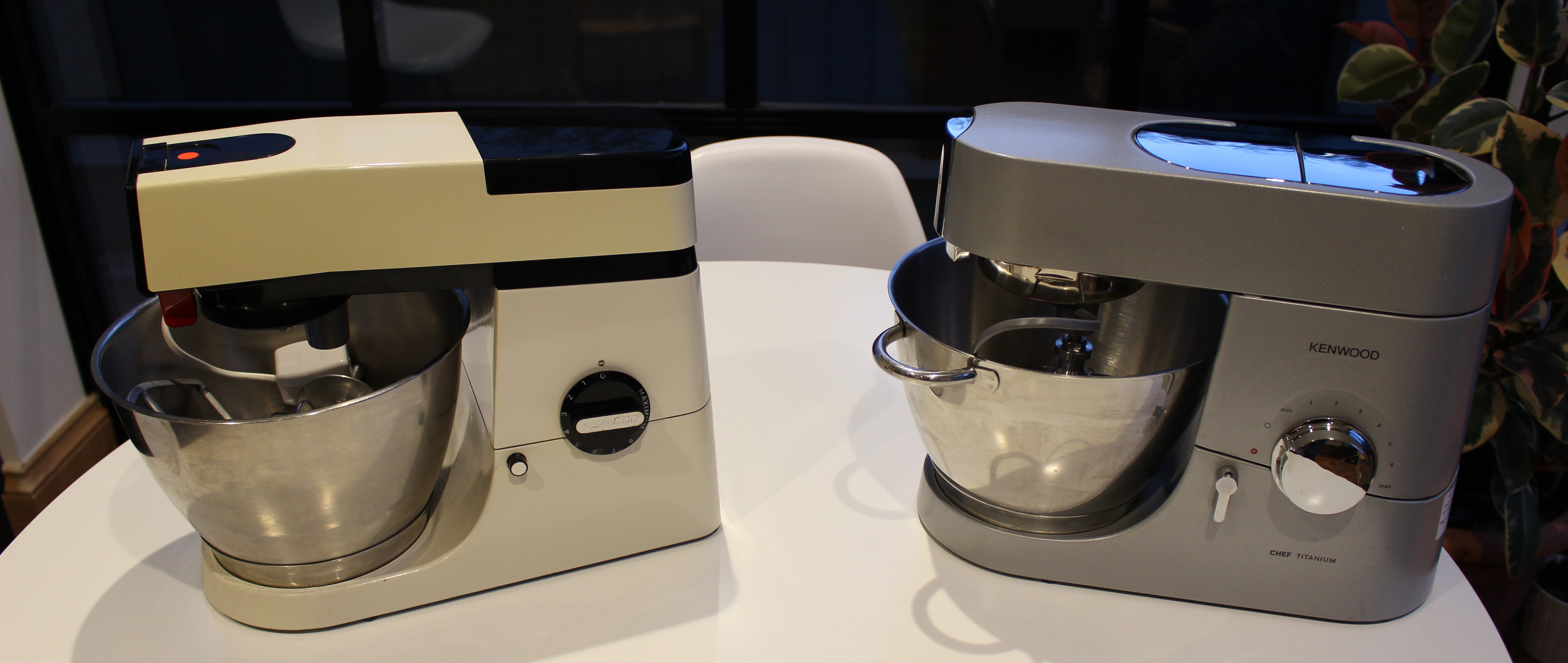
My illustration focuses on an old favourite of mine; the Kenwood Chef. My chosen opponents are a model from the early 1980s, the ubiquitous A901 Chef, made in England, and the much later 2000s KMC010 Chef, made in China.

The Chef is a good example for the shoot-out as the machine’s purpose hasn’t changed since it’s introduction to kitchens in the 1950s. Many Chef accessories produced over the years are interchangeable, owning to the foresight of good design.

Some people think that new machines are best and more capable while other people think older machines are best as they were built to last. Since I’ve dismantled, used and admired 100s of these machines, here’s my take.

Round 1 – Performance

Older Chefs are less powerful than newer machines. For example, the A901 has a 450W motor, whereas the later KMC010 has a much more powerful 1400W motor. This means than the newer machine will be more capable to mix more stodgy mixtures for longer. Counter intuitively, the more powerful machine may be more efficient for some loads, compared to the lower power one, although I’ve never measured this.

A901 – 0 KMC010 – 1

Round 2 – Noise (from the machine)

Kenwood has tended to favour evolution rather than revolution with their product progression. Many models available over the years appeared not to change much on the surface, but under the skin, small tweaks and improvements were taking place. So, in general, the newer the machine, the quieter they tend to be. There are some model variant exceptions to this, but the KMC010 is much quieter than my own good condition A901.

A901 – 0 KMC010 – 2

Oh dear, new things might be better after all..?

Round 3 – Durability

Now this is where things get interesting. Many of the machines I receive in my workshop for repair are getting on a bit. Some of them are over 40 years old. The machines have served their families well with faithful service.

Faulty older machines can often be turned around within a few hours in the workshop, to be back with the customer, to make more cakes. The A901 Chef is a tough old beast. The materials and finish rarely give any problems and major components rarely fail it seems.

KMC010 Chefs (and all newer models) that I see in the workshop are obviously much younger than the A901s. While very capable and powerful, sadly, they seem to have failed, often only with occasional light use.

Seemingly, it’s true what they say, the older machines were built to last and I base that purely on customer enquiries and items I see to repair every week. The newer machines often have features and buttons that don’t serve any real advantage, but have associated circuits which can and do go wrong, rendering the whole machine useless, if they fail.

A901 – 1 KMC010 – 2

Round 4 – Repairability

Now obviously, I am ‘repairability-biased’, this is a blog about repair after all. However, the facts speak for themselves. Older Chefs can be repaired with basic tools, reasonably priced components and a little know-how.

Newer Chefs, like the KMC010 are more complicated and have less user-serviceable parts. This makes otherwise serviceable machines far more likely to end up in the scrapyard with seemingly minor faults, that were too hard to diagnose and repair. The A901 wins hands down in the repairability stakes.

A901 – 2 KMC010 – 2

The feeling is tense and there’s an air of excitement as I get to call the decider on this slightly odd dual.

Round 5 – Value for money (the decider)

A new KMC010 Titanium costs over £600 today and it should be said that all Chefs are great machines and a worthy addition to any kitchen. However, a decent second-hand Chef from the 1960s to the early 1990s is a worthy contender for a tenth of the cost.

Have a look on eBay and you’ll see A701s, A701a, A901, A901E, KM200 model Chefs, starting at £40, often with many accessories. They’re just as useful and capable to serve most home needs. Indeed, I have a customer who uses her standard A901 in an industrial kitchen, every day, with no problems.

A901 – 3 KMC010 -2

The non-scientific conclusion…

  • Buy an older machine and take satisfaction that it will last generations, can be easily repaired and work with most accessories available now. Buying an older machine is probably less environmentally damaging than the manufacture of a new machine.
  • Buy a new machine and take satisfaction with additional performance and a manufacturers’ guarantee for the first year…

You know which machine I would buy…

This slideshow requires JavaScript.

Time to put the kettle on.

fixitworkshop.co.uk repair service and blog

The diary of a tinkerer: Stories, advice, tips and sometimes the odd failure to inspire your own repair.

The diary of a tinkerer: Stories, advice, tips and sometimes the odd failure to inspire your own repair.

Update July 2023:

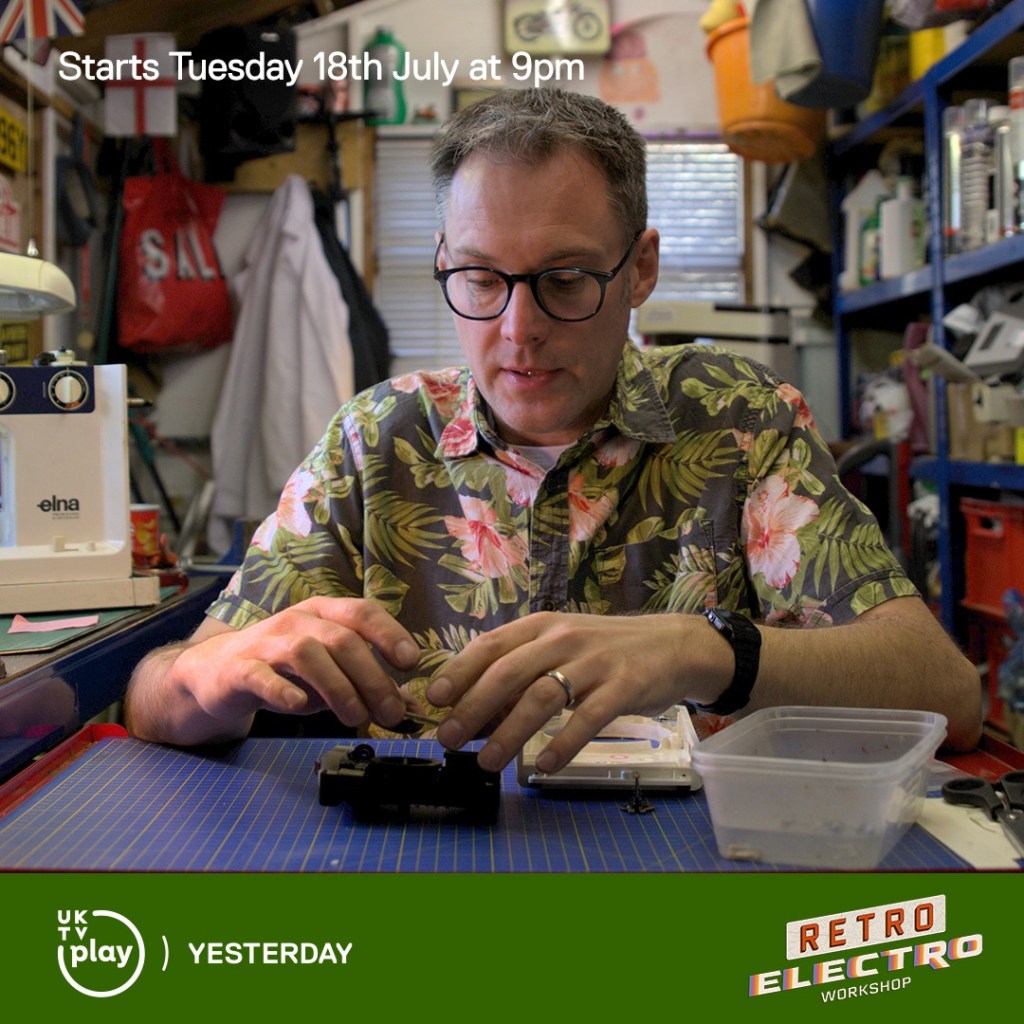
Matt Marchant is also appearing in Retro Electro Workshop, on Yesterday Channel and UKTV Play, alongside Rob Howard and Shamil Joomun.

  1. I write about things I fix and even those I can’t
  2. I offer a repair service for a small fee
  3. I occasionally volunteer at Repair Café and similar events in Sussex and surrounding area

The tinkerer at FixItWorkshop.co.uk is Matt Marchant

I love repairing things and hate throwing things away that can be saved. There’s far too much waste in the world.  Many things that can sometimes appear unrepairable, are indeed repairable, with a little tinkering. I want to encourage people who doubt their own ability to repair their things, to give repair a go.  After all, if ‘that thing’ isn’t working, grab a screwdriver, take it apart and investigate.  What have you got to lose? I’ve been tinkering with bikes, cars, coffee machines, toys and vacuum cleaners and pretty much anything that can be dismantled since I could hold a screwdriver.  I’ve worked for BT as a senior engineer, and I’ve studied design, business and electronics. Enjoy the repair diary of a tinkerer.  I hope it gives you a nudge to repair your broken thing.  If you can’t, I might be able to help.

Scroll through articles on repairs, views and news.