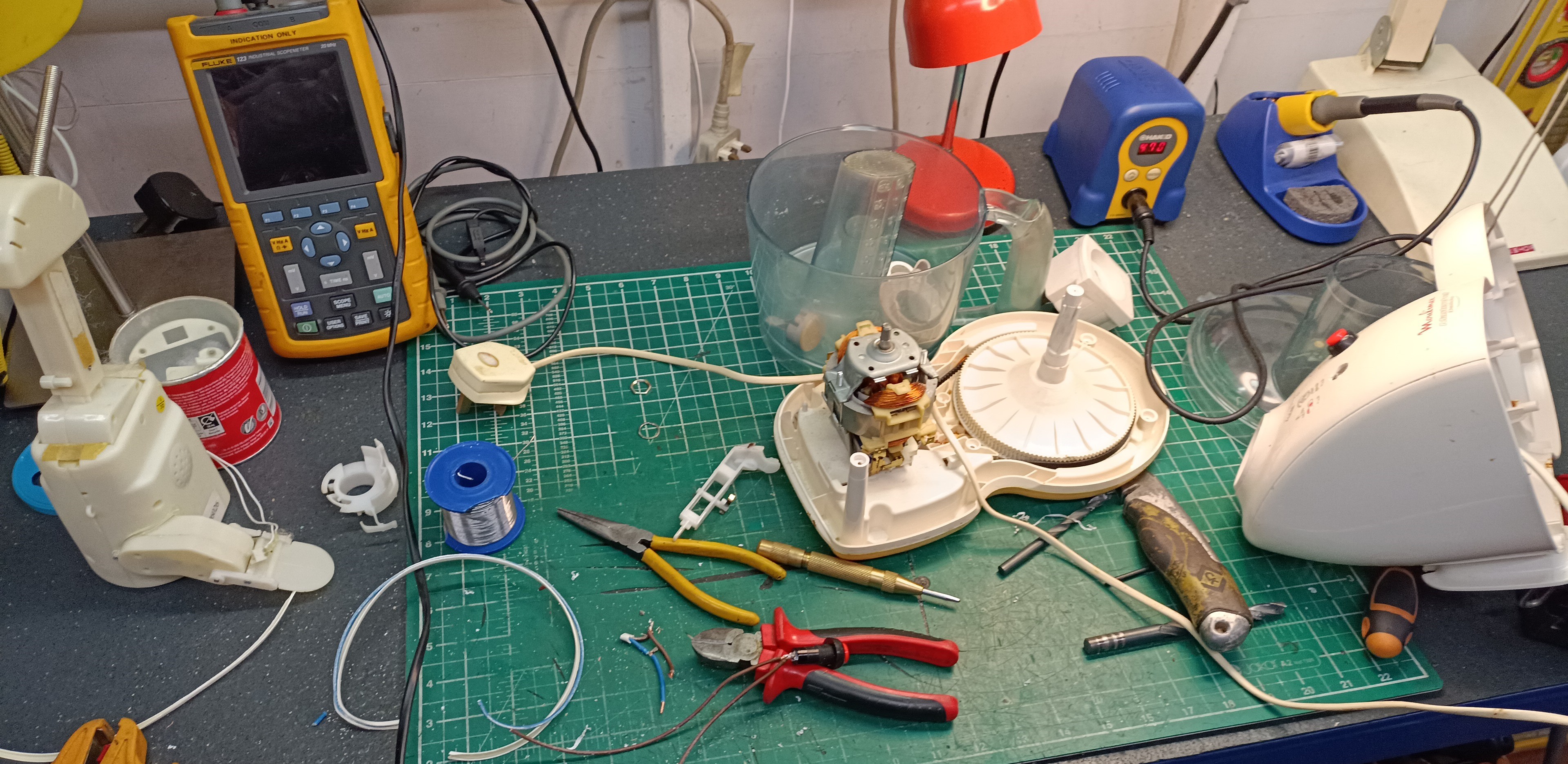
Moulinex magic in the workshop

Economically unviable, virtually no manufacturer support, practically zero second hand value. I’ve had worse machines through the workshop.

It’s not always about the cash…Better crack on.

Make and model: Moulinex Delicio (food processor)

Fault reported: Broken switch

Cost of replacement machine: £40.00 – £50.00 for an equivalent

Manufacturer support (in the UK): 0/10

Cost of parts (for this repair): £ under a tenner, including all parts, but not labour

My time spent on the repair: 1 hour

Tools needed: Small knife, pliers, small screwdrivers, soldering iron

Sundry items: Cable, heat shrink

Cleaning materials: Silicone spray, contact cleaner, wipes

Repair difficulty: 5/10 (fiddly)

Beverages: 1 tea

Biscuits: 2 ginger nuts

Bad language: 2/10

It must start early.  An attachment to inanimate objects, a personification if you will, of machines and their mechanical feelings.  Maybe it starts with teddy bears, Lego people or Matchbox cars. Of course, deep down I know that machines do not have feelings, but I do sometimes find it hard to simply give in with something, and throw it away. 

I don’t think that it’s a coincidence that many classic cars, rescued from the crushers’ teeth, tend to have a ‘face’.  Indeed, designers can often hit on a million-seller, if they get the ‘face’ right.  Think VW Beetle, Morris Minor and Mini. Perhaps these shapes bring back childhood memories of a favourite cuddly toy, which might translate to them being taken care of better and cherished for longer.

Anthropomorphism, the attribution of human traits and tendencies, is something many of us experience, but us repair nerds seem to take it to another level.  I’ll have to think of a catchy name for it.

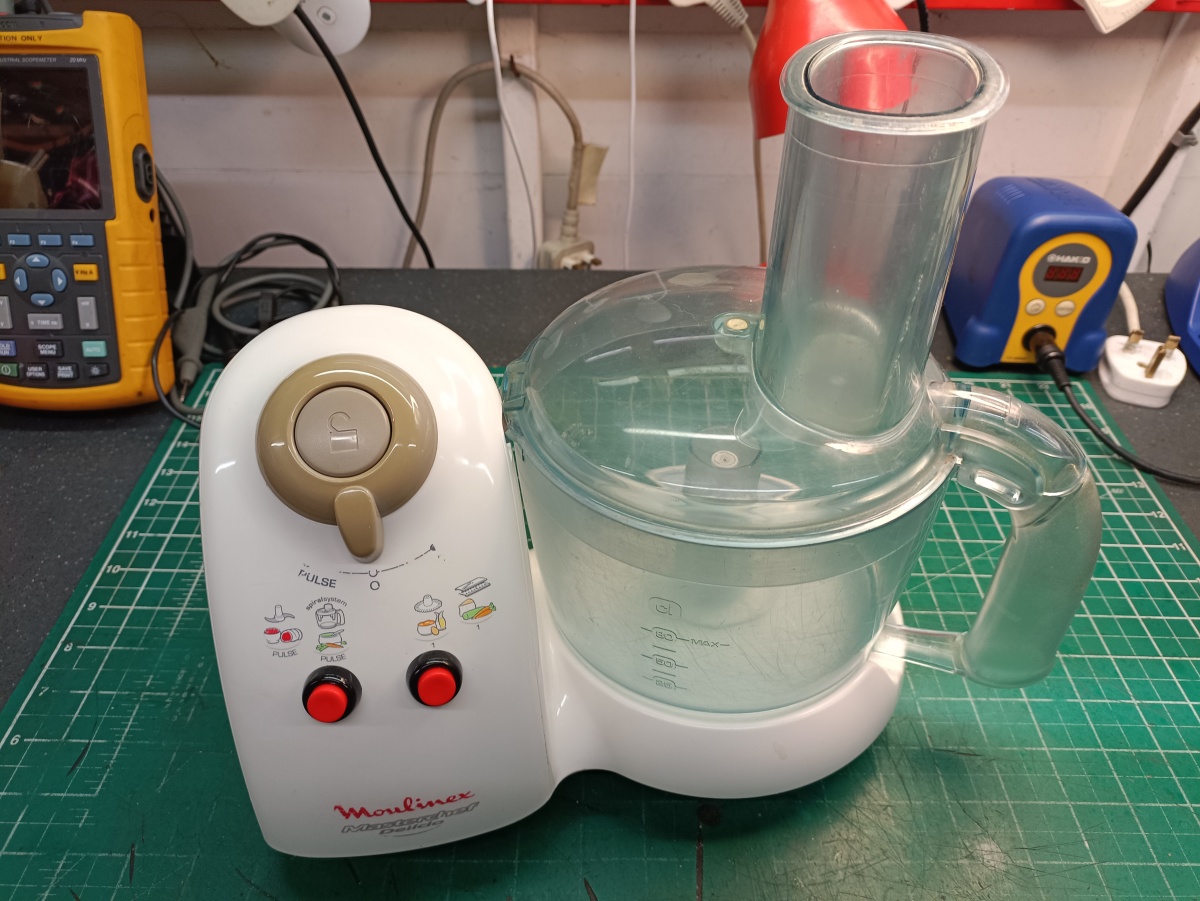
All this has reminded me about a recent such situation where my mum asked me if I could fix her broken Moulinex Delicio food processor, if it wasn’t too much trouble. 

The condition I ‘suffer’ from certainly doesn’t run in families and my mum was at first, ready to recycle the thing. But remembering all the cakes made with it over the years, especially ones made with my two daughters, seemed to put a different complexion on matters. So, I took the mixer away with me and put it on the workshop shelves, awaiting some attention.  At least there were other machines alongside, to keep it company.

Many food mixers tend to be large, heavy and bulky affairs which is OK for many, most of the time, but if you can’t manage the weight of something like an eleven kilo Kitchenaid Artisan every time homemade brownies are called for, something like this little light-weight Moulinex is ideal. So, two compelling reasons to keep the mixer; it’s lack of weight and some fond memories.

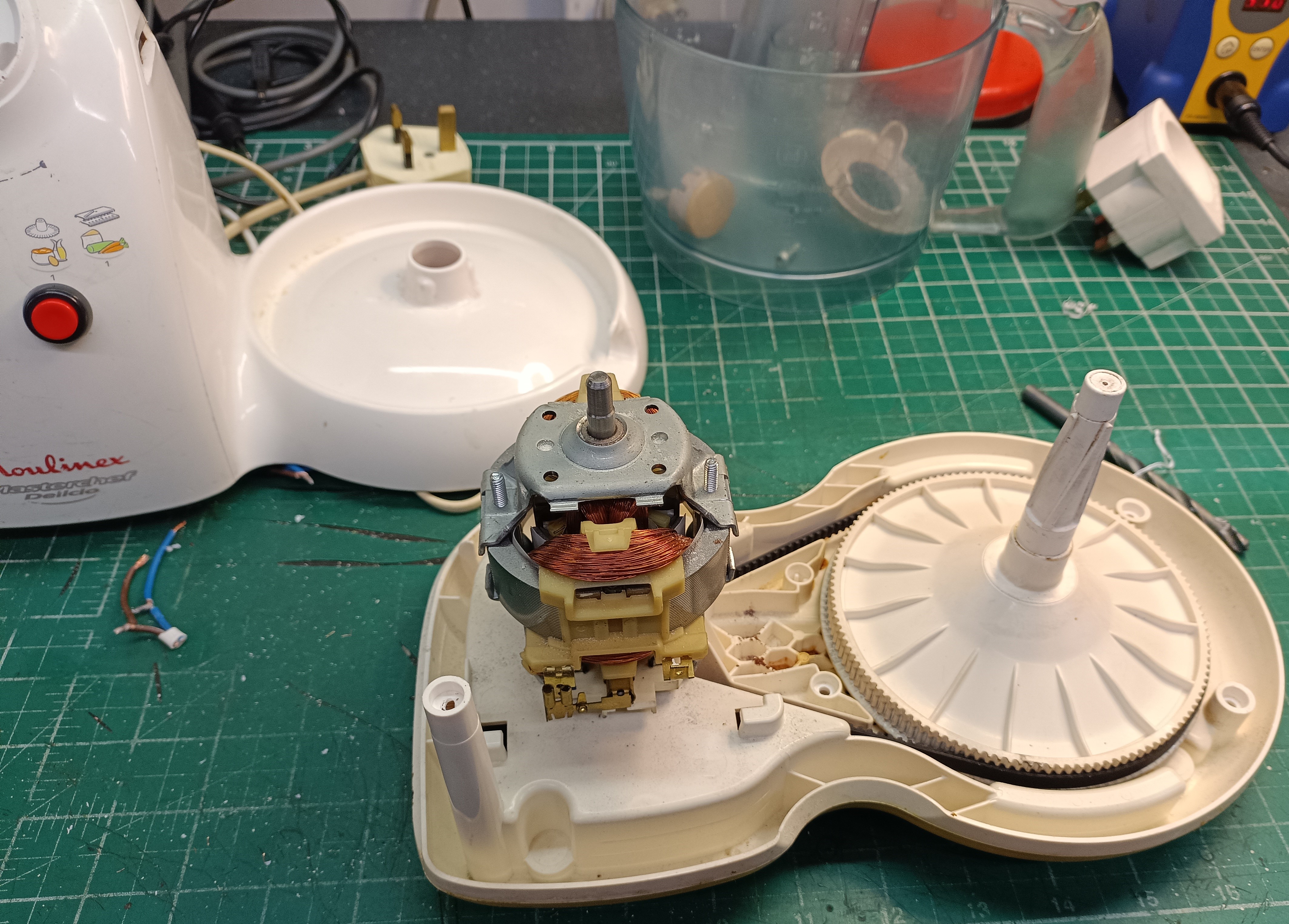
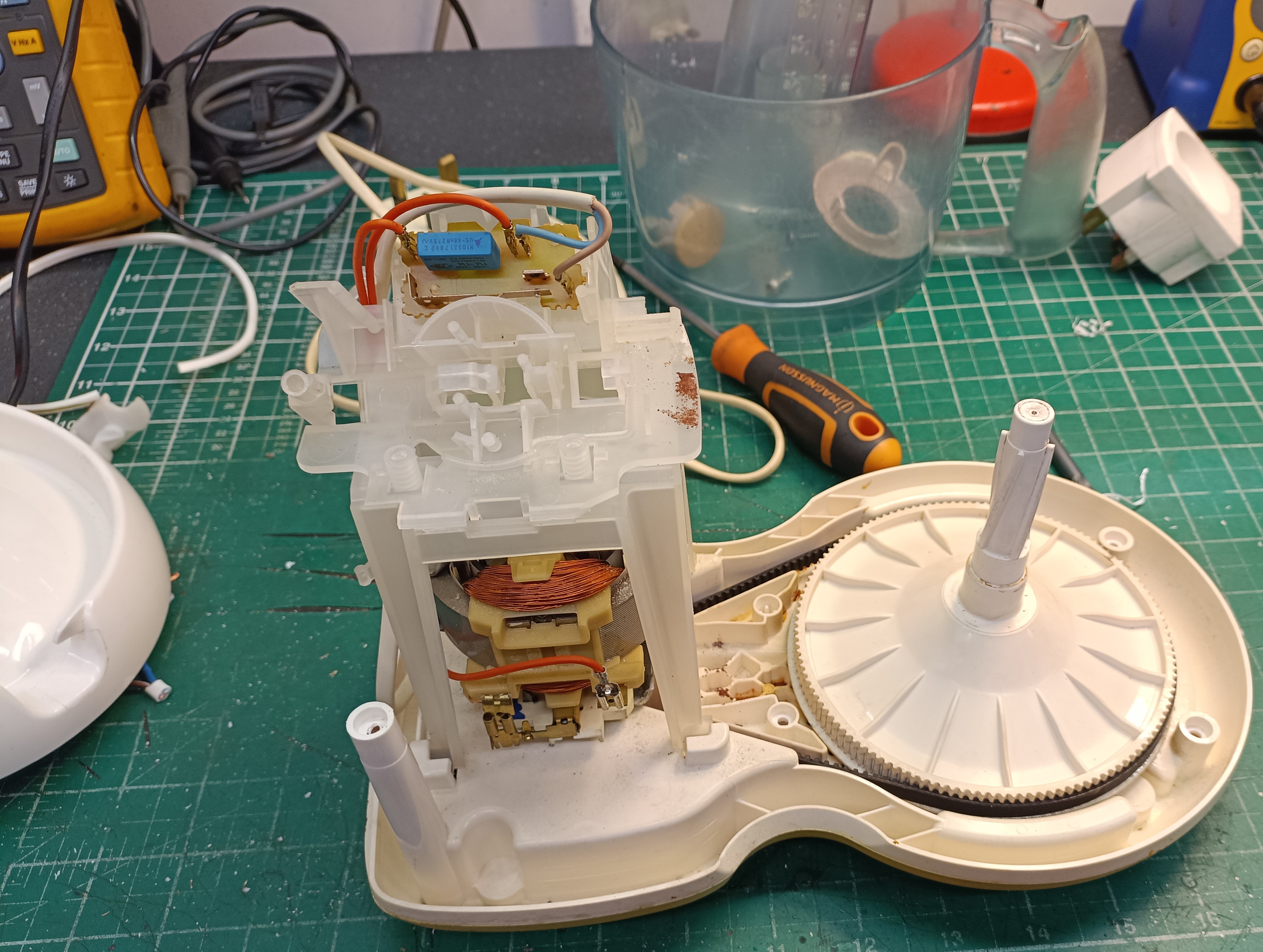
The problem was that the main on/off switch didn’t seem connected with the rest of the machine and to make things more complicated, the integral lid-lock was operated with the same button.  This part is therefore quite important since it might prevent one from shortening their fingers, by not allowing the spinning blades to ever come in to contact with wondering digits.

Now, I’m sure that this all seemed rather lovely in Moulinex HQ at the time, but small plastic switches connected with several thin moving parts combined with knocks and scrapes in a kitchen, is not going to end well.  As a matter of fact, Moulinex offered the offending switch assembly as a spare part until recently, so they must have known that the design was a bit iffy.  Sadly, I missed the boat and despite several attempts, I couldn’t find a replacement part anywhere. eBay revealed a couple of similar machines with faults, so it was back to the drawing board.

3D scanning and printing makes low-volume, but high-quality production a reality, and it’s really something that I need to get into, as I often have the need to copy rare, obsolete parts.  In time, I will. 

In this case, I did consider using one of the many online UK companies now specialising in this kind of thing, but the costs did not warrant it in this instance, so a new strategy was required.  I’ve spent many hours of my life browsing parts like this in catalogues, so I decided that a repair should be possible for under £10.00, using readily available, generic switches. Yes, that should be my budget challenge then, do the whole job for a tenner or under and since it was a family affair, no charges for labour!

The Delicio is a simple machine; no variable speed controller, just a single speed operation controlled either by latching or push-to-make switch.  It gets the job done quickly and without fuss. After a quick trawl of eBay, I opted for two small round, red button in black bezel switches with solder tags.  The switch series I opted for was available in push-to-make and latching, bingo!  And at £5.98 delivered, a total bargain.

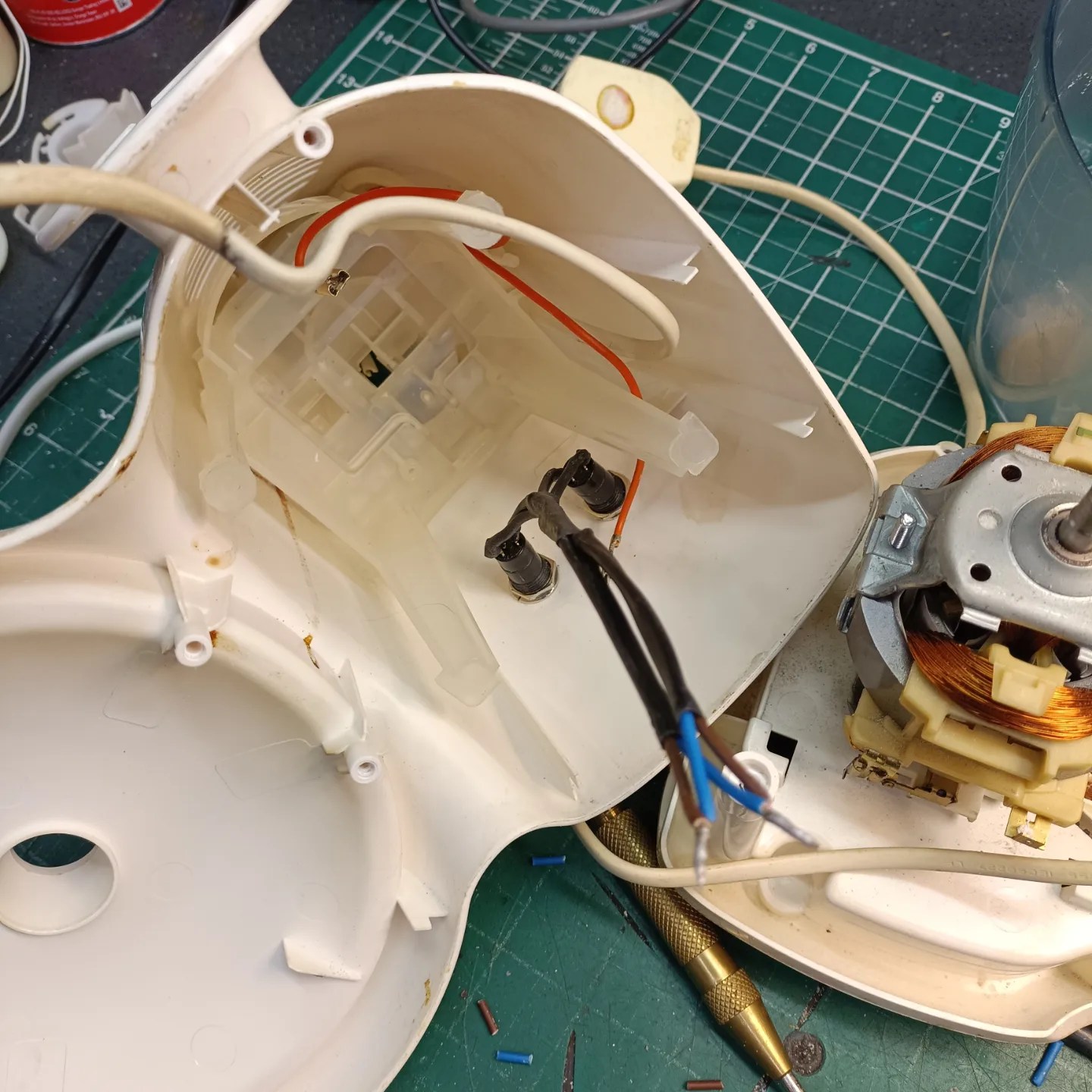
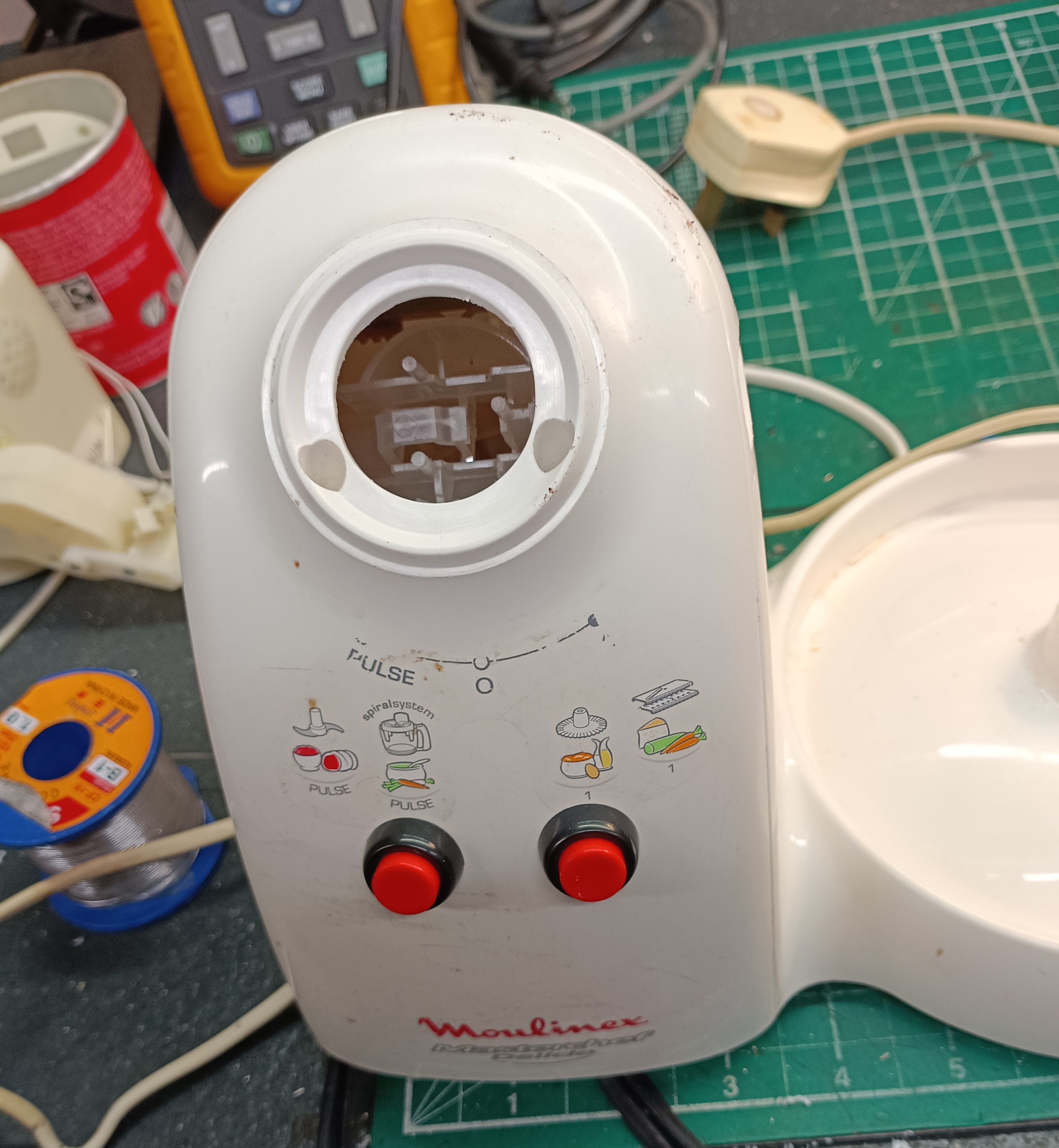
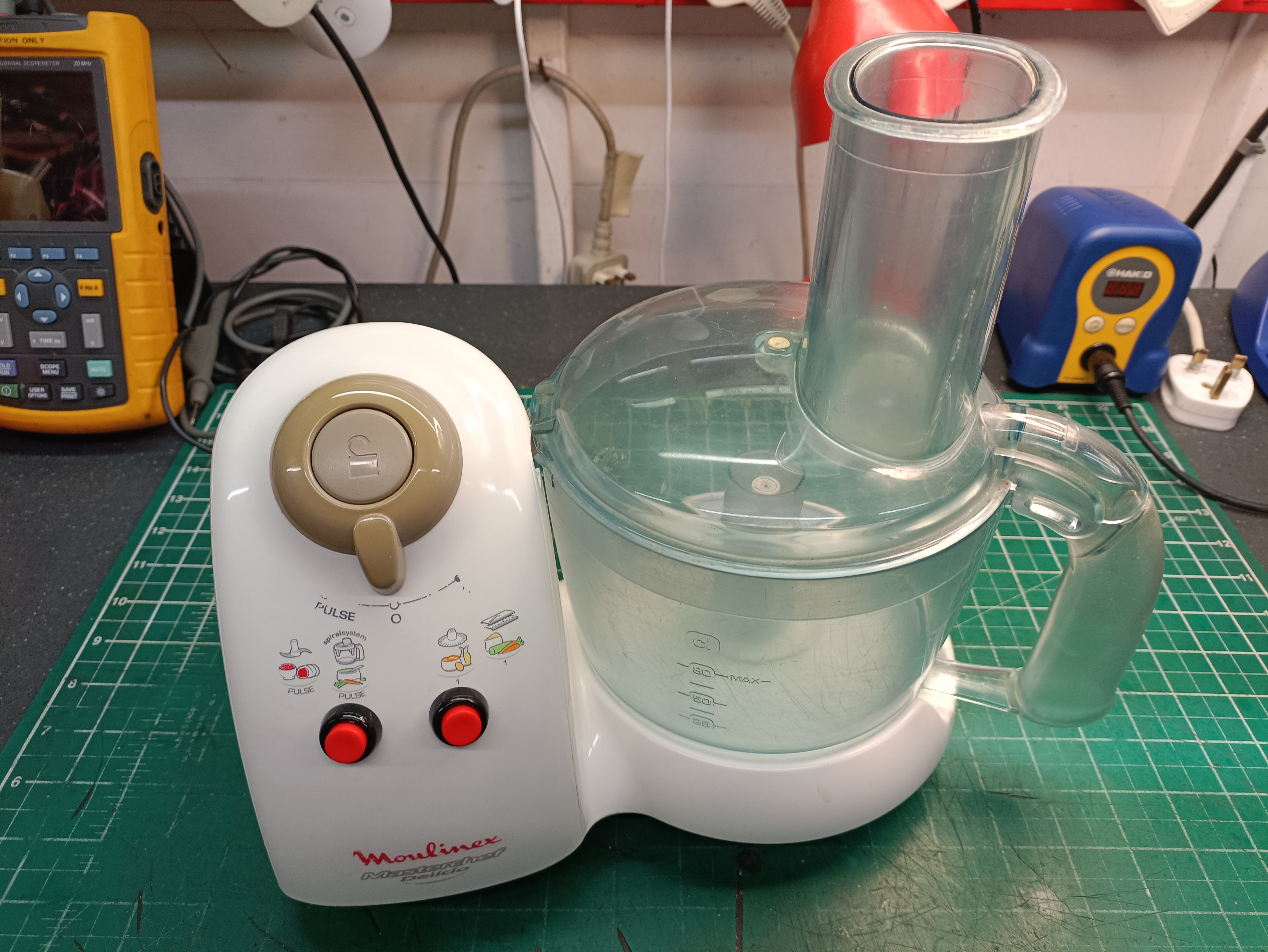
There’s something quite satisfying in selecting an item, taking it apart and then modifying it by way of repair, improvements or both, in such a way that differs little from its original design.  Subtle modifications or improvements, that the casual observer will never notice. If you look closely at the photos, I managed to line up the new buttons with the old printed text, to match the operation. Lucky.
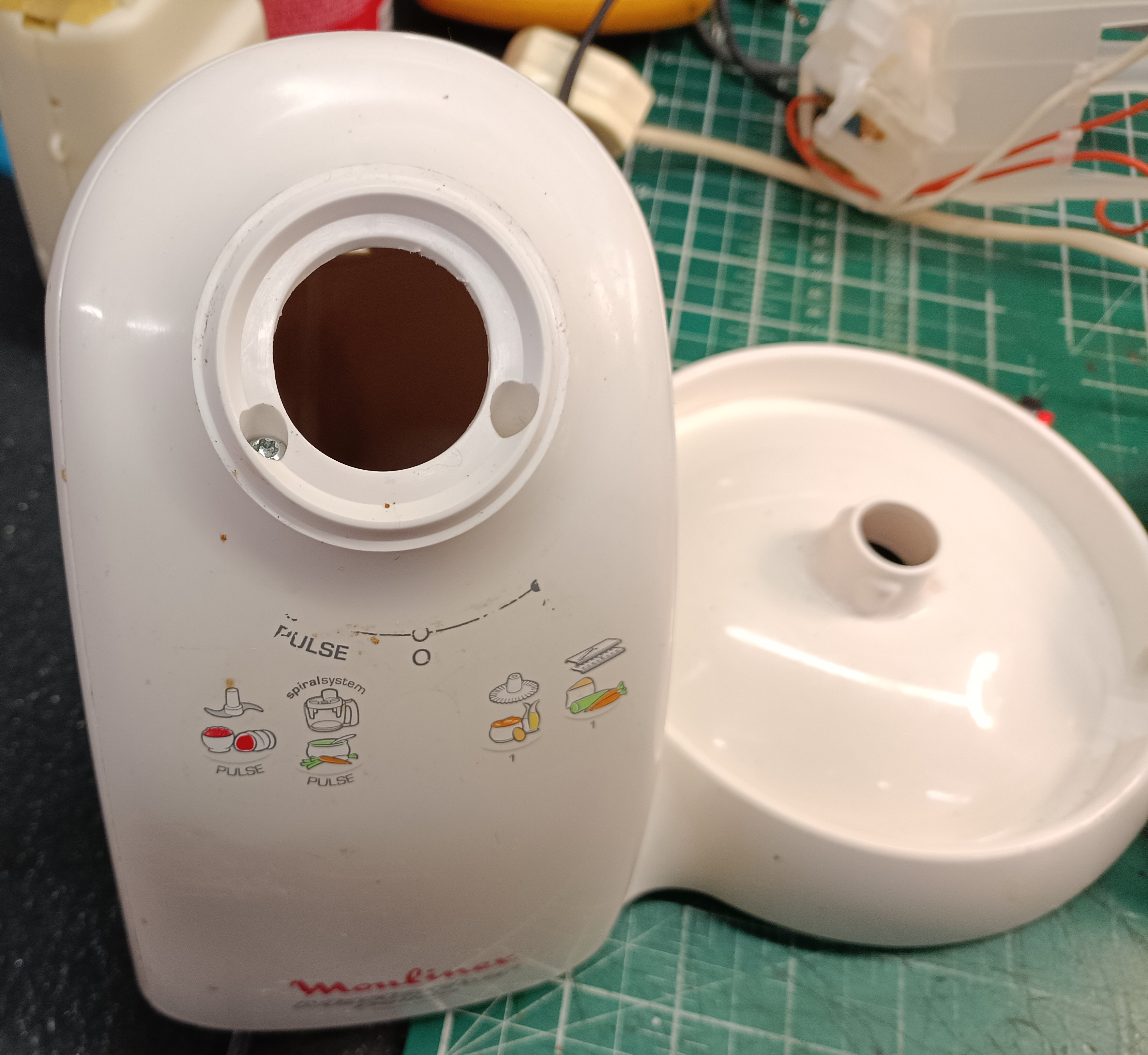
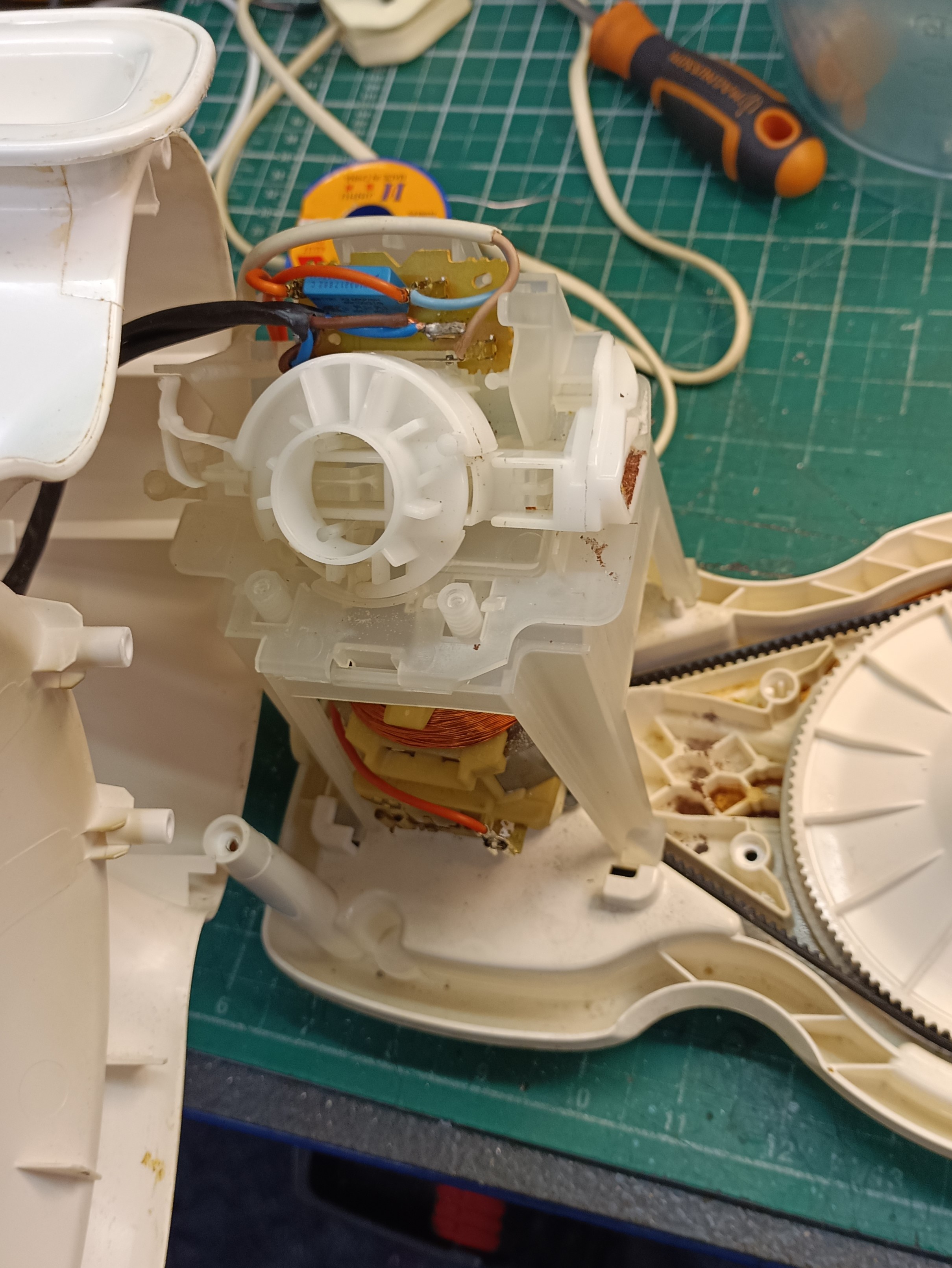
I won’t describe the repair in detail, suffice to say that I found a suitable location for the new switches in the machines’ chassis, drilled out the holes and then fitted them in place with the nuts supplied in the switches’ kit. No special tools required for this job really, just a selection of standard screwdrivers, some 0.75mm wire, heat shrink, cutters and a 12mm drill bit.  I already had some cable, I connected the new switches to the existing wiring harness, by-passing the original.

I was able to retain the original switches’ interlock by keeping the original switch in situ with a little epoxy resin.  This ensured both safety and the original aesthetic.  See what you think in the photos. I was quite pleased with it.

I completed the repair within an hour, which I almost forgot to report, included a wipe over and polish. And I managed it on only one cup of tea with a couple of my favourite ginger nuts.  Oh, and I didn’t go over budget. Any chance of a Vicky sponge, mum?!

Inside The Real Repair Shop 10: Storm in a Teacup

With the cost of energy soaring, people are suggesting ways to save money. This time in the Workshop, Matt compares three ways to boil-up to make a brew, a subject close to his heart!

In readiness for a winter of discontent, I’ve already removed the thermostat’s wiring and have prepared thick jumpers for the whole family, made with the added warmth that only loft insulation can bring.  I impressed myself with this stroke of genius and wonder why no-one else has ever tried this before? Can’t imagine why.

There’s a lot of talk about ways to save money on social media at the moment. One only has to do a bit of Googling to learn what we should stop doing or unplug next to save money.  There’s an old saying though that usually stands true: Don’t sweat the small stuff. 

Anyway, where was I? Back in the summer, I had an-over-the-wall conversation with my neighbour, Liz. It started off in the usual light-hearted manner, talking about this and that, when I heard a whistle coming from Liz’s kitchen, a noise which took me back to sometime in the dim and distant past.

Liz had switched to boiling water using a gas stove kettle and reliably informed me that it was ‘cheaper and greener’ to brew-up this way, rather than use her trusty modern kettle.  I very nearly lost my balance, leaning against our diving wall as I laughed and said, “that’s a load of old cobblers” – did I use cobblers, well something like that anyway.  With a slight frown of veiled raged from Liz, we both went off to carry on our evenings, but there was a piece of me worried that I’d offended dear Liz somehow.  What to do?  I’d almost forgotten about the whole thing until it came up again in conversation recently, but this time via another friend of the family.  Rather than scoff this time, I decided to investigate in a shed-like manner to work out who was right, me or Liz.

What is the most efficient way to boil water at the moment?

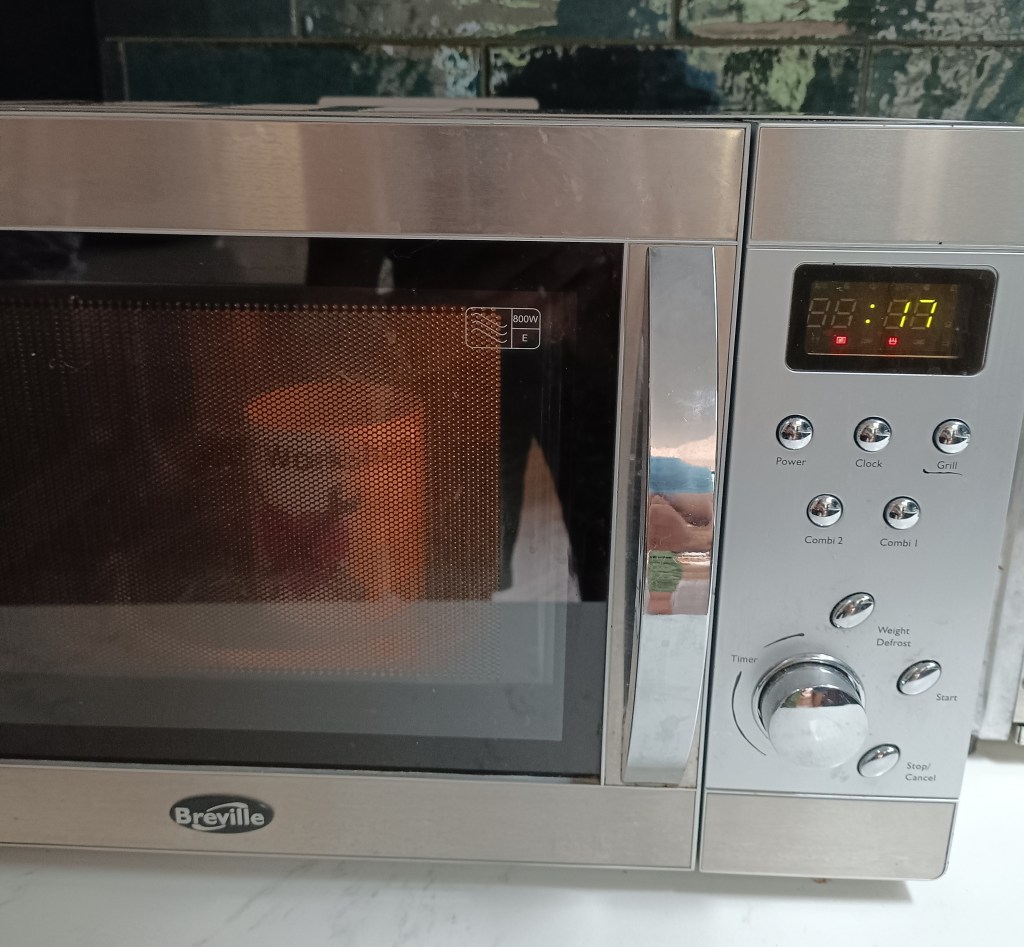
I decided to see just how much one cup (see photo) or three cups of water would take to boil using a modern 2500W electric kettle, a gas stove kettle (hob rated at 1500W) and a jug in an E rated 800W microwave.  Just for kicks.  Hasn’t everyone done this?  I used the same cup for the whole experiment.  Water was taken from the cold tap at room temperature.  I used the stopwatch on my phone and used a base rate of 29.48p/Kwh for electricity and 7.32p/kWh for gas. We’re with Eon and these rates seem to be ubiquitous at the moment. I timed how long either one cup or three cups would take to boil using each boiling vessel.  I started the test from the ‘on’ switch on the kettle, the gas ignited on the hob or the ‘on’ button on the microwave.  The test ended when the kettle switch turned off, the stove kettle first whistled and boiling bubbles were observed in the microwave.  By now, I’m sure you’re on the edge of your seats.

Everyone’s an expert these days and while I’ve done my best to make this a real-world test using a moderately scientific approach, I’m sure someone out there will drive a coach and horses through my method, but don’t bother, the results are astounding.

THE RESULTS ARE IN

Time matters

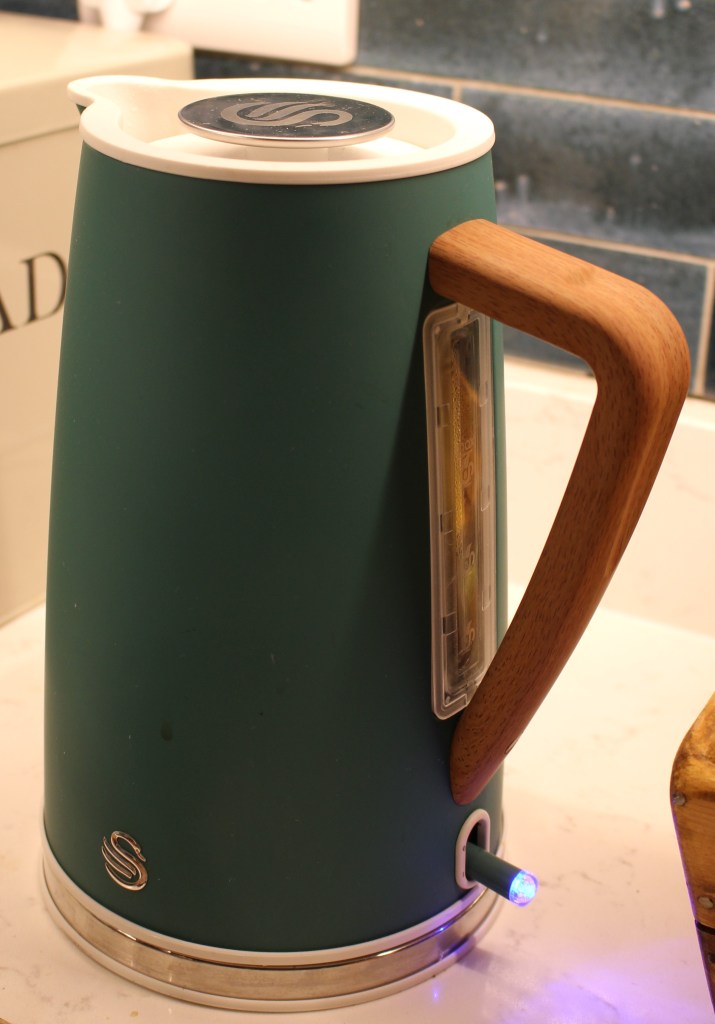
If you’re always in a rush and need your cuppa in a flash, then the only way to go is to use a modern electric disc-element kettle, like the one in the photo.  Using a microwave was second fastest, but not much faster than the very slow (by comparison) gas stove kettle.  One, nil, nil to the electric kettle then.

The real boiling issue – what did it cost?

Gas is cheaper than electricity on my energy tariff, which is a similar story for many other domestic customers at the moment. The microwave proved to be the cheapest method to boil one cup of water followed by gas in this test, but the results changed dramatically when three cups were boiled – a complete reversal in fortunes in fact. Three-way tie.

Environmental impact

What about the CO2 emitted? Perhaps the trickiest measure to nail down, but using Defra* approved conversions, based on the kWh for both fuels, it stands to reason that the electric kettle emitted the least CO2 as it was on for the least amount of time. The electric kettle triumphs overall.

*UK Department for Environment, Food & Rural Affairs

So, in conclusion, a gas stove may be cheaper to make a brew for one (at the moment), but one must be careful to measure the water required carefully and a slight increase in the tariff could see all savings easily eroded. The microwave was the wild card entry (my mate Paul’s suggestion) and it proved that it’s a reliable and cheap way of heating, if compared to the stove – for some forms of cooking. 

The bottom line is that a modern electric kettle will do the job faster, usually cheaper and cleaner than its rivals.  Time for a brew? Go on, treat yourself.

What’s in your man-drawer?

I discuss some basic tools that should be found in every home…

I think it was Michael McIntyre who first referred to the man-drawer as ‘the funniest drawer in the kitchen’, full of all the ‘that’ll come in handy items’ that we accumulate over time.  It’s brilliant observational comedy, and he nailed it so well that today, we often refer to the ‘man drawer’ as a thing in our homes.  The reason that the joke still resonates today is that it’s true.  But, what should be in a man (or woman) drawer for the conscious home maintainer?

Toolbox talk!

I want to talk about the tools that I think every home should have. Tools that could empower you with a fighting chance of having a go at fixing something yourself. The tools that will help you get the best from your appliances, make things last longer and help save you money.  If you already have a good selection of tools, skip the next paragraph and head straight to the ‘common jobs, useful tools to have’ section.  If not, do read on.

Let’s bust some tool-related myths. Firstly; tools are expensive.  Sure, like anything in life, you can pay through the nose for a set of screwdrivers or spanners if you want to, and there’s a tool quality to suit all circumstances and pockets.  But here’s the thing, for most DIY purposes, a reasonable set of basic screwdrivers costs less than a tenner and the best part is that you’ll get that money back again and again when they’re put to use.  Secondly, you need to be an ‘expert’ to use tools.  Well, a knife and fork are tools and we all (hopefully) use those, so don’t be deterred by people who might dissuade you from tackling jobs yourself.  I’m wary of the term ‘expert’ anyway.  In my experience, experts are a rare thing. Luckily, these days, most of us have access to YouTube.  Search for the thing that’s foxing you and the chances are that one of the 2.3 billion users have an answer. 

Before you reach for your phone to fix a dripping tap, if you haven’t got some already, you’ll need to arm yourself with some basic tools.  Below is a brief summary of tools I think every home should have and what I think they can be used for.  Some jobs are obvious, some less so.

Common jobs, 6 useful tools to have

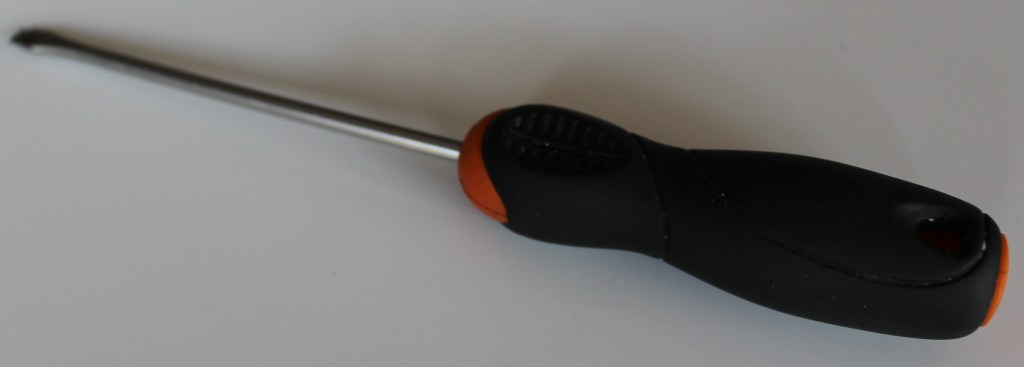
1:  Small flat-blade electricians’ screwdriver. I think it’s possible to write a thesis on the usefulness of a small flat-blade screwdriver, but I’ll spare you that for now.  For small change, you can buy one and use it to: Wire a plug, adjust light fittings, get batteries out of a gadget, scrape-off old paint from a surface, prising something open, cleaning nooks and crannies. A screwdriver like this has uses beyond screws.

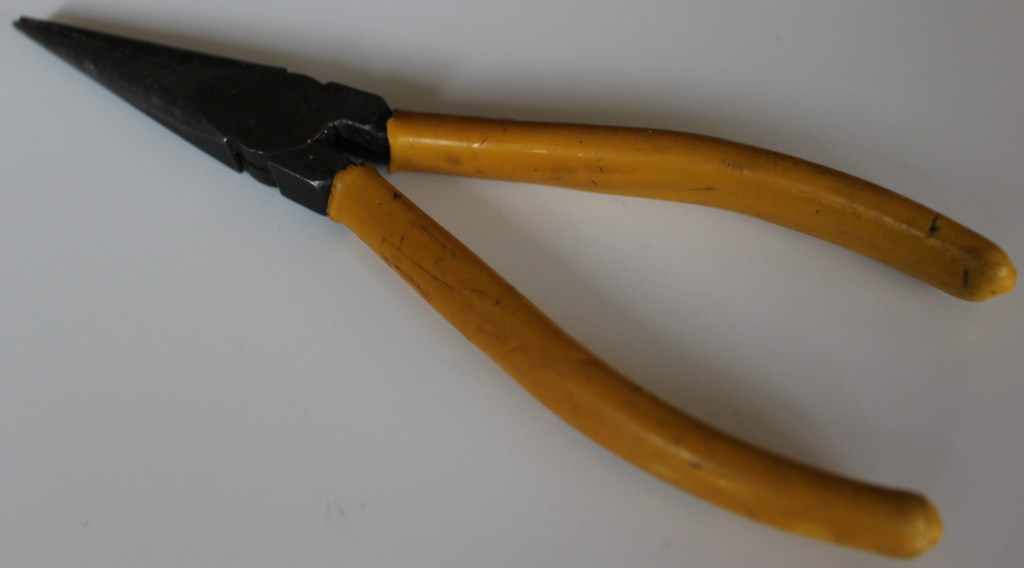
2:  Pliers and cutter combination tool.  Really useful for cutting and shaping garden wire, fixing Christmas lights, fixing kids toys, recovering items that have ‘fallen down a gap’ not forgetting cutting and trimming wire.  If you have a bike, a lawnmower, taps or doors in your life, then you need pliers and cutters as adjustment of those items will be needed from time to time.  Do it yourself, and you’ll save yourself time and money.

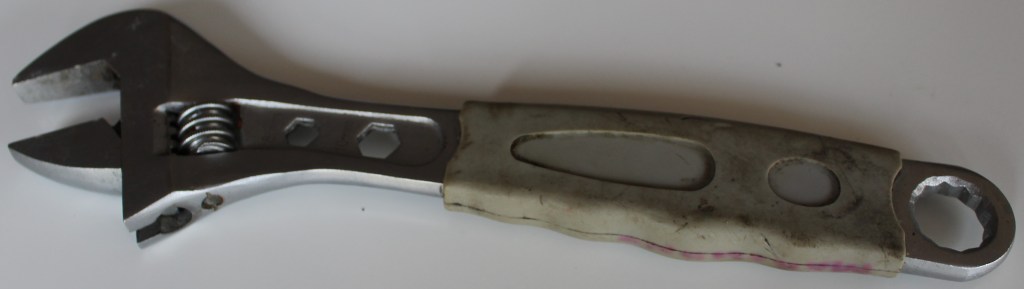
3: Adjustable spanner. If you don’t have space/ need/ cash for a full spanner set, consider an adjustable spanner instead.  OK, so they’re not ideal for regular nut-spinning, they are useful for those less frequently required tasks such as; adjusting a bike saddle, tightening a tap and adjusting a radiator valve.

4:  Cable ties and electrical tape. OK, not strictly tools, but honestly, I can’t think of more useful tool/fixings to have in your own man-drawer.  Cable ties and electrical tape has a million uses, are cheap, readily available and can fix so many things either temporarily or permanently including; tying cables, mending a broken handle on a hoover, fixing a backpack strap, mending a buggy, making a hook loop, tying a door back.  I always keep both in my mobile tool wrap to fix something, on the go. Get some today.

5:  Screwdriver set. If you’re going to tackle more jobs around the home, invest in one that contains at least; big and small flat blade screwdrivers and large, medium and small cross-head screwdrivers. From kitchen appliance maintenance, kids toy adjustment, door hinge fixing to furniture assembly, a basic screwdriver allows you to keep things running for longer and to do the job properly.

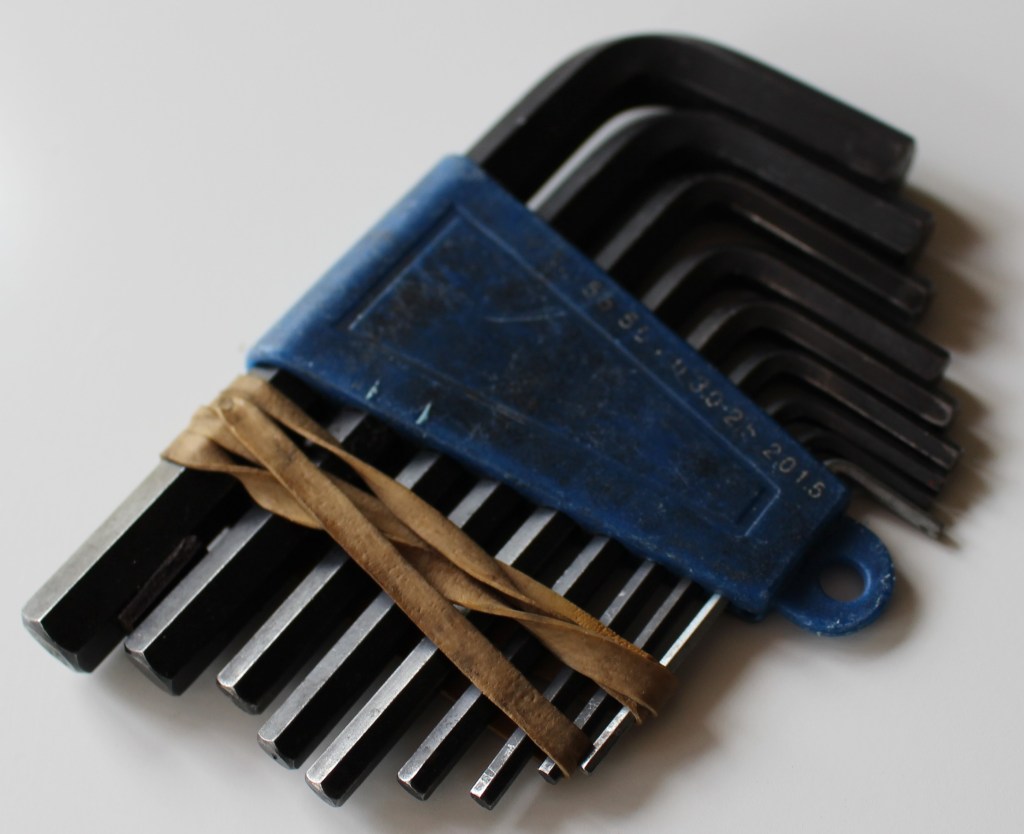
6:  A small set of Allen keys.  Allen ‘hex’ screws are used on lots of things now including bikes, home appliances and children’s toys. As with the other tools mentioned here, you don’t need to spend a lot of money to get a set of keys that will open many common household objects.

Don’t worry if you don’t yet have the knowledge to fix your coffee machine, just a quick search on YouTube will show you how to remove the doofer to access the widget to clean the thingy. Using a few of the aforementioned tools will allow you to complete the job like a pro, saving you cash, saving the appliance from landfill and giving you the power to do more.  Just remember to unplug from the socket first.  Tools also make excellent gifts, so the next time you’re wondering what to buy a loved one, have a sneaky peek in their man drawer, make a note of what’s missing for your gift list.

Until the next time… Do you have a DIY fixing related matter that you’d like me to explore in this section?  If so, please get in touch.

A KitchenAid struggling to make dough!

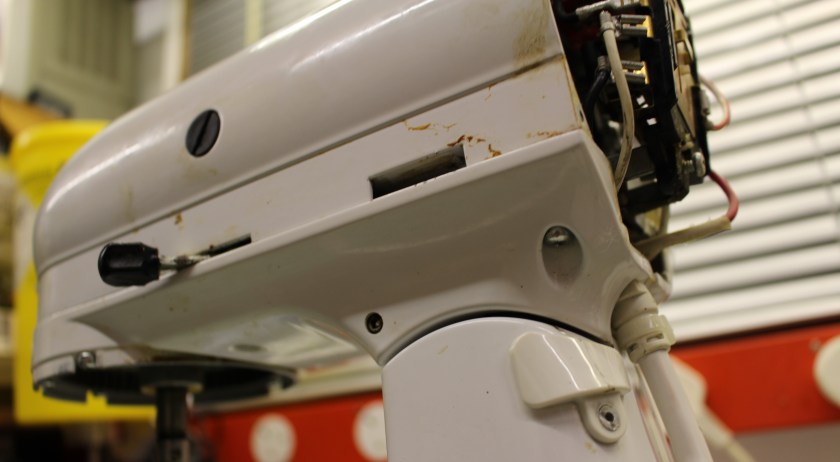
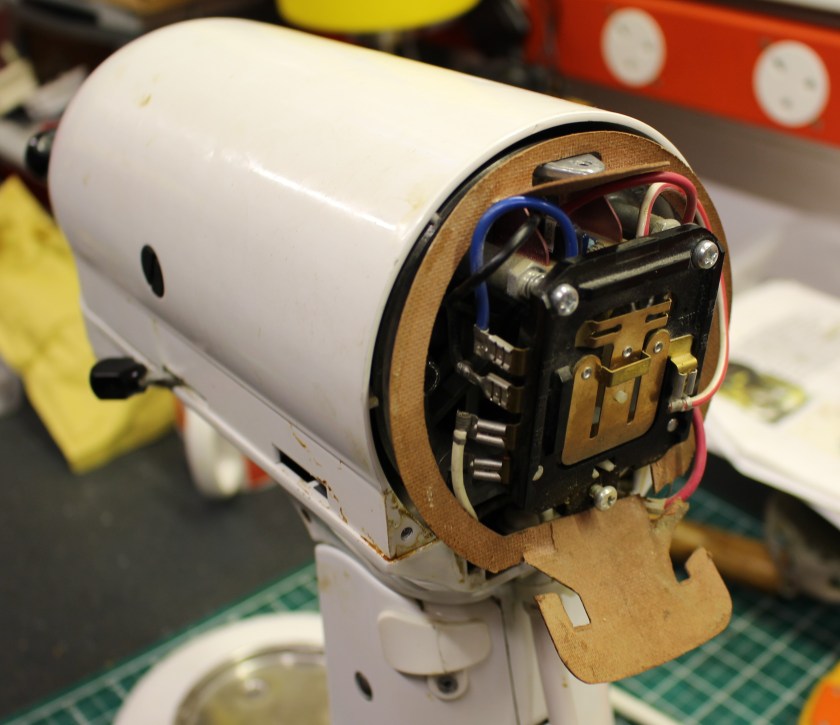
A KitchenAid 5K45SS gets a light overhaul and a replacement worm gear assembly to restore it to its former glory.

My regular reader might gasp in horror to learn that this time on ‘Diary of a Tinkerer’, I’m writing about the opposition. What? Uh?

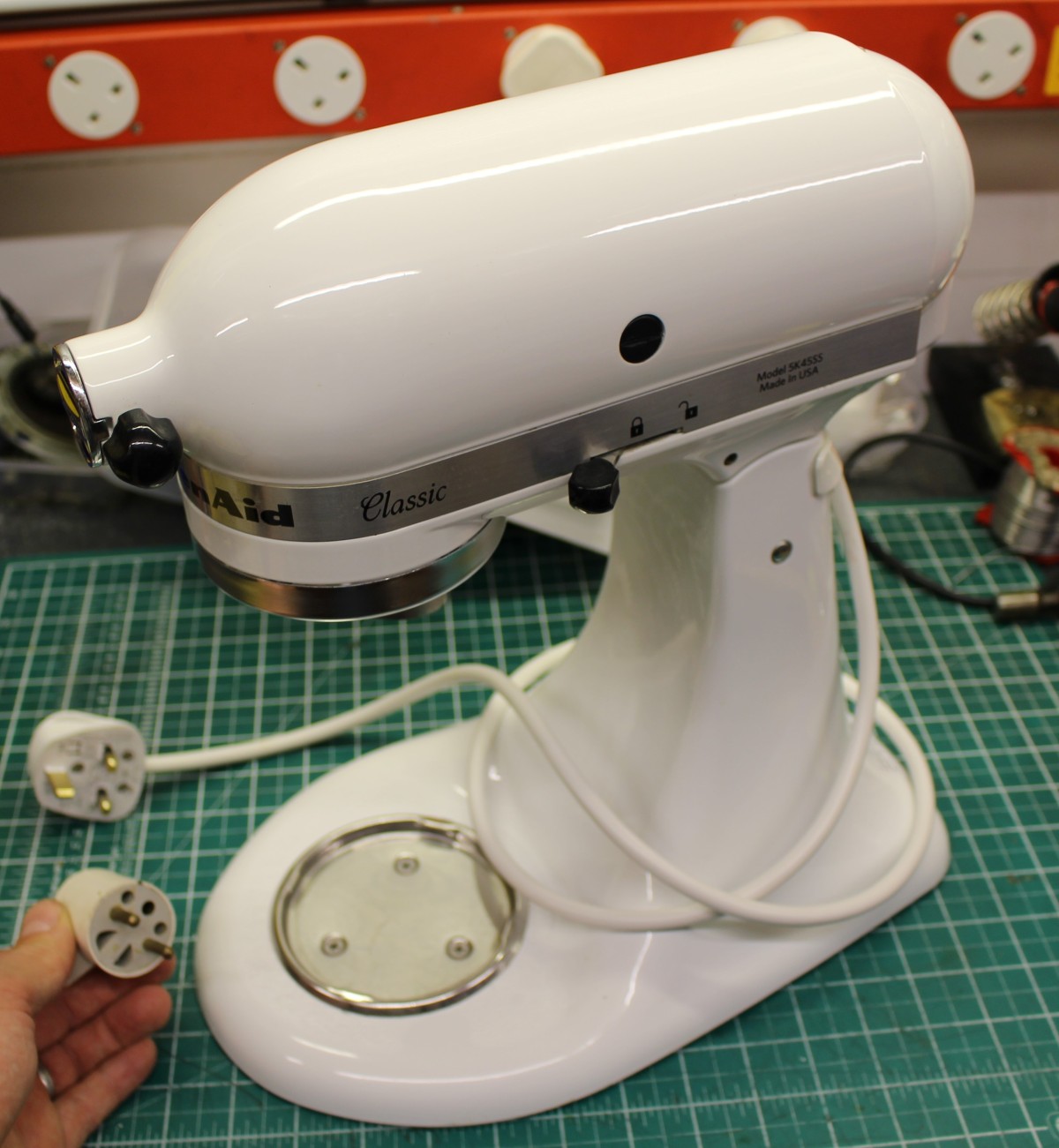
Yes, I’m writing about a KitchenAid stand mixer and not a Kenwood Chef for a change. Are these things all the same? Well, I guess that the model you see below does a similar job and has a wide range of accessories, making it extremely versatile, like a Chef. However, the overall package is different and while the Chef has gently evolved over 70-odd years in production, the original KitchenAid remains closer in function and form to its original design. That’s not to say that a KitchenAid bought today is the same as one bought 50 years ago, far from it. New models benefit from modern motors and modern manufacturing processes, but it’s all packaged with a retro-feel. I’m not a fan of retro-stylised items as they’re often not as good as the original. However, the KitchenAid is different as it’s truly original, well-made and not just playing at it.

KitchenAid stand mixers have been around for over 100 years and the basic design has its origins in the US with the Hobart Company. The KitchenAid brand is now owned by the Whirlpool Corporation, and current models feature robust construction and hard wearing finishes ensuring long-service. KitchenAid machines are durable, stylish and available in a wide selection of colours.

Now, I know what you’re thinking; Do I prefer the Kenwood Chef or my new American friend, the KitchenAid? Well it’s hard to say. I love the construction and the sound industrial design of older Chefs, and it must be said that recently made models have lost some of that robustness with the use of overcomplicated electronics and gimmicky LED lighting.

Over the years in production, KitchenAid machines have retained a ‘function over form’ approach and appearances have changed little. KitchenAids are simple to operate, durable and can be repaired easily. It’s an example that ‘modern Kenwood’ and other manufacturers, could learn from.

KitchenAid’s mantra is simple; Less is more, so much so, that it’s now a design classic in its own right.

Make and model: Whirlpool Corporation KitchenAid 5K45SS

Fault reported: Rough running, noisy operation

Cost of replacement machine: £500

Manufacturer support (in the UK): 6/10

Cost of parts (for this repair): £37.98 (Worm gear assembly 240309-2)

My time spent on the repair: 2 hours

Tools needed: Screw drivers, pliers, cutters, drift for planet pin

Sundry items: Food safe grease

Cleaning materials: Silicone spray, damp cloth, cleaning spirit

Repair difficulty: 4/10

Beverages: 2 X teas

Biscuits consumed: 3 X ginger nuts

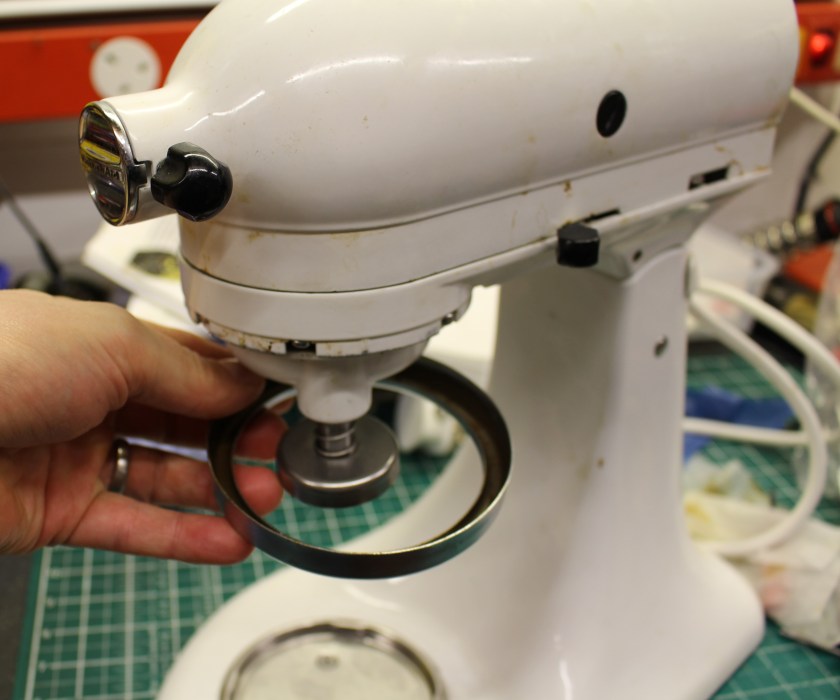
This machine you see in the photos came into the workshop with a few issues. Firstly, it needed a good clean; something that machines visiting me get whether they need it or not. I always make sure that things are polished or paintwork touched-in, if possible. It’s a little bit of OCD that’s hard to shake-off. I think I want all my customers to see what’s possible with a little-workshop love!

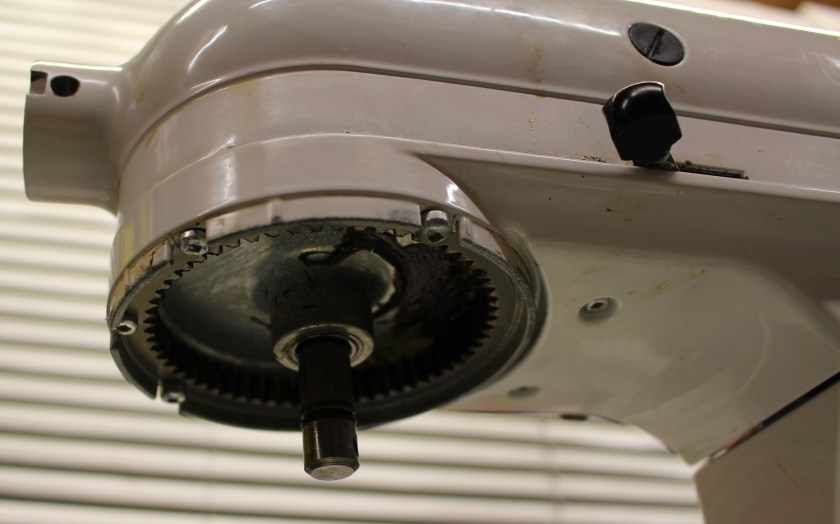
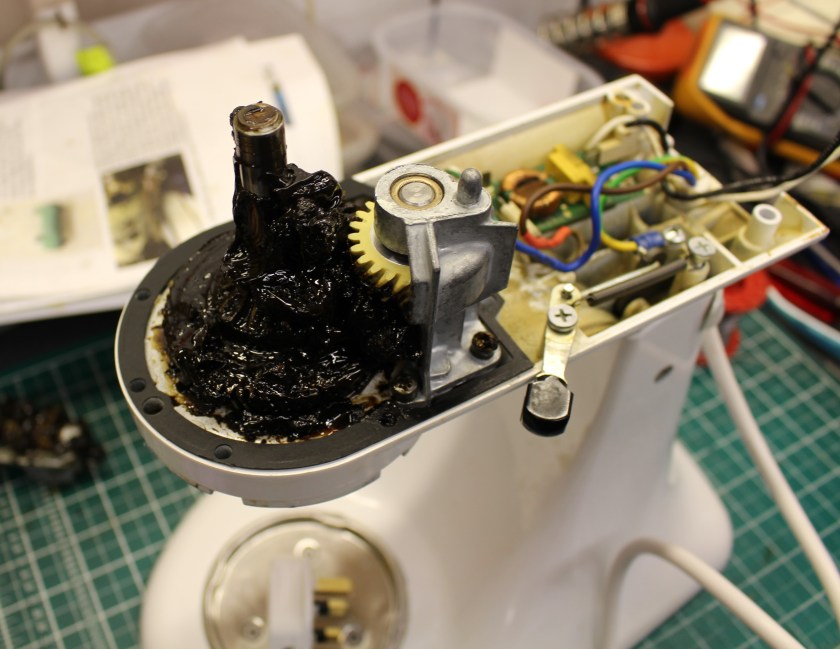
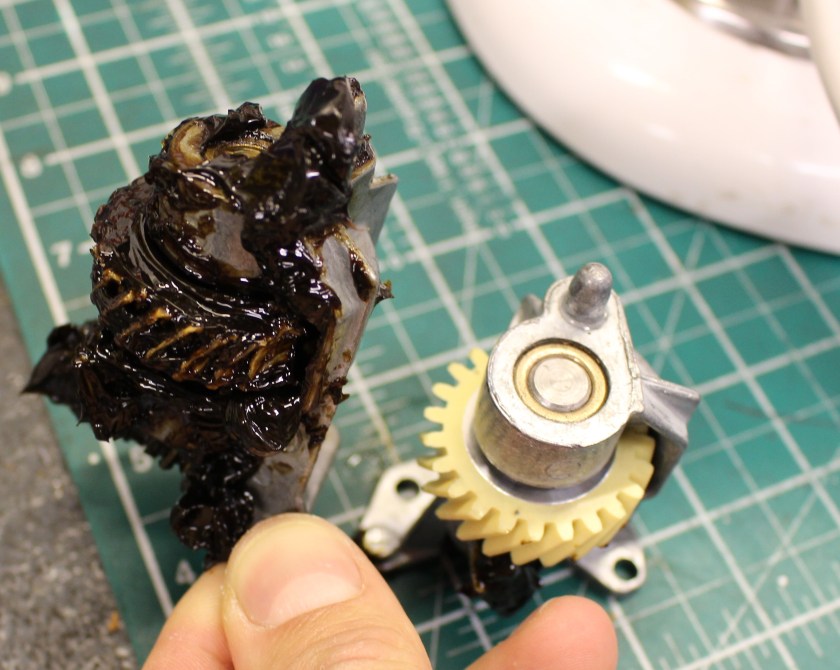
Cleaning over, and on to the main problem. This machine had had a hard life making lots of dough, or maybe cement, and routine use day-in day-out had taken its toll on the worm pinion gear assembly. I’m sure you’ve heard of that. In Plain English, it’s the bit that transfers the movement from the motor to the bit which drives the mixer’s blender.

The machine was rough in operation and the planet wheel (where the mixer bit attaches) was intermittent. No good for dough. No good for anything.

Due to their simple construction, dismantling just involves one cross-head screwdriver and a small drift and soft hammer. Simple stuff, no Torx screws or plastic tangs to worry about here, just traditional assembly techniques, which means that the machine can be repaired many times over a long-life, without fixings becoming loose and tired.

The worm pinion gear assembly (I hope you were paying attention) is available as a complete unit with bracket and bearing or available as seperate components. On an item like this, I prefer to replace the whole assembly as parts like this wear together. It’s personal choice at the end of the day, but sometimes, it’s a false economy to replace a spare part within a spare part, as I’ve found out to my cost, during many a previous repair.

As a side point; the worm gear on this machine can be described as a sacrificial part. The motor output is made of toughened steel, the gear that drives the mixer bits is forged steel, both hard and tough. The worm gear is made from Nylon, which is hard wearing, but less so than the other moving metal parts. If the machine is overloaded, it’s the worm gear that will fail first before the other, more expensive parts. Many manufacturers do this and it’s recognised as good engineering practice.

With the gear replaced, just a couple of screws to remove and replace, together with new (top-up) grease applied and the mixer worked well, once again.

The last job on this machine was to replace the very short flex and Euro plug fitted. This particular machine had been owned by an American couple, living in Europe but were now living in England and therefore required the correct UK specification plug. Together with the correct three-core flex, this machine was ready again to earn its keep.

Time to make a pizza I think.

Another Smoking Kenwood Chef Excel A902/ A904

I’ve repaired a few Kenwood Chefs recently, but this one seemed worthy of a mention on these pages as it’s slightly different to the ones I’ve repaired so far.

Many Kenwood Chef accessories are usable on Chefs from all eras, due to logical thinking by the designers over the years and this is something to be applauded as it reduces waste.  For example, the beater on a 1970s machine will fit one from today.  An interesting fact for any occasion.

I’ve repaired many A701s and A901s, but this was the first A902/4, so I thought I’d share some of my repair experience in order to help others.

The owner contacted me explaining that she’d been using the family’s cherished Chef to make a cake when a plume of smoke started coming from the mixer.  The smell was bad and she’d quickly disconnected the unit from the mains.  The owner then contacted me to ask ‘was the Chef worth repairing’?  Of course it was!

I suspected the infamous speed control components which tends to fail with age.  However, this model featured extra components all mounted on a neat printed circuit board (PCB) which is fixed near the motor.  A reasonably priced repair kit, with new rubber feet was available online so I ordered one up straightaway.

Opening up the A902/4 is a similar job on many Chefs and after removing a few screws, the motor and gubbins is available for maintenance.

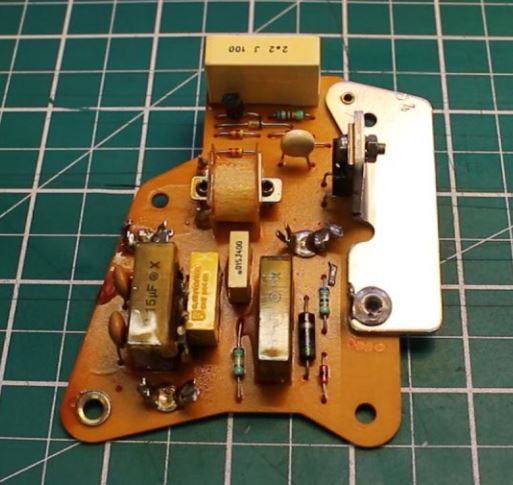
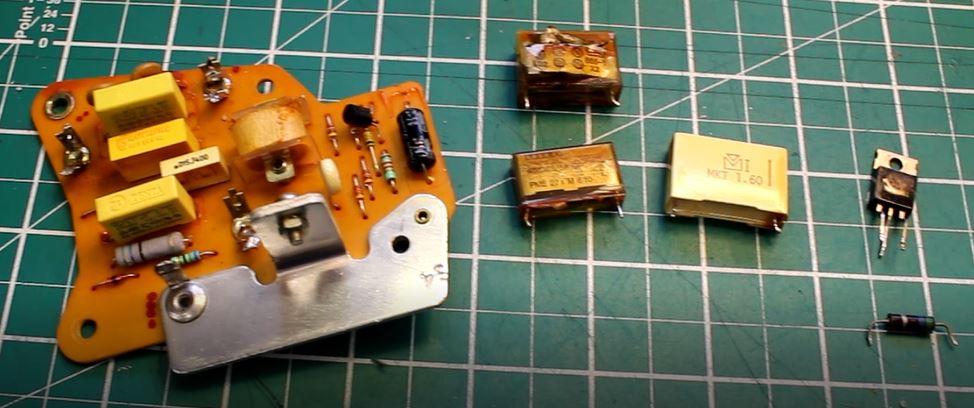
As suspected, two out of the three capacitors on the PCB had blown visibly, due to crystallisation and general fatigue, so these needed to be replaced.

PCB
FixItWorkshop, May’18, Kenwood Chef Excel A902/A904, PCB before work.

PCB renewed
FixItWorkshop, May’18, Kenwood Chef Excel A902/A904, old and new components.

As all the components are PCB mounted, each part must be de-soldered first, contacts cleaned before re-assembly which is time consuming, but satisfying and even though I’ve done this kind of work many times before, I always take a couple of photos and mark wires with a pen or label, as it’s very easy to make mistakes later.

The kit included replacements for the faulty bits, plus some additional parts which should be changed as a matter of course.  I also chose a kit with replacement rubber feet for the machine as the ones fitted had squashed ‘flat’ with age, a very common problem with the Chefs of this vintage.

New components fitted, the motor ran sweetly once again, without smoke, wobble or extra noise.  It’s worth noting that the A902/4 is quieter than earlier Chef models and is probably worth seeking out if you’re in the market for a second-hand unit.

Another ‘happy little Chef’ leaves the workshop.


Cost of new machine: £400 plus.  Cost of new parts:  £15.24 plus my time.

Gaggia Classic machine wakes up to smell the coffee.

A Gaggia Classic Coffee Machine repair…

A simple repair…. That’s what I thought when a friend asked if I could look at his Gaggia Classic Coffee Machine, which had developed a nasty little leak when in use.  The coffee wasn’t all that good either, due to the lack of pressure available, caused by the leak.  In short, it needed attention.

IMG_3616
FixItWorkshop, Oct’17, Gaggia Classic Coffee Machine, with a leak.

The owner had already bought a repair kit consisting of the main seals/ gaskets that commonly fail, so I thought no problem, take to pieces, replace seals, happy days.  Er, not quite.

Once I’d stripped the machine down, pretty straightforward on these machines, the bare parts were exposed, which revealed the problem.  After being fired up briefly, not to make coffee I’d like to point out, water could be seen escaping from the boiler unit, a alloy bodied lump of metal, split in two halves, held together by 4 screws.  The boiler, as the name suggests, heats the water up with one heating element  and creates steam for the steam wand, with another element, all part of the same module.

After separating the boiler halves, I traced the leak to a faulty gasket, but crucially, one side of the mating faces was heavily corroded and unlikely to re-seal with a new part fitted on its own.  Remedial action was required.

This model is a few years old and a replacement boiler is still available on a few websites and prices vary from £40 to £60 at the time of writing, so at that price, starts to make the cost of repair unviable.

I decided that the face with the corrosion had enough material to withstand loosing some, so went about sanding the worst of the corrosion away before gradually moving on to  smoother and smoother sandpaper.

Because Gaggia Classics are fairly common, I decided to video this repair process as I suspect the corrosion affects many machines with age and just fitting a repair kit won’t cure the problem on its own.  See below.  I hope it helps anyone else with the same machine facing the same problem.


Once I was happy with the new finish, I fitted a new gasket and reassembled the boiler.  After putting it all back together, I purged several tanks of water through the system to remove debris, before attempting a cup of coffee.  Once filled up with my favourite Lidl coffee, the machine performed well once again with no leaks and the end product tasted great.

Cost of a new machine:  £249.00.  Cost of repair:  £4.50, plus time.