
Inside The Real Repair Shop 10: Storm in a Teacup

With the cost of energy soaring, people are suggesting ways to save money. This time in the Workshop, Matt compares three ways to boil-up to make a brew, a subject close to his heart!

In readiness for a winter of discontent, I’ve already removed the thermostat’s wiring and have prepared thick jumpers for the whole family, made with the added warmth that only loft insulation can bring.  I impressed myself with this stroke of genius and wonder why no-one else has ever tried this before? Can’t imagine why.

There’s a lot of talk about ways to save money on social media at the moment. One only has to do a bit of Googling to learn what we should stop doing or unplug next to save money.  There’s an old saying though that usually stands true: Don’t sweat the small stuff. 

Anyway, where was I? Back in the summer, I had an-over-the-wall conversation with my neighbour, Liz. It started off in the usual light-hearted manner, talking about this and that, when I heard a whistle coming from Liz’s kitchen, a noise which took me back to sometime in the dim and distant past.

Liz had switched to boiling water using a gas stove kettle and reliably informed me that it was ‘cheaper and greener’ to brew-up this way, rather than use her trusty modern kettle.  I very nearly lost my balance, leaning against our diving wall as I laughed and said, “that’s a load of old cobblers” – did I use cobblers, well something like that anyway.  With a slight frown of veiled raged from Liz, we both went off to carry on our evenings, but there was a piece of me worried that I’d offended dear Liz somehow.  What to do?  I’d almost forgotten about the whole thing until it came up again in conversation recently, but this time via another friend of the family.  Rather than scoff this time, I decided to investigate in a shed-like manner to work out who was right, me or Liz.

What is the most efficient way to boil water at the moment?
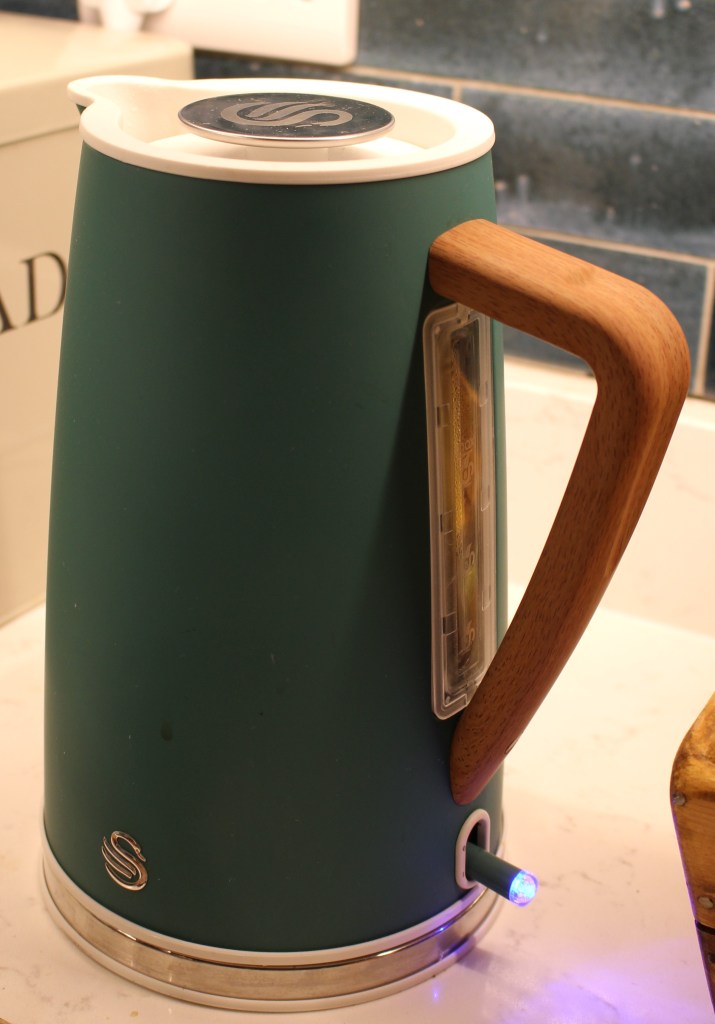
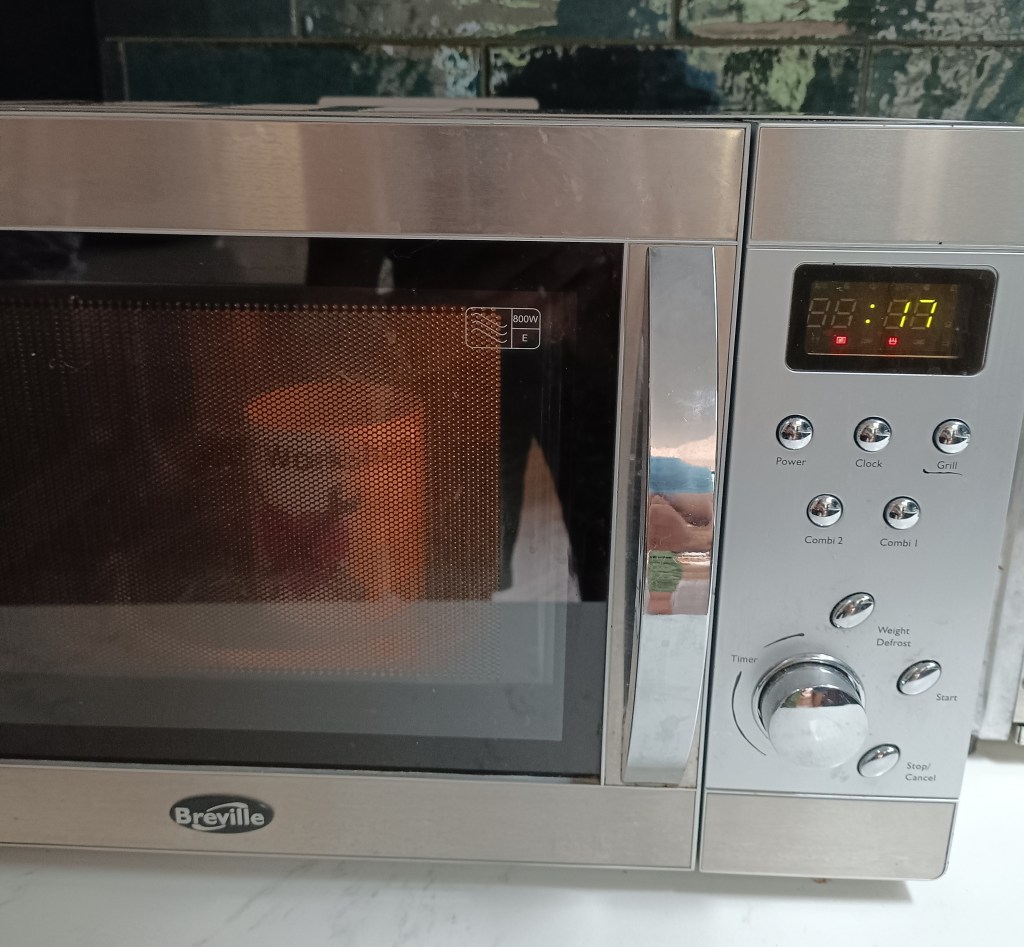
I decided to see just how much one cup (see photo) or three cups of water would take to boil using a modern 2500W electric kettle, a gas stove kettle (hob rated at 1500W) and a jug in an E rated 800W microwave.  Just for kicks.  Hasn’t everyone done this?  I used the same cup for the whole experiment.  Water was taken from the cold tap at room temperature.  I used the stopwatch on my phone and used a base rate of 29.48p/Kwh for electricity and 7.32p/kWh for gas. We’re with Eon and these rates seem to be ubiquitous at the moment. I timed how long either one cup or three cups would take to boil using each boiling vessel.  I started the test from the ‘on’ switch on the kettle, the gas ignited on the hob or the ‘on’ button on the microwave.  The test ended when the kettle switch turned off, the stove kettle first whistled and boiling bubbles were observed in the microwave.  By now, I’m sure you’re on the edge of your seats.

Everyone’s an expert these days and while I’ve done my best to make this a real-world test using a moderately scientific approach, I’m sure someone out there will drive a coach and horses through my method, but don’t bother, the results are astounding.

THE RESULTS ARE IN

Time matters
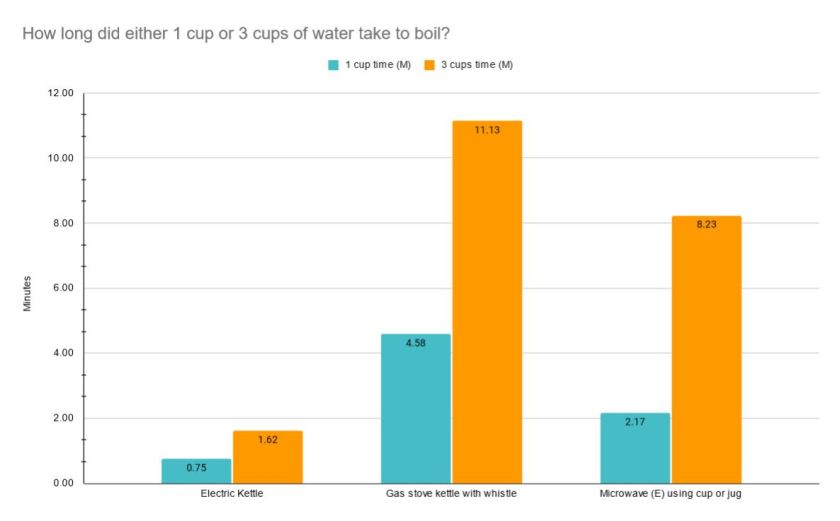
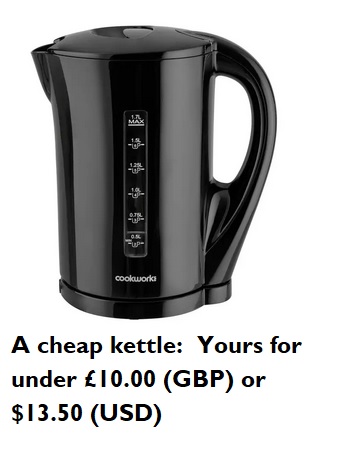
If you’re always in a rush and need your cuppa in a flash, then the only way to go is to use a modern electric disc-element kettle, like the one in the photo.  Using a microwave was second fastest, but not much faster than the very slow (by comparison) gas stove kettle.  One, nil, nil to the electric kettle then.

The real boiling issue – what did it cost?
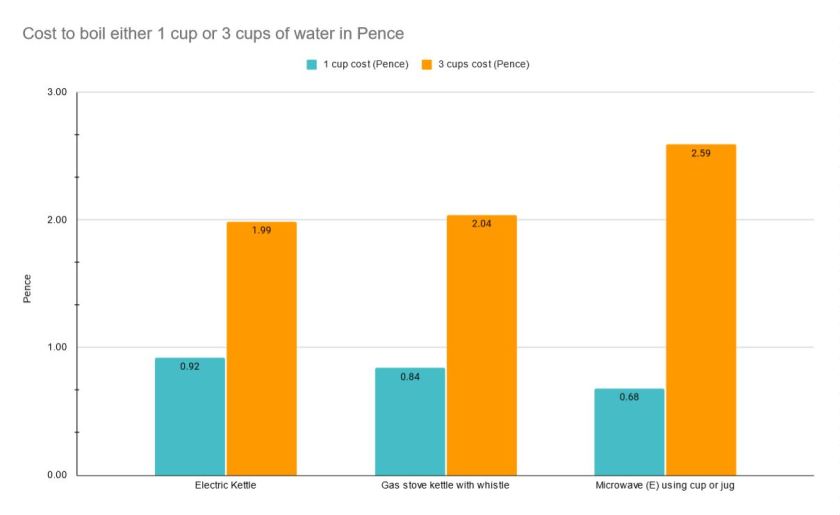
Gas is cheaper than electricity on my energy tariff, which is a similar story for many other domestic customers at the moment. The microwave proved to be the cheapest method to boil one cup of water followed by gas in this test, but the results changed dramatically when three cups were boiled – a complete reversal in fortunes in fact. Three-way tie.

Environmental impact
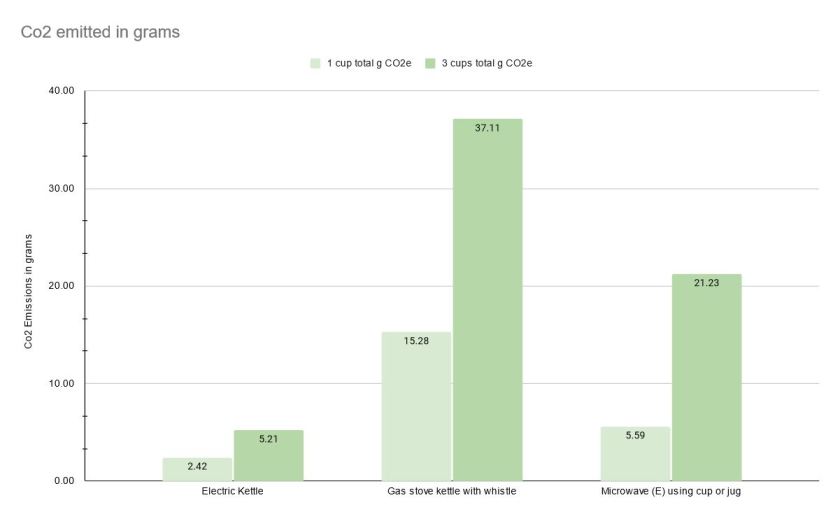
What about the CO2 emitted? Perhaps the trickiest measure to nail down, but using Defra* approved conversions, based on the kWh for both fuels, it stands to reason that the electric kettle emitted the least CO2 as it was on for the least amount of time. The electric kettle triumphs overall.

*UK Department for Environment, Food & Rural Affairs

So, in conclusion, a gas stove may be cheaper to make a brew for one (at the moment), but one must be careful to measure the water required carefully and a slight increase in the tariff could see all savings easily eroded. The microwave was the wild card entry (my mate Paul’s suggestion) and it proved that it’s a reliable and cheap way of heating, if compared to the stove – for some forms of cooking. 

The bottom line is that a modern electric kettle will do the job faster, usually cheaper and cleaner than its rivals.  Time for a brew? Go on, treat yourself.
Inside The Real Repair Shop 1

They do make them like they used to. You just have to know where to look.

Think back 30 years, and if you can’t, ask anyone over the age of 42. In the place you grew up, how old was the kettle? It might seem a strange question, but as a (slightly odd) child, I noticed stuff like that. I can fondly remember my parents’ own Russell Hobbs K2 kettle, which had been given to them as a wedding gift and was still going strong after they divorced, 25 years later. Unlike their marriage, the kettle was well engineered, robust and easy to mend.

Russell Hobbs advert for the seminal K2 kettle, familiar to many. Image taken from Google Images, FixItWorkshop is not the copyright owner.

Not long ago, long service was expected from appliances and my friends and relatives had similar experiences. Trust me, I’ve asked them. Buying spare parts was also a thing. You could easily repair kettles of that vintage with basic tools and without the need of a yet-to-be-invented online video. Hardware shops would stock cost-effective spare parts like elements and rubber seals to keep your kettle running for longer, but over time, this type of thing has become the reserve of nerds like myself.

During the last 40 years, the market for small appliances such as vacuum cleaners, toasters, kettles and much more has become congested with laughably cheap goods, and while the prices can make items accessible, it’s usually a case of ‘buy cheap, buy twice’. 

Manufacturers have perfected built-in obsolescence to such a degree that they can time your product to fail, just after the warranty expires. Bad for many reasons, but the main thing is that a £15 toaster thrown out after two years will probably end up as landfill. There are free, environmentally kinder disposal routes available from your local council in the UK, but many people just don’t bother.  Sad, but true.

It’s still possible to buy something well-designed and robust that will be supported by a responsible manufacturer, you just need to know what to look for.

Do you really need it?

Just because your friend has a kettle with an interactive disco display controlled by their iPhone, do you need one?  Probably not.  No one does. Google ‘the best kettle’ and you’ll find products that have more knobs and whistles than a power station.  This makes them more complicated and likely to go wrong in the future and contain more precious metals, increasing their environmental impact.  Remember what you need the product to do. Keep it simple.

How long will it last, will it be any good?

This is a tricky one to quantify as lots of things affect that.  But ask yourself, is a kettle costing a tenner going to be a family heirloom to hand-down?  Probably not.  It will boil water, it will make a lot of noise, it will be inefficient.  Take  customer reviews on Amazon with a pinch of salt. Trust organisations such as ‘Which’ to guide you on matters of performance and longevity before handing over your hard-earned wedge.

Can I get help when I need it?

Many retailers and manufacturers are not set up to take care of your product once it’s in your hands.  At the end of your twelve-month warranty, is there a local agent or are there spares available to fix your product, when you need it?  Before making a purchase, do some online research on your chosen toaster manufacturer.  Do they have a help desk, can they supply reasonably priced parts, are there engineers out there who can help repair your item? Responsible manufacturers are out there…

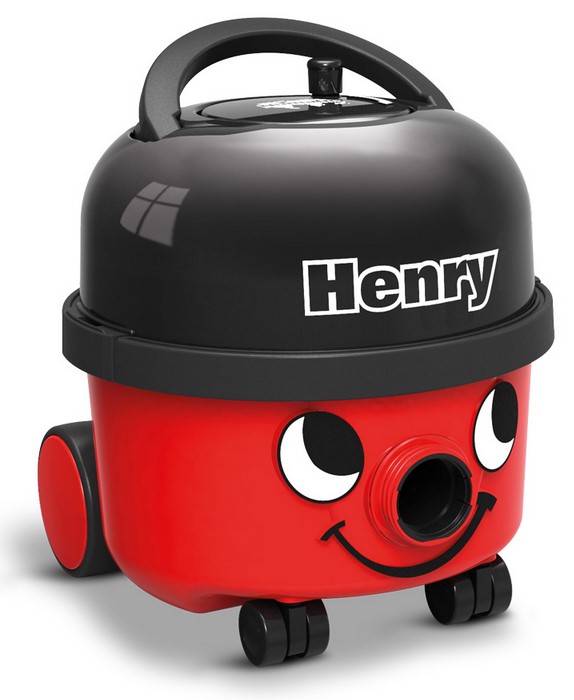
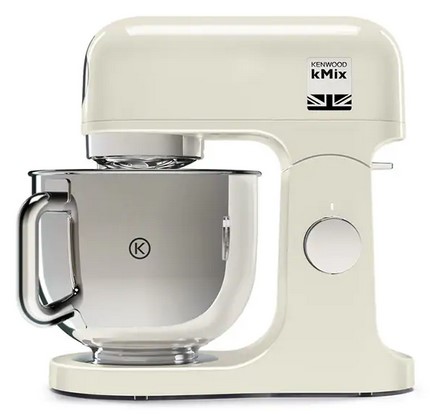
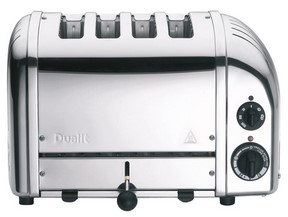
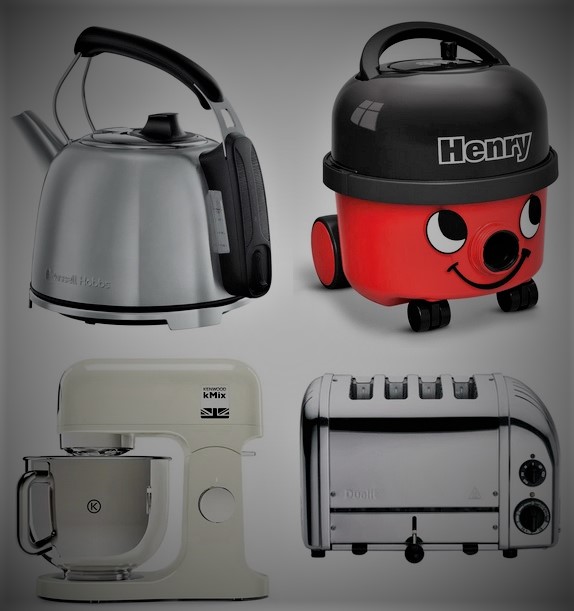
Russell Hobbs K65, Henry HVR160 vacuum cleaner, Kenwood Kmix KMX750 Dualit classic toaster. What do they all have in common? All have reasonable support from the manufacturer, after purchase.

Give yourself time to work this stuff out, and you’ll end up replacing your appliance less often.  Better still, you’ll be able to fix it when it goes wrong, saving it from becoming waste. You’ll also be able to pass it on when the time comes, which is a far better thing to do.  If buying new isn’t an option, don’t be afraid to buy quality appliances second-hand from places like eBay, Facebook and Gumtree.  It might not come in a new box with a receipt, but it’ll still be decent, without costing the earth.

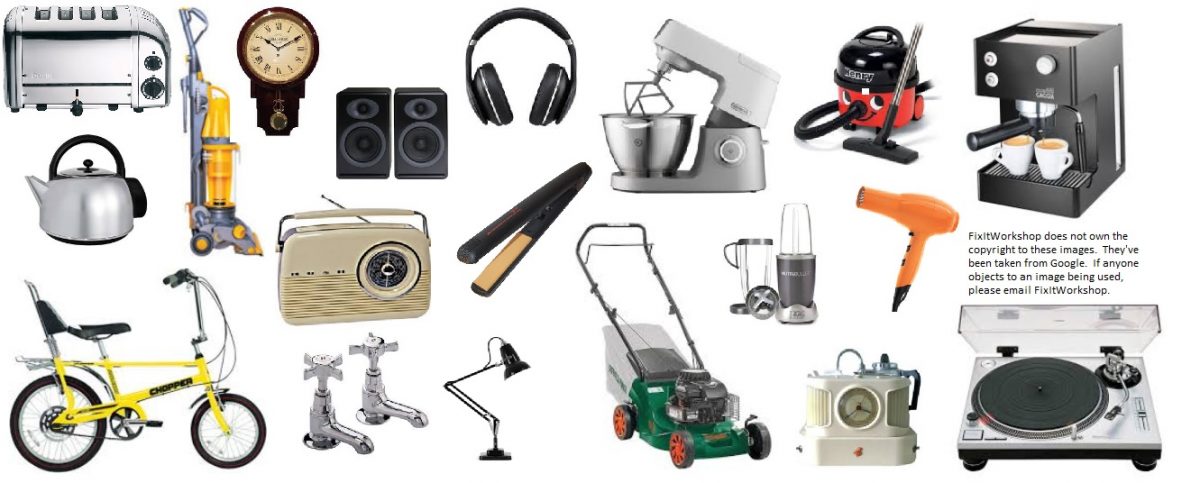
Matt or Fixitworkshop is not affiliated with any of the products shown in this article.  The items displayed are for illustration only, but were chosen with care based on Matt’s own repair knowledge and experiences.

Repair, kettles and er, the Citroen 2CV

Less is usually more. Simpler devices can mean repair is more likely in the event of failure.

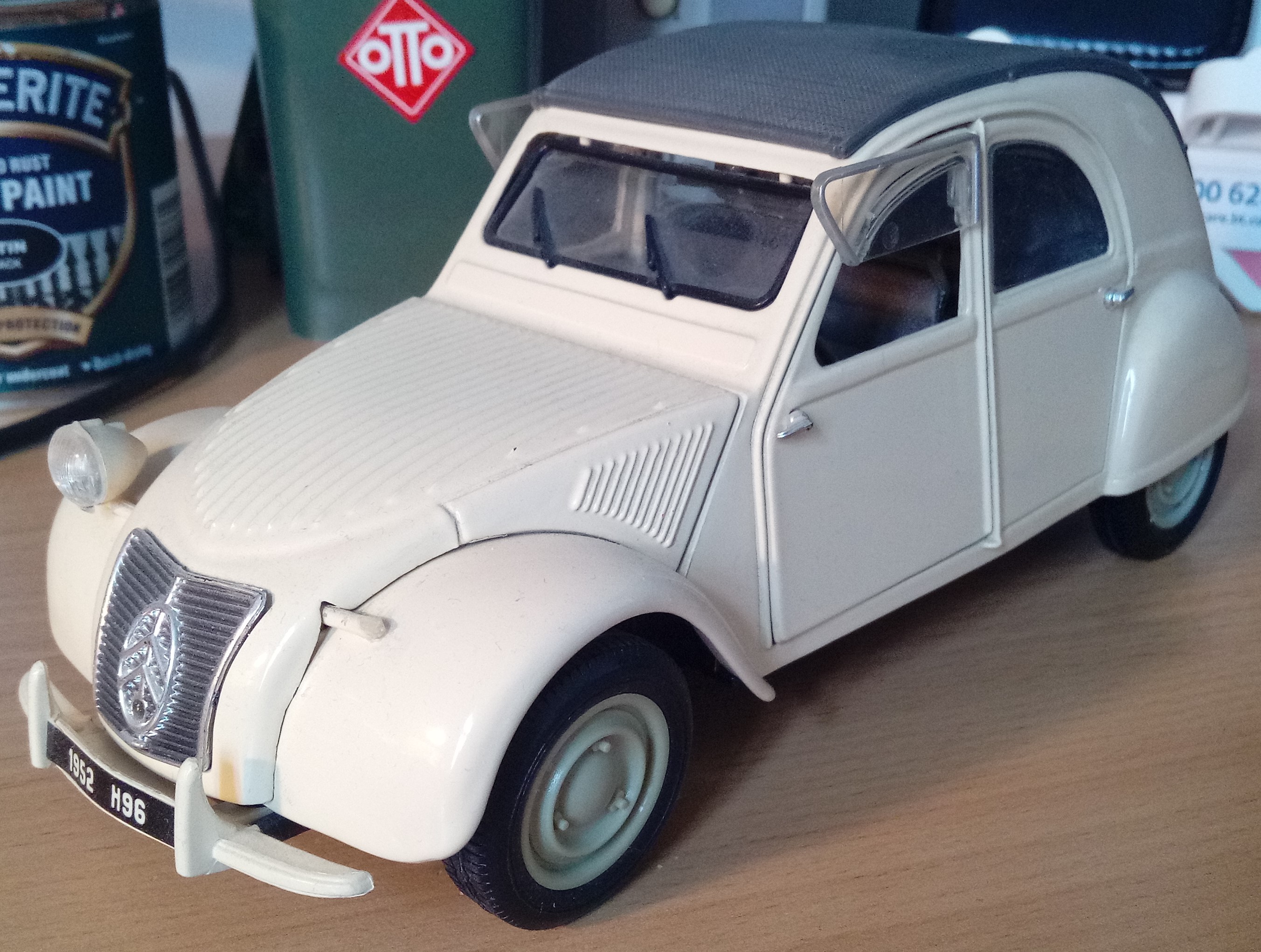
I keep a model of a Citroen 2CV car on my desk at work.  It’s about 30-odd years old and it’s a bit battered due to an incident involving a shelf, my old cat and an 8ft drop, but that’s another story.

IMG_20200704_122535
FixItWorkshop, Worthing, July’20, The 2CV (AZ series)

The 2CV is there to remind me to keep things simple, to the point.

To me (and many others) the 2CV represents pure function over form.  Nothing on the car is superfluous to its function as a capable load lugging, robust, ever-repairable and frugal vehicle. I have a soft spot for these cars. They encapsulate the phrase ‘less is more’.

Not every story from the workshop is rosy and my heart usually sinks when I receive something to fix that has tiny printed circuit boards fitted inside that do ‘something’ and nothing at the same time.

What the Tin Snail do I mean by that? Many appliances and machines manufactured in the last 20 years or so often contain ‘mini’ circuits that control ‘something’.

Take an electric kettle, something that most people have in their homes. Kettles generally are a water holding vessel, a heating system, and an on/off switch with a boiling water state detecting negative feedback loop (it switches off by itself when the water boils).  There’s also some wire and stuff.

Electric kettles haven’t really changed that much over the years, after all the basic need hasn’t changed:  You put water in, you switch it on, you get hot water to make a drink. Nothing has changed. However, many offered these days are fitted with things like filters, LED lighting and other electronic temperature control systems with bells on.

Trouble is, all these (kettle) gadgets tend to be controlled by a small circuit board which isn’t repairable or even replaceable. It only takes an accidental water spill, some static electricity or bump mishap and that tiny circuitry is toast.  Not even a professional circuit repair agent, let along home spanner wielder would have a chance of repairing the broken circuit. When failure occurs, many will just discard the appliance and go and buy another one, quickly. Who wants to be without tea or coffee?!

The tragedy is that the rest of the (kettle in this case) appliance is, nine times out of ten, OK and if it was made with more traditional components that one could see with the naked eye, the appliance would stand far more chance of being repaired easily and economically. Something to think about, next time you’re considering a new purchase.