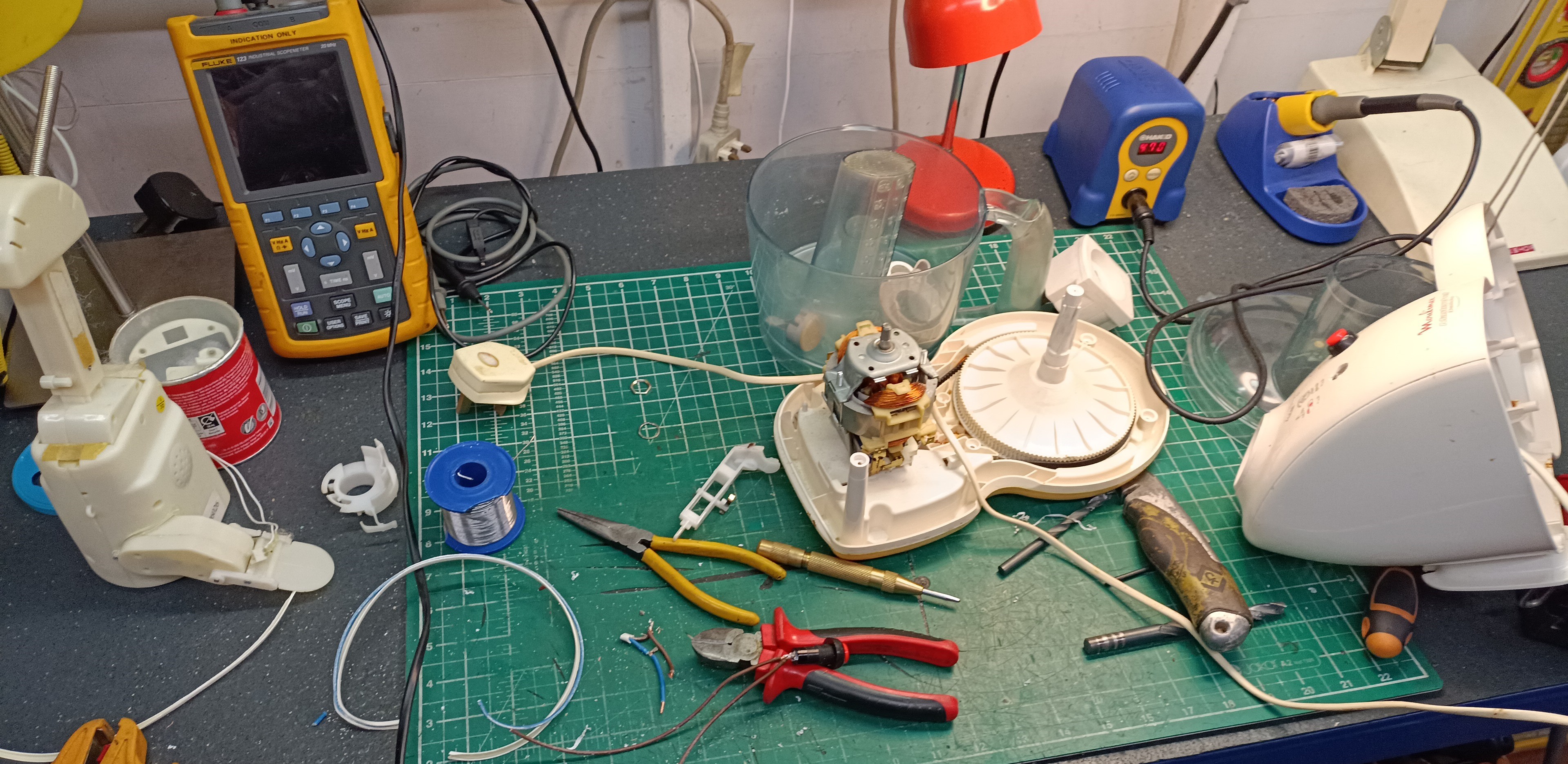
Moulinex magic in the workshop

Economically unviable, virtually no manufacturer support, practically zero second hand value. I’ve had worse machines through the workshop.

It’s not always about the cash…Better crack on.

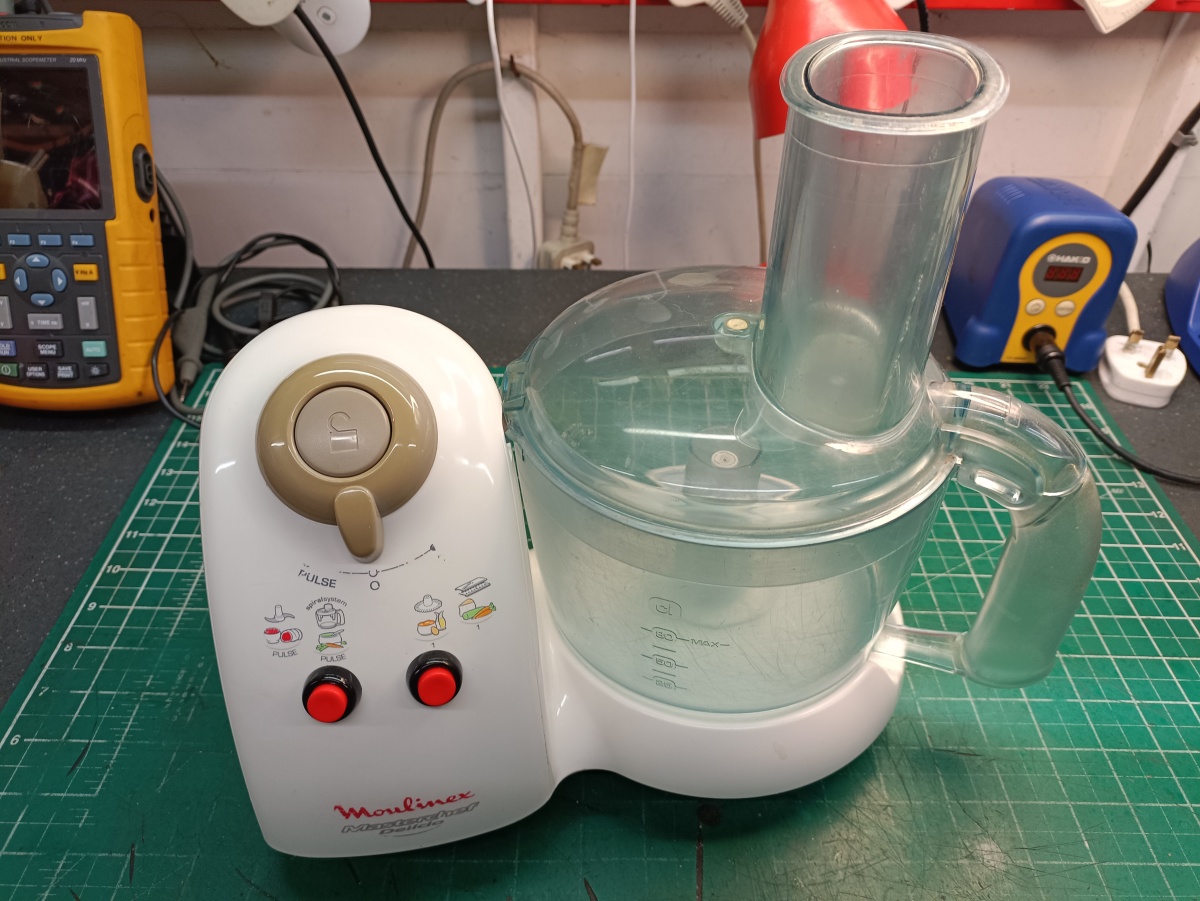
Make and model: Moulinex Delicio (food processor)

Fault reported: Broken switch

Cost of replacement machine: £40.00 – £50.00 for an equivalent

Manufacturer support (in the UK): 0/10

Cost of parts (for this repair): £ under a tenner, including all parts, but not labour

My time spent on the repair: 1 hour

Tools needed: Small knife, pliers, small screwdrivers, soldering iron

Sundry items: Cable, heat shrink

Cleaning materials: Silicone spray, contact cleaner, wipes

Repair difficulty: 5/10 (fiddly)

Beverages: 1 tea

Biscuits: 2 ginger nuts

Bad language: 2/10

It must start early.  An attachment to inanimate objects, a personification if you will, of machines and their mechanical feelings.  Maybe it starts with teddy bears, Lego people or Matchbox cars. Of course, deep down I know that machines do not have feelings, but I do sometimes find it hard to simply give in with something, and throw it away. 

I don’t think that it’s a coincidence that many classic cars, rescued from the crushers’ teeth, tend to have a ‘face’.  Indeed, designers can often hit on a million-seller, if they get the ‘face’ right.  Think VW Beetle, Morris Minor and Mini. Perhaps these shapes bring back childhood memories of a favourite cuddly toy, which might translate to them being taken care of better and cherished for longer.

Anthropomorphism, the attribution of human traits and tendencies, is something many of us experience, but us repair nerds seem to take it to another level.  I’ll have to think of a catchy name for it.

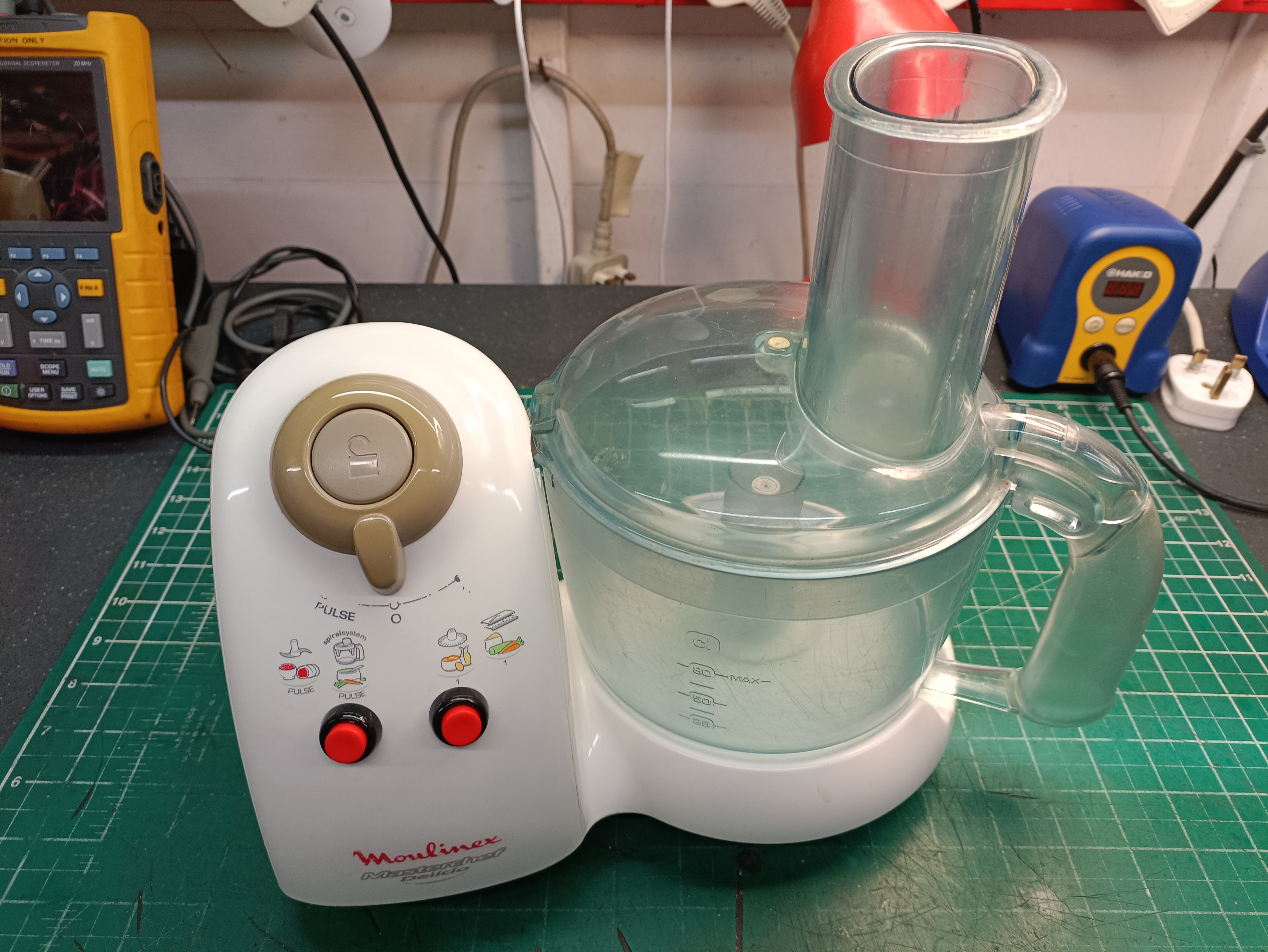
All this has reminded me about a recent such situation where my mum asked me if I could fix her broken Moulinex Delicio food processor, if it wasn’t too much trouble. 

The condition I ‘suffer’ from certainly doesn’t run in families and my mum was at first, ready to recycle the thing. But remembering all the cakes made with it over the years, especially ones made with my two daughters, seemed to put a different complexion on matters. So, I took the mixer away with me and put it on the workshop shelves, awaiting some attention.  At least there were other machines alongside, to keep it company.

Many food mixers tend to be large, heavy and bulky affairs which is OK for many, most of the time, but if you can’t manage the weight of something like an eleven kilo Kitchenaid Artisan every time homemade brownies are called for, something like this little light-weight Moulinex is ideal. So, two compelling reasons to keep the mixer; it’s lack of weight and some fond memories.

The problem was that the main on/off switch didn’t seem connected with the rest of the machine and to make things more complicated, the integral lid-lock was operated with the same button.  This part is therefore quite important since it might prevent one from shortening their fingers, by not allowing the spinning blades to ever come in to contact with wondering digits.

Now, I’m sure that this all seemed rather lovely in Moulinex HQ at the time, but small plastic switches connected with several thin moving parts combined with knocks and scrapes in a kitchen, is not going to end well.  As a matter of fact, Moulinex offered the offending switch assembly as a spare part until recently, so they must have known that the design was a bit iffy.  Sadly, I missed the boat and despite several attempts, I couldn’t find a replacement part anywhere. eBay revealed a couple of similar machines with faults, so it was back to the drawing board.

3D scanning and printing makes low-volume, but high-quality production a reality, and it’s really something that I need to get into, as I often have the need to copy rare, obsolete parts.  In time, I will. 

In this case, I did consider using one of the many online UK companies now specialising in this kind of thing, but the costs did not warrant it in this instance, so a new strategy was required.  I’ve spent many hours of my life browsing parts like this in catalogues, so I decided that a repair should be possible for under £10.00, using readily available, generic switches. Yes, that should be my budget challenge then, do the whole job for a tenner or under and since it was a family affair, no charges for labour!

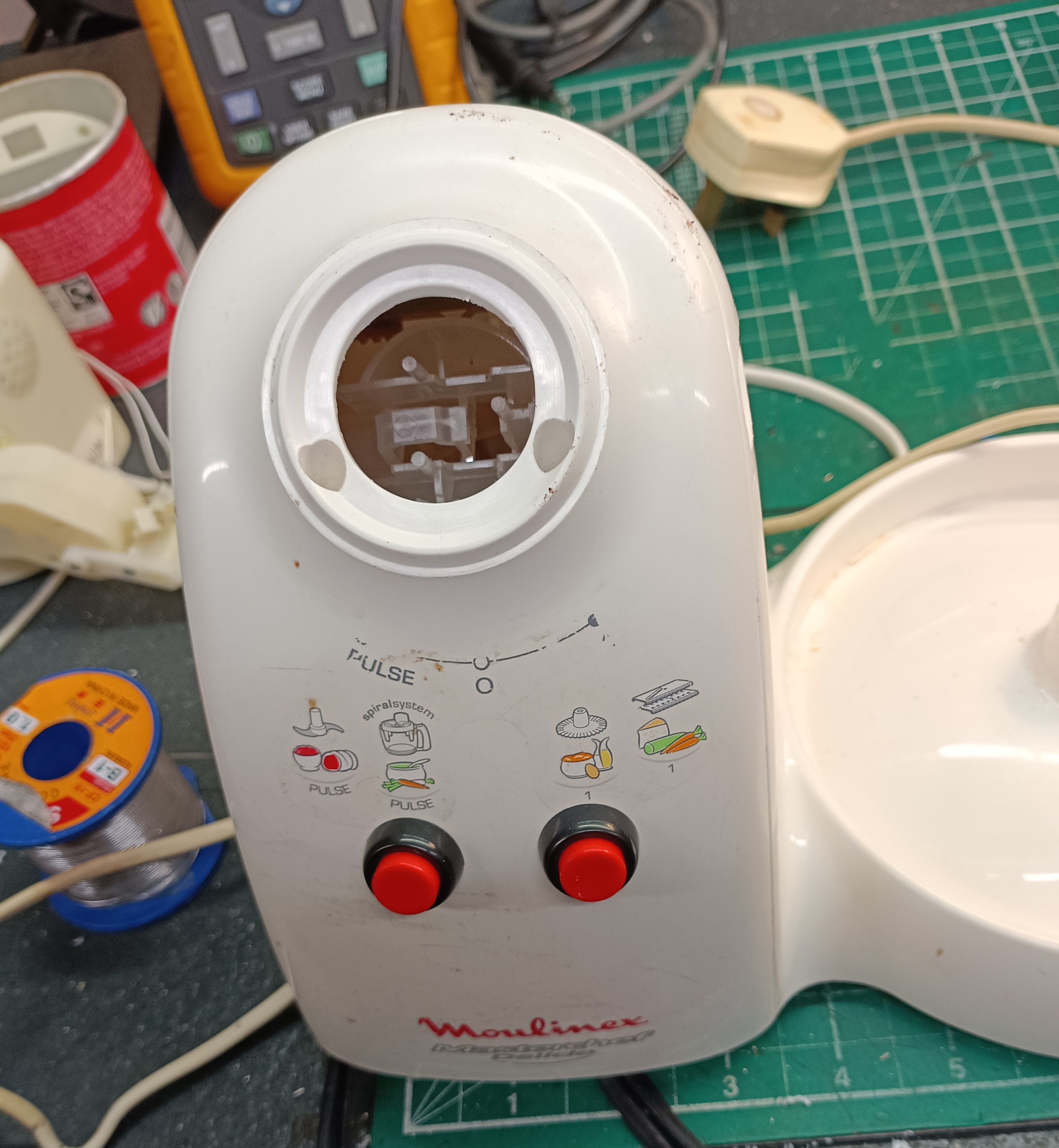
The Delicio is a simple machine; no variable speed controller, just a single speed operation controlled either by latching or push-to-make switch.  It gets the job done quickly and without fuss. After a quick trawl of eBay, I opted for two small round, red button in black bezel switches with solder tags.  The switch series I opted for was available in push-to-make and latching, bingo!  And at £5.98 delivered, a total bargain.

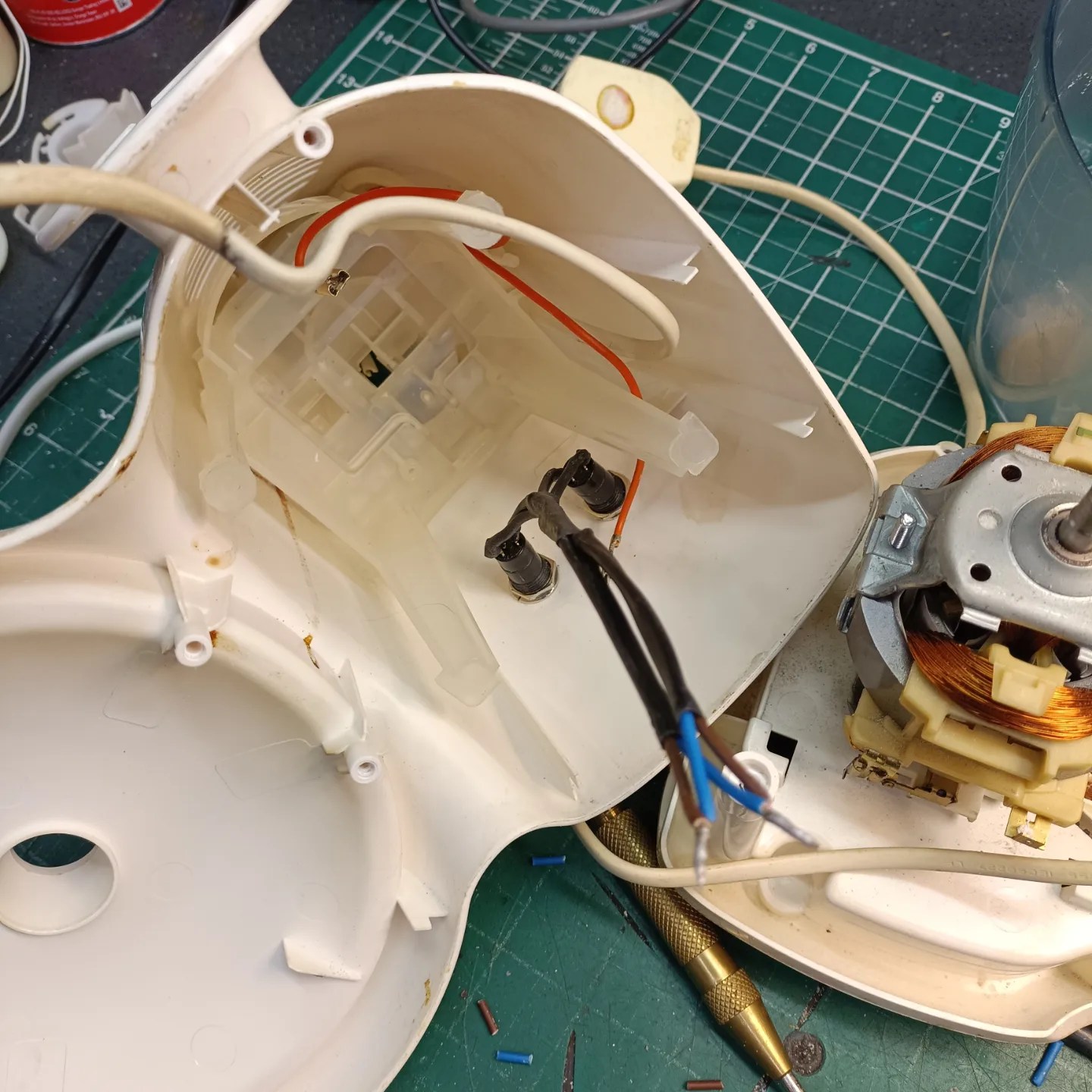
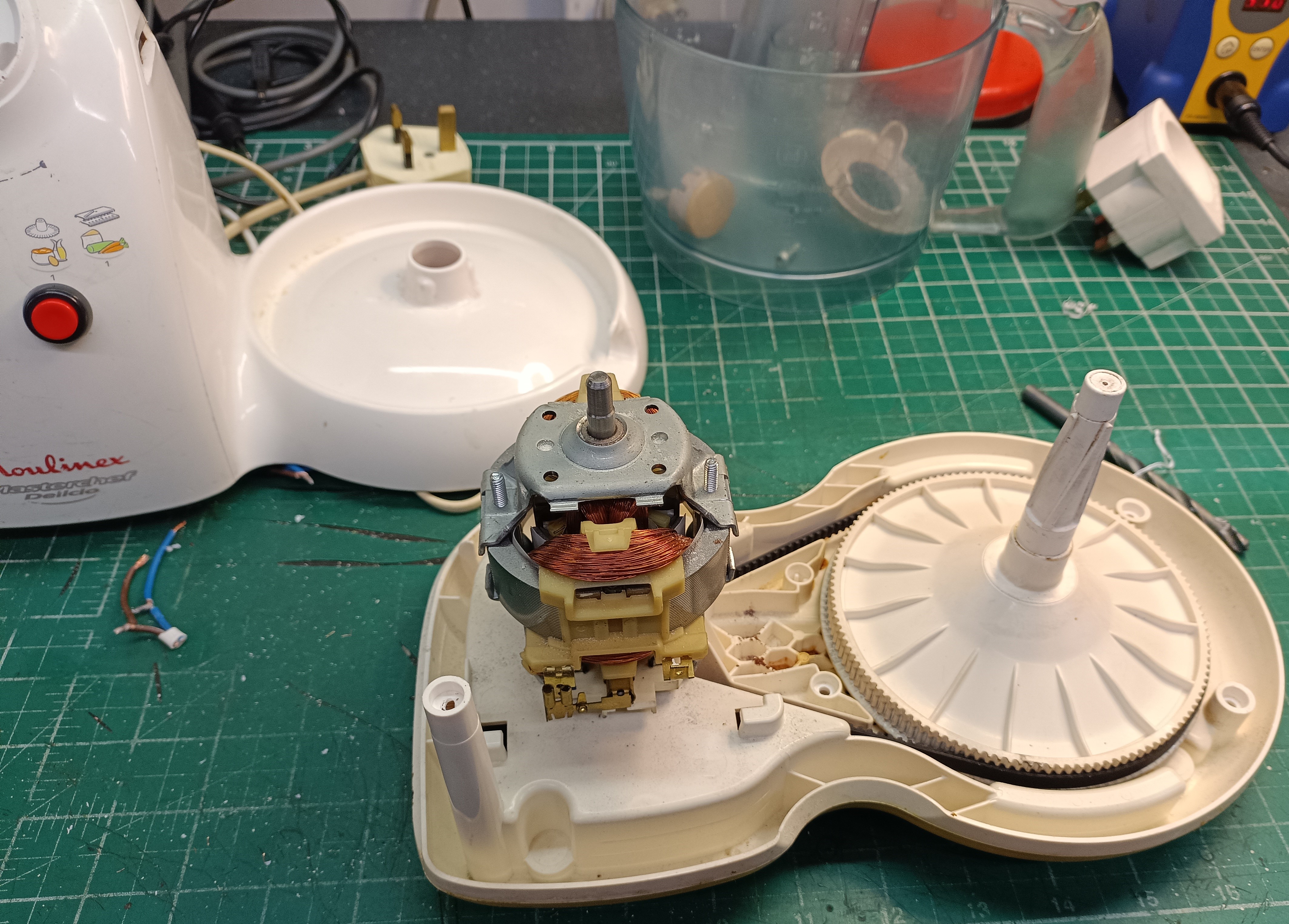
There’s something quite satisfying in selecting an item, taking it apart and then modifying it by way of repair, improvements or both, in such a way that differs little from its original design.  Subtle modifications or improvements, that the casual observer will never notice. If you look closely at the photos, I managed to line up the new buttons with the old printed text, to match the operation. Lucky.
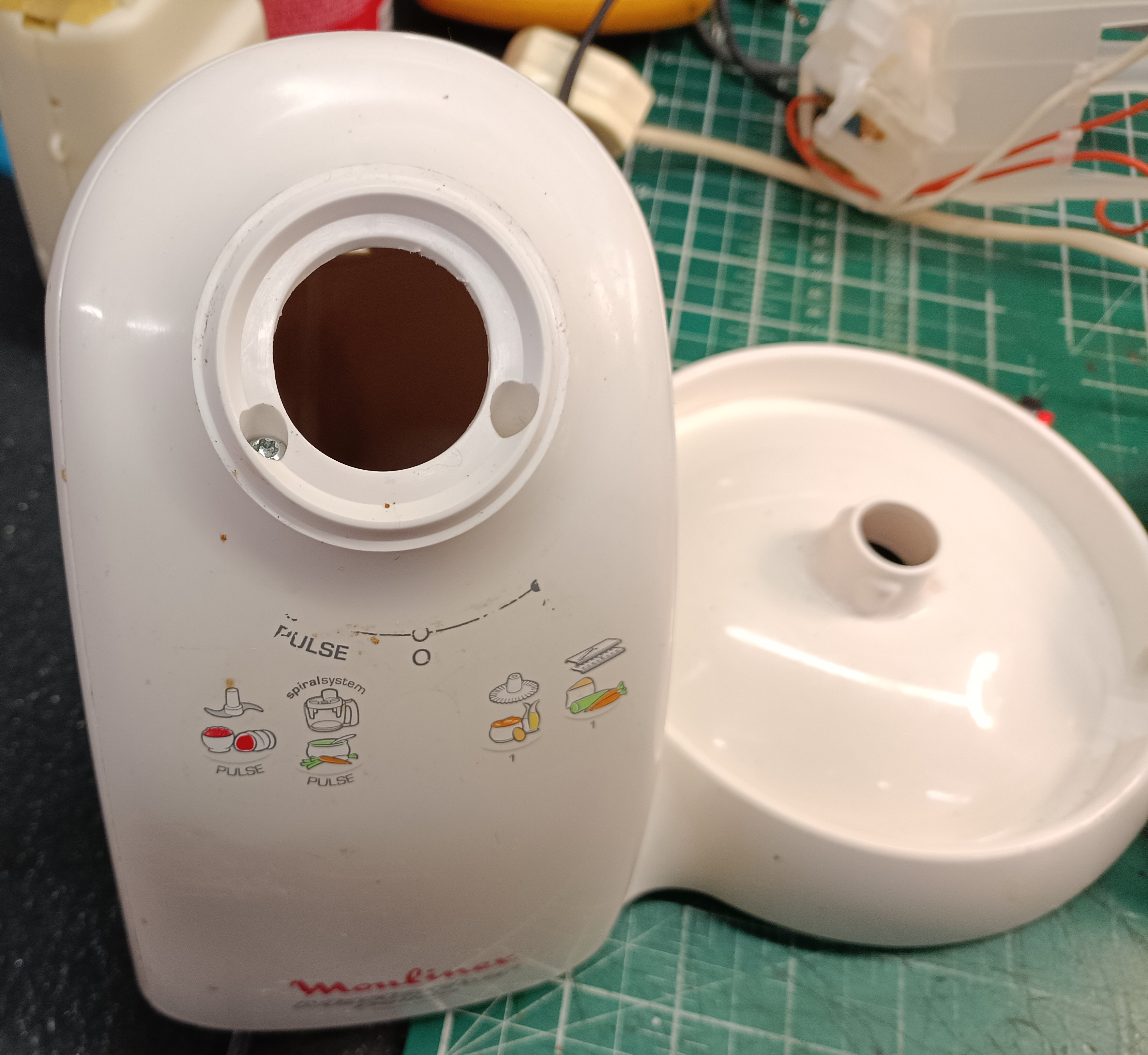
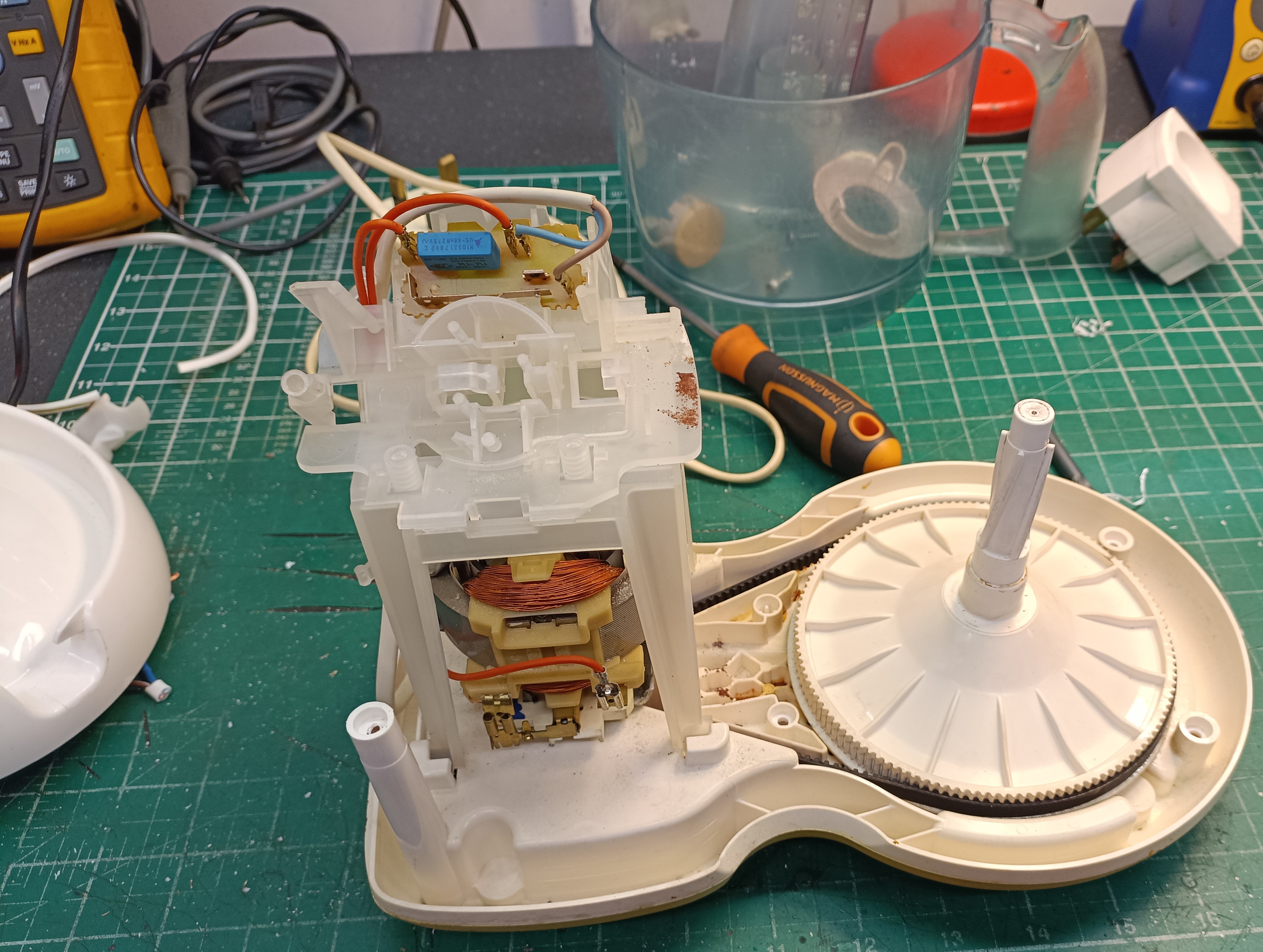
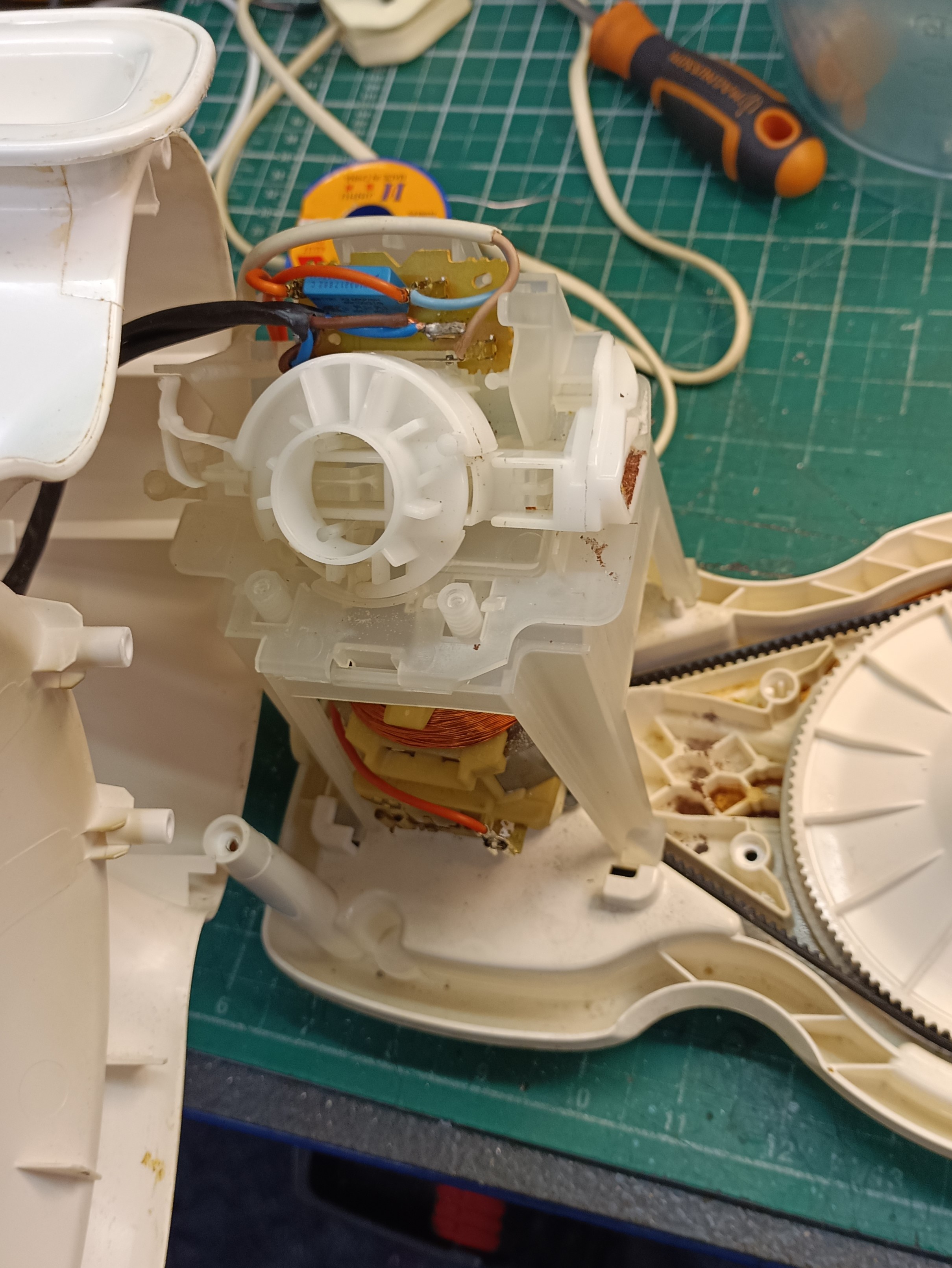
I won’t describe the repair in detail, suffice to say that I found a suitable location for the new switches in the machines’ chassis, drilled out the holes and then fitted them in place with the nuts supplied in the switches’ kit. No special tools required for this job really, just a selection of standard screwdrivers, some 0.75mm wire, heat shrink, cutters and a 12mm drill bit.  I already had some cable, I connected the new switches to the existing wiring harness, by-passing the original.

I was able to retain the original switches’ interlock by keeping the original switch in situ with a little epoxy resin.  This ensured both safety and the original aesthetic.  See what you think in the photos. I was quite pleased with it.

I completed the repair within an hour, which I almost forgot to report, included a wipe over and polish. And I managed it on only one cup of tea with a couple of my favourite ginger nuts.  Oh, and I didn’t go over budget. Any chance of a Vicky sponge, mum?!

Right to repair or despair‽

Right to repair laws are a good thing on the face of it, but don’t go anywhere near far enough to give the public back control over their appliances.

As you might expect, I’ve been keeping a weather eye on our neighbours in France over the last couple of years and was pleasantly surprised when they announced a Repairability Index scheme, on the 1st of January 2021, the first European country to do so.

The scheme in France will make it easier for consumers to assess the longevity of some products on the market. But I nearly choked on my custard cream, when the UK Government announced a Right to Repair bill for UK consumers, which came into force on the 1st of July 2021.  The news report made it sound as if a magic wand had been waved by the Brits, and that all our gadget maladies had vanished.  Sadly not.

There’s always a backstory to any announcement like this, and the new UK ‘right to repair’ laws, are on the face of it, a good thing. However, don’t for one minute that the new laws passed will help the public directly.

The laws will make it compulsory for manufacturers to provide spare parts and documentation to professionals, whoever they are, for at least ten years. Consumer items such as TVs, fridges and washing machines, will in theory, be given the opportunity to last longer.  But there are problems, and here’s why. The legislation doesn’t specifically cover planned obsolescence, parts prices and consumer accessibility or product durability. These are all issues generally accepted as the main barriers to repair. Let me explain.

During the many years I’ve spent locked away securely in the workshop, I’ve regularly been presented with items which were designed, made and sold with no attempt on the manufacturers’ or retailers’ part to design-in repair. In other words, many items that I see are not meant to be repaired at all, and there’s usually no support network in place, when the product is out there in circulation. Sometimes I can fix these things, sometimes I can’t and many-a-time, I’m working without certainty. Over the years, I’ve built-up knowledge on certain products and have a working knowledge of various spares providers for many items, but this trainspotter knowledge, isn’t easy to acquire. It takes many shed-years and a limited social life.

Items such as complicated coffee machines and toasters do have some spare parts available, sometimes long after they’ve gone out of production, but prices for spares are often so high that repair might not be cost-effective.  I once attempted to repair my own UK made Triton shower as the heater inside had failed.  The shower was 10 years old and parts, were available here in the UK, for delivery next working day.  Price of a replacement boiler £80.  Price of the same brand-new complete shower from Screwfix, £50 with a new warranty.  Now, as much as I’m passionate about repair, I’m not daft.  I had a bath instead.

The new legislation, which is regarded by me and others in repair circles, is a step in the right direction and certainly highlights the current issues around our throwaway society. But it doesn’t scratch the surface of the problem. Not even close.

A true Right to Repair would enforce proportionate parts prices, sensible repair accessibility, free documentation and accessible repair support from manufactures and retailers directly to consumers and independent repairers.  Luckily though, there is good news.  Repair initiatives such as therestartproject.org, repair.eu and the Repair Café movement are actively campaigning, organising petitions and actively lobbying governments for change, and you can get involved. Repair Cafés operate in my own area of Adur and Worthing (Sussex, UK) and are home to dedicated repairers and tinkerers.

And there’s more good news. Over the last 20 years or so, eBay has revolutionised the second hand domestic goods parts market. If you need a cost-effective part for your vacuum cleaner, coffee machine or washing machine, you might just find the part you need online from parts breaker, on eBay. I’ve saved many a vacuum cleaner using a second-hand motor for a tenner and recommend it, if you know what you’re looking for and have the nerve. If the government is serious about right to repair, the circular economy and its goal of reaching net-zero carbon emissions, the process needs to include all stakeholders. Honest and transparent consultation with robust legislation that includes the second hand parts market and the home repairer is the only way to truly gain back control of our appliances.

Matt, July 2021.

Old vs new, which is best?

Having repaired more than 100 Kenwood Chefs, I compare newish and older machines. Which is best?

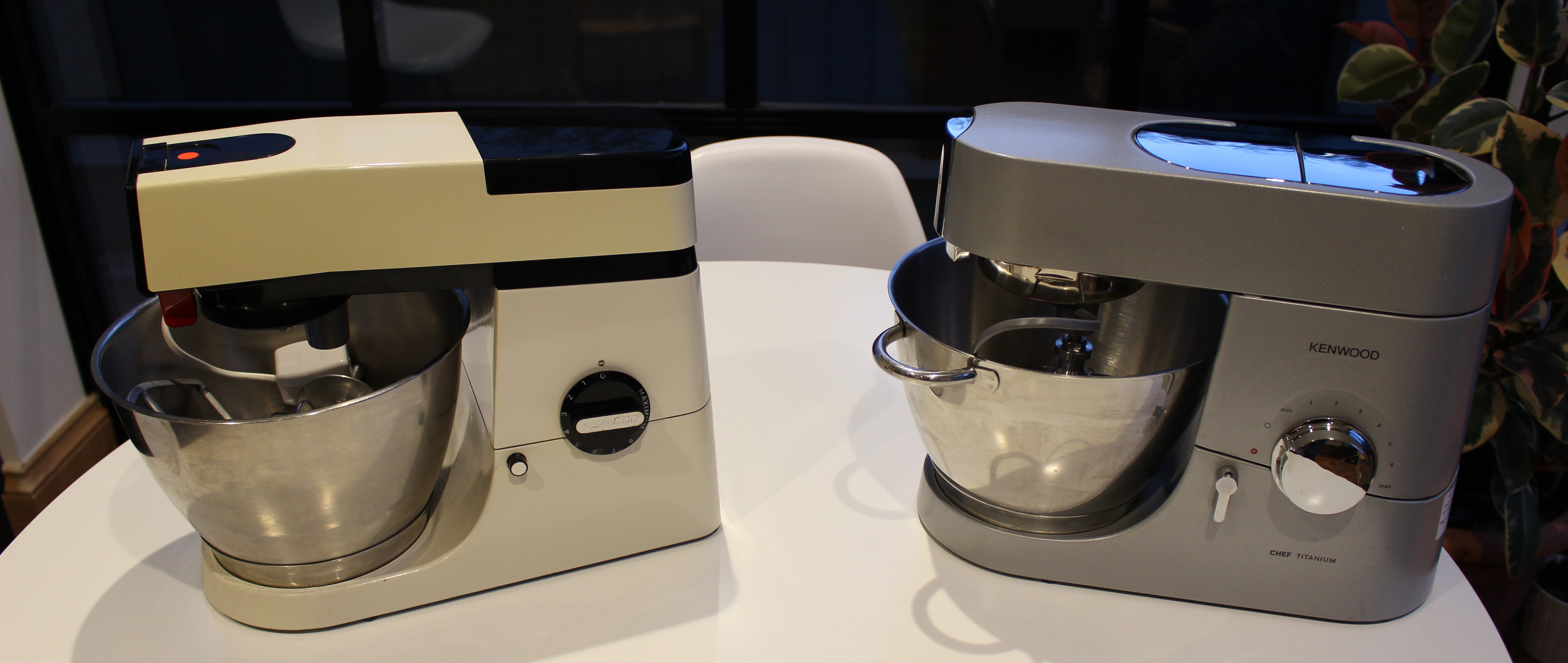
IMG_2724

Believe it or not, people do ask me which is best: New or old machines?

There is of course, no right or wrong answer and the answer will vary, depending on the product and application.

But since the question comes up from time-to-time, I thought I’d give my opinion on the matter and have a bit of fun with the subject, a kind of shoot-out if you will.

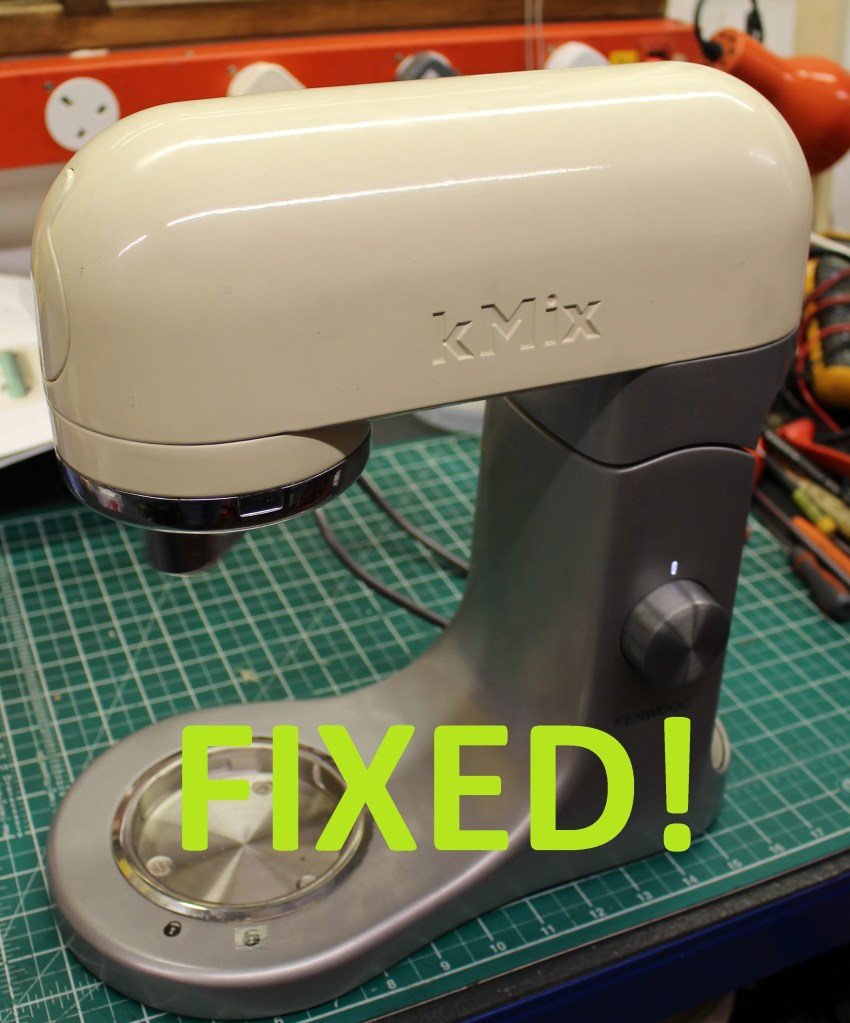
My illustration focuses on an old favourite of mine; the Kenwood Chef. My chosen opponents are a model from the early 1980s, the ubiquitous A901 Chef, made in England, and the much later 2000s KMC010 Chef, made in China.

The Chef is a good example for the shoot-out as the machine’s purpose hasn’t changed since it’s introduction to kitchens in the 1950s. Many Chef accessories produced over the years are interchangeable, owning to the foresight of good design.

Some people think that new machines are best and more capable while other people think older machines are best as they were built to last. Since I’ve dismantled, used and admired 100s of these machines, here’s my take.

Round 1 – Performance

Older Chefs are less powerful than newer machines. For example, the A901 has a 450W motor, whereas the later KMC010 has a much more powerful 1400W motor. This means than the newer machine will be more capable to mix more stodgy mixtures for longer. Counter intuitively, the more powerful machine may be more efficient for some loads, compared to the lower power one, although I’ve never measured this.

A901 – 0 KMC010 – 1

Round 2 – Noise (from the machine)

Kenwood has tended to favour evolution rather than revolution with their product progression. Many models available over the years appeared not to change much on the surface, but under the skin, small tweaks and improvements were taking place. So, in general, the newer the machine, the quieter they tend to be. There are some model variant exceptions to this, but the KMC010 is much quieter than my own good condition A901.

A901 – 0 KMC010 – 2

Oh dear, new things might be better after all..?

Round 3 – Durability

Now this is where things get interesting. Many of the machines I receive in my workshop for repair are getting on a bit. Some of them are over 40 years old. The machines have served their families well with faithful service.

Faulty older machines can often be turned around within a few hours in the workshop, to be back with the customer, to make more cakes. The A901 Chef is a tough old beast. The materials and finish rarely give any problems and major components rarely fail it seems.

KMC010 Chefs (and all newer models) that I see in the workshop are obviously much younger than the A901s. While very capable and powerful, sadly, they seem to have failed, often only with occasional light use.

Seemingly, it’s true what they say, the older machines were built to last and I base that purely on customer enquiries and items I see to repair every week. The newer machines often have features and buttons that don’t serve any real advantage, but have associated circuits which can and do go wrong, rendering the whole machine useless, if they fail.

A901 – 1 KMC010 – 2

Round 4 – Repairability

Now obviously, I am ‘repairability-biased’, this is a blog about repair after all. However, the facts speak for themselves. Older Chefs can be repaired with basic tools, reasonably priced components and a little know-how.

Newer Chefs, like the KMC010 are more complicated and have less user-serviceable parts. This makes otherwise serviceable machines far more likely to end up in the scrapyard with seemingly minor faults, that were too hard to diagnose and repair. The A901 wins hands down in the repairability stakes.

A901 – 2 KMC010 – 2

The feeling is tense and there’s an air of excitement as I get to call the decider on this slightly odd dual.

Round 5 – Value for money (the decider)

A new KMC010 Titanium costs over £600 today and it should be said that all Chefs are great machines and a worthy addition to any kitchen. However, a decent second-hand Chef from the 1960s to the early 1990s is a worthy contender for a tenth of the cost.

Have a look on eBay and you’ll see A701s, A701a, A901, A901E, KM200 model Chefs, starting at £40, often with many accessories. They’re just as useful and capable to serve most home needs. Indeed, I have a customer who uses her standard A901 in an industrial kitchen, every day, with no problems.

A901 – 3 KMC010 -2

The non-scientific conclusion…

  • Buy an older machine and take satisfaction that it will last generations, can be easily repaired and work with most accessories available now. Buying an older machine is probably less environmentally damaging than the manufacture of a new machine.
  • Buy a new machine and take satisfaction with additional performance and a manufacturers’ guarantee for the first year…

You know which machine I would buy…

This slideshow requires JavaScript.

Time to put the kettle on.