Hybrid Hoover-VAX vacuum cleaner combination experiment…

Recycling vacuum cleaner parts.

A slightly unusual workshop repair this time.

My brother-in-law popped in to see us for a cuppa recently and mentioned he was off to the tip with an old VAX cylinder style bag-less vacuum cleaner, in pieces, not the carpet washer type.  It was on its way to the great scrap yard in the sky.  Luckily, I was on hand to divert the sick VAX via the workshop.

It was being disposed of due to the flex having gone faulty together with the opinion that it wasn’t working that well before the mains cable failed.  Well, I hate to see good machinery go to waste.

On this VAX, the mains flex is stored within the vacuum cleaner housing and is wound up on a spring-loaded coil during storage.  When in use, the user can pull the mains plug until the desired cable flex length is reached.  When the user is finished cleaning their carpet, a foot operated button causes the flex to speedily disappear back in to the vacuum cleaner.  My brother-in-law had already looked at the spring-loaded mains flex winding mechanism, which had resulted in the bi-metallic coil spring escaping from the enclosure, freeing itself in to an orbit.  It’s quite a shock and sometimes dangerous when this happens!

What to do.  I was very nearly tempted to dump this vacuum cleaner too as the build quality of the whole thing reminded me of the plastic toys one gets in Christmas crackers, but that’s not really in the spirit of The Workshop.

Then I remembered I had a defunct Hoover Telios that was minus a motor, perhaps this would be a suitable parts donor?  I liked the idea of making one working vacuum cleaner from two unhappy ones.

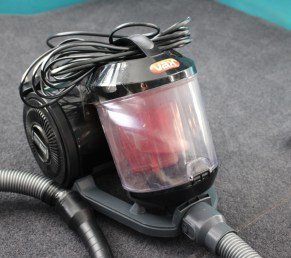
The Telios had a working mains lead flex, but the automatic spring loaded mechanism on that was past its best, so I decided to use the working lead on the VAX.  The VAX would be without its flex winding mechanism, but at least it would work.  I adapted a cable tie to make a cable grip, to prevent a user from pulling the cable from the VAX, when in use.  The cable would have to be stored, wrapped around the vacuum cleaner, after use, a small price for working machine.
IMG_5022
FixItWorkshop, Feb’18, VAX cylinder vacuum cleaner.

The other job was to address the poor performance.

This product is clearly an inferior Dyson rip-off and therefore has a couple of filters; one for the intake and one for the exhaust, like a Dyson.  As suspected, both of these were virtually blocked!  The filters on this model were not as easy to get at nor as easy to clean.  I’m not sure whether these filters are meant to be washed, but wash them I did and after 24 hours of drying on the radiator, they were as good as new.  Once refitted, full performance was restored, for the price of a bowl of warm water and Fairy liquid.

Finally, the VAX was missing its cleaning head for the hose, so I decided to use the Hoover one (which was quite a nice design) with the VAX’s hose.  After some jiggery pokery and some electrical tape, it fitted.

IMG_5023
FixItWorkshop, Feb’18, VAX cylinder vacuum cleaner- with Hoover parts.

What we’ve now ended up with is a working VAX vacuum cleaner, using some parts from a beyond economical to repair Hoover.  Whilst it’s not the most elegant repair I’ve ever completed, I now have  something working from two nearly condemned items and surely, that’s good thing?
Runaway Hillbilly Golf Trolley…

Golf trolley heads for the hills…

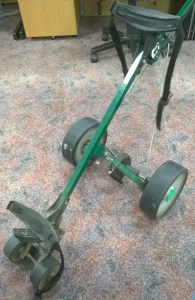
Readers of this blog (I know there are millions of you) will recognise this golf trolley and I’m pleased to report that my first repair, the one to the motor, is still working perfectly.  However, the owner of the trolley contacted me with a (funny) problem.  Whilst recently enjoying a round of golf on the local fairway, the trolley decided to, by itself, begin to edge away from the second tee and then with some speed, head off in to the distance, without any operation of the dial switch, situated on the handle.  Whilst this seemed funny at first, I remembered that the motor on this trolley had the kind of torque that, coupled to small gearbox and wheels on a heavy frame, could do some serious damage, left unchecked.

Original photo taken in Aug’17, below.

WP_20170803_14_08_27_Pro
FixItWorkshop, Worthing, Aug’17 Hillbilly Compact Golf Trolley

Unlike many modern electric golf trolleys, it doesn’t feature GPS guidance, remote control or amazingly, a dead-man’s switch, which seems like a major safety oversight to me.  I’d have expected either a kill switch or dead-man’s switch* fitted to the handle on a trolley like this as the runaway scenario could never occur due to fail-safe nature of the switch being operated.  With one, the trolley would only run when the operators’ hand was on the handle or cut out when the kill switch is activated, as with the saftety cord mechanism, on a jet ski for example.  Perhaps the Mk2 Hillbilly Compact featured this.

*For example, a dead-man’s switch is usually fitted to something like an electric saw where the operator must old a handle-type switch to make it run.  Once the operator lets go of the handle, the motor automatically fails-safe and cuts-out.

On with the repair.  The trolley features some exposed connectors and cabling and it seemed sensible to check the continuity of the cables running up and down the handle shaft, as repeated trolley folding might have caused a problem with the wiring.  Fortunately, the cabling was OK.

The owner had mentioned that the handle, where the speed control switch is located, had got wet in the past, which made my alarm bells ring.

Opening up the handle, which only required a basic tool kit, revealed evidence of water damage and corrosion to the speed control terminals.  Luckily the owner of the trolley had stocked up on spare switches!

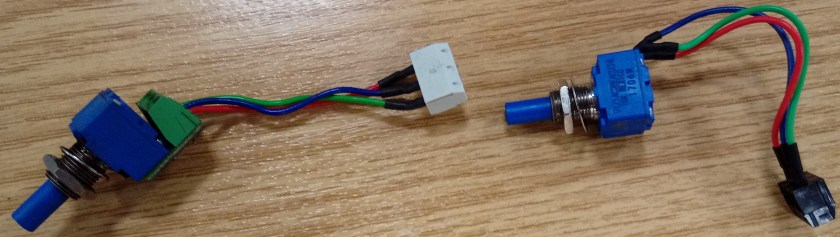
Removing the existing switch revealed intermittent continuity and varying amounts of resistance, which was not good.  A fault most likely to have been caused by water ingress or excessive shock.  The owner had supplied two ‘new old stock’ (NOS) switches.  Which one to fit?

From time to time, it’s downright sensible to either fit NOS or second-parts as they’re usually cost-effective and are more likely to fit over pattern parts.  But time can also affect apparently shiny parts.  This was a case in point.  I knew that the switch should vary resistance from open circuit to 10KOhms in either direction from COMM.  The old one didn’t and one of the ‘new’ parts only went to 2KOhms, so was not in specification.  Luckily, the remaining NOS switch worked fine and once refitted, and the handle reassembled, the golf trolley was ready to make the job of carrying clubs easier, once again.

IMG_20180131_135745
FixItWorkshop, Feb’18, Hillbilly Compact speed control switch, new and old- test NOS parts before fitting.

Cost of replacement trolley:  ££££ Cost of repair; £10 plus time.  Moral of the story; don’t assume NOS parts will work.  Test them first.