
Inside The Real Repair Shop 11: Lego, Radios and Allegros

This time, Matt talks about cars on fire, tinkering and repair education.

Festive greetings from the workshop and well, hasn’t the year flown by?

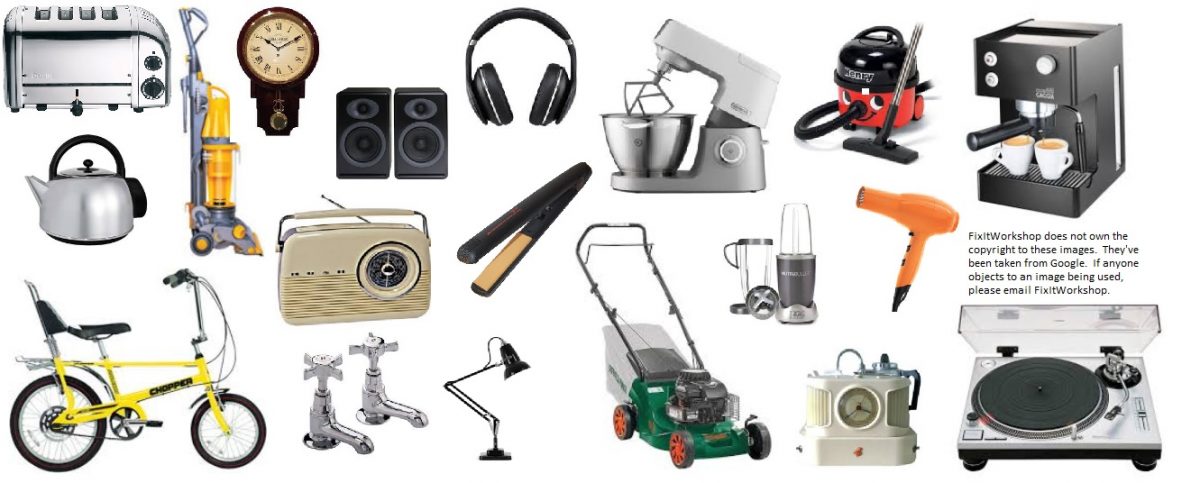
As some of you know already, repair work is a bit of a side-hustle for me, and it’s something I’ve enjoyed since I was a child. Seriously, I would dismantle my parents’ vacuum cleaners, radios, clocks and later, the family car’s engine. Things sort of got out of control when I set fire to my uncles’ Austin Allegro though by muddling up some dashboard wires. Fortunately, the Allegro was made of stronger stuff and survived my handy work, despite a few scorch marks. Anyway, what were they thinking, letting an 8-year-old work on a car unsupervised!

For me, a long-long time ago now, a Fisher Price handyman set turned into Lego building and craft play using old washing up bottles and loo rolls. This turned into blowing up electronics kits, which then moved on to building bikes and cars.  As a late teenager, I then got an apprenticeship with BT and studied while I learned about telephone exchanges and communications technologies. All of this might explain why I was never picked for the school team. You can’t have it all, I guess.

Playing with Lego and kits from Tandy (remember them?) for me as a kid definitely helped me to have a positive approach to repair and to not be fearful of getting it wrong. We only really learn from mistakes, of course. And I was lucky to have people around me at the time who were (mainly) happy with me dismantling household things with real tools, taking risks with real appliances and building weird inventions in the kitchen. But it wasn’t all good-humoured in our house! I still remember getting a stern telling off for dismantling a Mini carburettor on the draining board, next to the family’s drying crockery. My mum was upset with me for some reason.

Where’s all this going anyway? Well, as an adult who sometimes acts all grown-up, I’ve since had time to reflect on this maybe unusual set of circumstances, which ultimately lead me to where I am now in Worthing, at 44 years of age. I make no apology for being a pushy parent to my two daughters, encouraging them to create and build stuff; from toilet rolls and sticky tape to their increasing collection of Lego sets, or are they really my Lego sets? I want my kids to learn as I did, the joy of building, testing and usually failing to solve problems. It doesn’t always work like that, but you know what I mean.

I get a wide range of repair enquiries in my inbox, from Kenwood Chef restorations to lamp re-wires to kids’ toy repairs, many enquiries with interesting back-stories too. But sometimes I just can’t take on a repair if I feel that it can be done by the person enquiring. For example, fitting a new plug to an appliance, which I feel, if needed, should be attempted by most folk. The main issue affecting many people, and therefore preventing them from tacking the job themselves, is a lack of confidence. I see it all the time, from vacuum cleaners that just need minor adjustments or cleaning, to lamps that only need a new bulb.  When people ask me to do repair work like this, I’ll always give them the option to do the work themselves first, with some guidance – which probably isn’t good for business, but will ultimately help that person to maybe help themselves.

Of course, as adults, there are local repair cafés, DIY college courses and YouTube that can help any budding diy’er, but to be truly repair savvy, I believe that one must start their learning younger and begin through play and the classroom.

In this article, I wanted to share some of my educational thoughts on repair.  Appliance repair and general household maintenance isn’t covered as a subject at school (in the UK) to my knowledge, and as we make it to adulthood, we’re just expected to figure it out for ourselves or ask someone else. The closest we get to repair work in secondary school is in Design Technology, but hoover teardowns and rebuilds are not covered.  Is this because it’s perceived as unglamorous, basic, simple work, I wonder? Perhaps it’s something I’ll take up with the current Education Secretary, although I’ll have to be quick, as it may all change next week! In all seriousness, our education system needs to encourage practical self-reliance, encompassing repair, if our government is truly serious about sustainability and our environment.  In the same way that secondary school mathematics should include topics on mortgages and loan applications, technology subjects should also encompass domestic appliance fault-finding and furniture assembly education, alongside more classical topics so that our children today turn out as adults tomorrow, who can, at least, wire a plug.

Until the next time…

Inside The Real Repair Shop 10: Storm in a Teacup

With the cost of energy soaring, people are suggesting ways to save money. This time in the Workshop, Matt compares three ways to boil-up to make a brew, a subject close to his heart!

In readiness for a winter of discontent, I’ve already removed the thermostat’s wiring and have prepared thick jumpers for the whole family, made with the added warmth that only loft insulation can bring.  I impressed myself with this stroke of genius and wonder why no-one else has ever tried this before? Can’t imagine why.

There’s a lot of talk about ways to save money on social media at the moment. One only has to do a bit of Googling to learn what we should stop doing or unplug next to save money.  There’s an old saying though that usually stands true: Don’t sweat the small stuff. 

Anyway, where was I? Back in the summer, I had an-over-the-wall conversation with my neighbour, Liz. It started off in the usual light-hearted manner, talking about this and that, when I heard a whistle coming from Liz’s kitchen, a noise which took me back to sometime in the dim and distant past.

Liz had switched to boiling water using a gas stove kettle and reliably informed me that it was ‘cheaper and greener’ to brew-up this way, rather than use her trusty modern kettle.  I very nearly lost my balance, leaning against our diving wall as I laughed and said, “that’s a load of old cobblers” – did I use cobblers, well something like that anyway.  With a slight frown of veiled raged from Liz, we both went off to carry on our evenings, but there was a piece of me worried that I’d offended dear Liz somehow.  What to do?  I’d almost forgotten about the whole thing until it came up again in conversation recently, but this time via another friend of the family.  Rather than scoff this time, I decided to investigate in a shed-like manner to work out who was right, me or Liz.

What is the most efficient way to boil water at the moment?

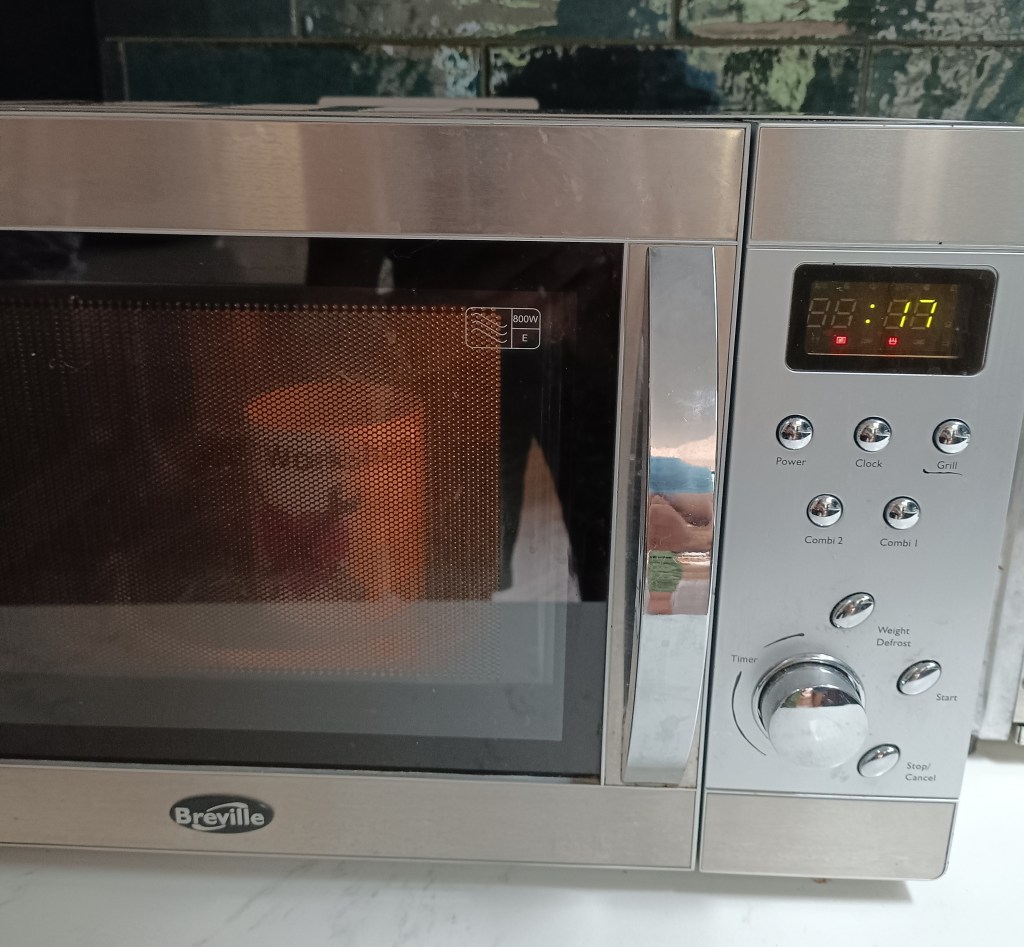
I decided to see just how much one cup (see photo) or three cups of water would take to boil using a modern 2500W electric kettle, a gas stove kettle (hob rated at 1500W) and a jug in an E rated 800W microwave.  Just for kicks.  Hasn’t everyone done this?  I used the same cup for the whole experiment.  Water was taken from the cold tap at room temperature.  I used the stopwatch on my phone and used a base rate of 29.48p/Kwh for electricity and 7.32p/kWh for gas. We’re with Eon and these rates seem to be ubiquitous at the moment. I timed how long either one cup or three cups would take to boil using each boiling vessel.  I started the test from the ‘on’ switch on the kettle, the gas ignited on the hob or the ‘on’ button on the microwave.  The test ended when the kettle switch turned off, the stove kettle first whistled and boiling bubbles were observed in the microwave.  By now, I’m sure you’re on the edge of your seats.

Everyone’s an expert these days and while I’ve done my best to make this a real-world test using a moderately scientific approach, I’m sure someone out there will drive a coach and horses through my method, but don’t bother, the results are astounding.

THE RESULTS ARE IN

Time matters

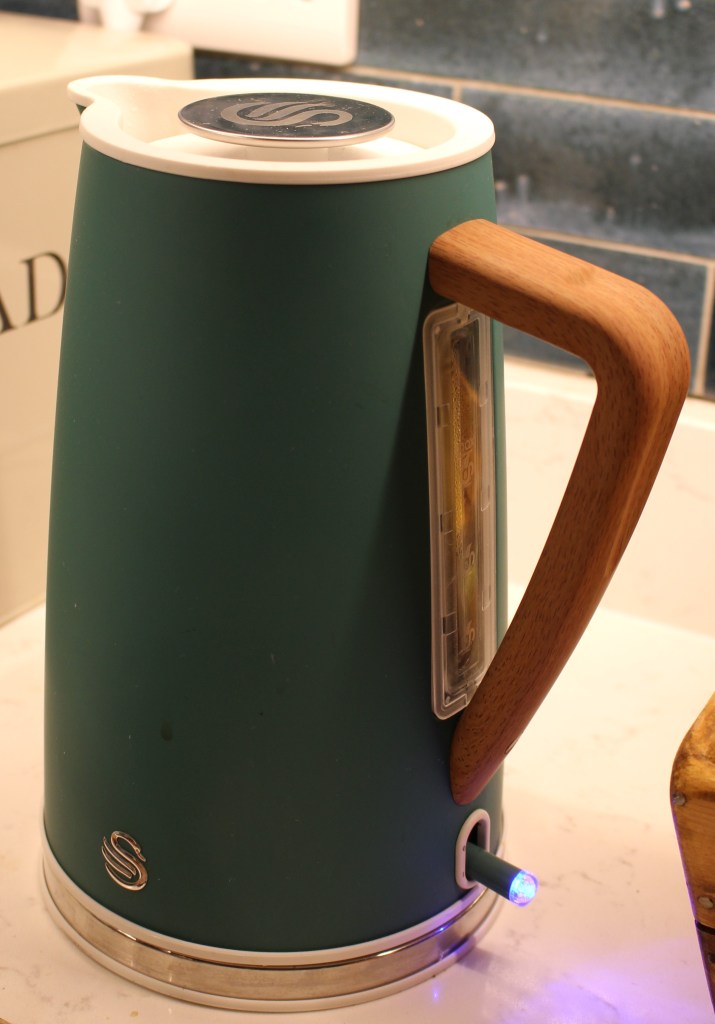
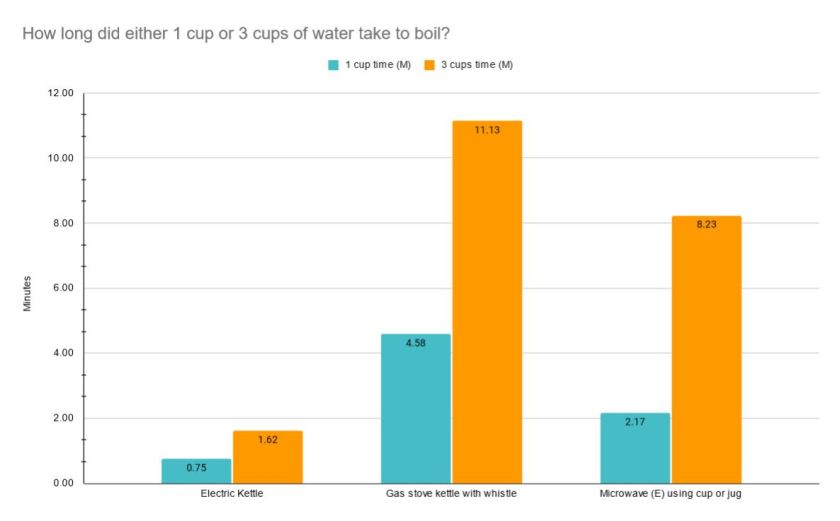
If you’re always in a rush and need your cuppa in a flash, then the only way to go is to use a modern electric disc-element kettle, like the one in the photo.  Using a microwave was second fastest, but not much faster than the very slow (by comparison) gas stove kettle.  One, nil, nil to the electric kettle then.

The real boiling issue – what did it cost?

Gas is cheaper than electricity on my energy tariff, which is a similar story for many other domestic customers at the moment. The microwave proved to be the cheapest method to boil one cup of water followed by gas in this test, but the results changed dramatically when three cups were boiled – a complete reversal in fortunes in fact. Three-way tie.

Environmental impact

What about the CO2 emitted? Perhaps the trickiest measure to nail down, but using Defra* approved conversions, based on the kWh for both fuels, it stands to reason that the electric kettle emitted the least CO2 as it was on for the least amount of time. The electric kettle triumphs overall.

*UK Department for Environment, Food & Rural Affairs

So, in conclusion, a gas stove may be cheaper to make a brew for one (at the moment), but one must be careful to measure the water required carefully and a slight increase in the tariff could see all savings easily eroded. The microwave was the wild card entry (my mate Paul’s suggestion) and it proved that it’s a reliable and cheap way of heating, if compared to the stove – for some forms of cooking. 

The bottom line is that a modern electric kettle will do the job faster, usually cheaper and cleaner than its rivals.  Time for a brew? Go on, treat yourself.

Slow Fisher-Price Mechanical Music Box Record Player

Repaired Fisher Price record player

Here’s a blast from the past:  A mechanical toy, that’s really cool.  One that brings fond memories from my childhood… I’m 38 as I write this (I’m 40 as I edit this- time goes so fast).

Strictly speaking, this is not a customer’s toy, but a family heirloom which had been festering in the shed for over 20 years.  Consequently, it now wasn’t in great shape.

After dusting it down, we realised that records were playing intermittently and slowly at best and the problem seemed related to the rather cool winding mechanism within.

After dismantling the unit and giving the mechanicals a light service, the turntable platter turned freely once again.  Our two (now three) year old daughter can now play with the record player as her mum did – very cute.


Enjoy!