Hubble bubble toy’s in trouble.

This bubble machine needed more huff and puff.

About a year ago, we bought an Early Learning Centre Freddy the Fish Bubble Machine for our daughter and it’s been a great addition to summer garden fun, as it unleashes thousands of bubbles per minute.  It’s been truly bubble-tastic.

However, it’s decided to become a little temperamental of late when switched on.  With good batteries and a full tank of bubble fuel, the machine would sometimes cough and sputter and generally be a disappointment in the bubble-making department.

The toy is shaped like a fish, like the name suggests and has a small reservoir for the bubble mix and a carousel of bubble wands operated by a motor which is ‘blown’ by a small fan inside, to inflate the bubbles to the optimal size.

The fault:  The fan would sometimes, by itself, vary in speed, reducing the speed of the air though the bubble wand carousel, which would limit the quantity and quality of bubbles produced.  Most disappointing.

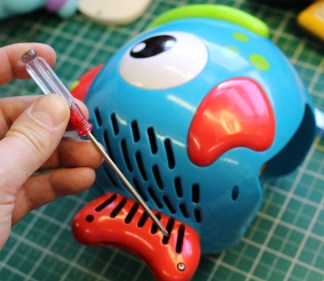
The toy is held together by small Pozi-drive screws and the whole things comes apart in two halves.  It gets a bit tricky inside as there are a few small components held in place using the internal plastic parts.  After testing the batteries, I thought I’d start by testing the action of the on/off switch which seemed to click on/ off OK, but I wondered what the quality of the electrical mechanism was like.  A quick test with the multi-meter revealed slightly variable resistances, indicating either damp or dirt had entered the switch, highly likely considering what the toy does.
IMG_4091.JPG
FixItWorkshop, Sept’17, Early Learning Centre Freddy Fish Bubble Machine

The switch is reasonably well protected from the elements, but I suspect it had become immersed in water, not really what the switch or toy is meant to handle.  It’s not Ingress Protected Rated (IP).

The switch isn’t really designed to be repaired, but after a few minutes bending the small tabs holding it together, I revealed the switch contacts.  A quick clean with switch cleaner and blue towel and the switch was working as it should once more.  Once reassembled, the toy performed well once again and was soon filling the garden with bubbly magic.

Turning back time: Bentima mantelpiece Westminster chimes clock

A little clock repair

Someone got in touch regarding a family heirloom clock that wasn’t running.  The Bentima clock itself was in good overall condition and considering its age, had been in the same family for a couple of generations or so.  The owner really missed the clock ticking and chimes on the hour.

WP_20170922_12_02_47_Pro
FixItWorkshop, Sep’17, Bentima mantelpiece clock.

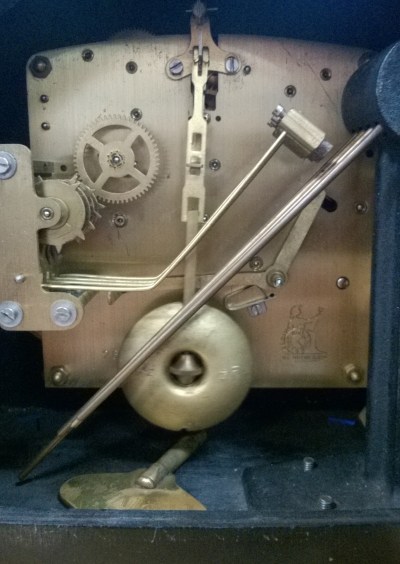
Access to the clock’s mechanism is pretty straightforward on this type of clock as there’s a simple wooden door on the back with a catch.  Opening up that door reveals a weighted pendulum with escapement above.  It was clear that someone, at some point, had replaced the pendulum spring and that all that was probably required was a minor adjustment to make the ‘tick match the tock’, or in other words, get the clock back ‘in beat’…tick-tock-tick-tock-tick-tock… evenly spread.

WP_20170922_12_00_46_Pro
FixItWorkshop, Sep’17, Bentima mantelpiece clock, mechanism.

On this mechanism, all that was needed was a level surface and a small flat-bladed screwdriver to slightly move the pendulum pivot point. Once running, a small adjustment to slow-down the running was needed (time was too fast), but this was easily adjusted using the knurled screw on the pendulum.  I recommended that if a flat level surface at home couldn’t be found, 1 penny pieces could be used under the clock’s feet to restore balance.  A nice little repair.

Cost of a clock like this:  Check eBay.  Cost of repair; my time.

V-Tech Splash & Sing baby bath book

This toy wasn’t singing at its best…

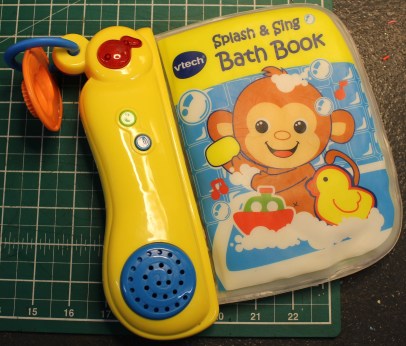
My daughter was kindly given a V-Tech Splash & Sing baby book and always enjoyed singing along to the music it made.  It’s a splash-proof book which is suitable for bath time play, but not necessarily for complete submersion at 100 metres!

IMG_4383
FixItWorkshop, Sep’17, V-Tech Splash & Sing baby bath time book.

It’s a battery operated toy and has an on/off switch and volume control on the front.  If the middle page of the book is squeezed in a couple of places, there are small switch buttons inside the book page itself, the corresponding the tune changes, relating to the picture on the page- I hope that makes sense.

The tunes on this book stopped changing with button presses and it became annoying to here the same tune constantly being played at bath time.  Very annoying.

The casing is held together with a few Pozi-head screws and after a bit of wriggling, the pages came free from the spine (the bit with the batteries and on/off switch).

Upon testing, the wires between the pages and the spine had broken internally and no longer connected to the corresponding page buttons.  They’d probably broken as the pages were turned over a good few uses.

This toy is definitely not designed to be repaired.  The only way to get to the wiring was to cut open the page, cut out the damaged wiring and replace it with something a bit tougher.  The previous wiring was very flimsy and it would only be a matter of time before it broke, too soon.

I decided to use some thin gauge speaker cable, the sort you find in cheap portable radios for the repair.  This worked really well and after some careful soldering and gluing of the cut-open page, the toy was ready for reassembly.

This repair probably wouldn’t cost in, in the real world, but I hate extreme built-in obsolescence and this toy showed examples of it.

Cost of the toy, circa £14.00.  Cost of repair; my time plus some old wire I had lying about.


Testing, testing, 1-2-what?

My Fairlady sings again…

When my wife isn’t looking after our daughter, she sings part-time in and around Sussex and uses a simple portable microphone and amplifier set for gigs. The amp and the rest of the kit lead a hard life, being transported between the car boot and venue and on one occasion, the microphone was dropped from a height.  I guess things could have been worse, it could have been the amp!

The microphone now rattled badly and seemed to cut out when connected up, even when turned up to 11.  Not a good sound when she was in the middle of ‘Moon River’.

The microphone actually came from a Lidl karaoke set and is made by Silvercrest, a Lidl brand.  It’s a heavy, metal bodied microphone with a decent quality feel and metal grilled top.

The rattle seemed to coincide with the cutting out, so it seemed sensible to open up the mic.  Three Phillips screws hold the casing together and upon opening it up, the problem quickly became apparent.  The metal weight inside had come away from the inside of the casing and was occasionally ‘shorting’ the connections on the back of the on/off switch.  Not good.

While in bits, I checked all the wiring for continuity, no problems there and decided to clean the switch with contact cleaner for good measure.  Once all the electrical side of the mic was proved, I reassembled the casing with the parts, adding a little hot-melt glue to the metal weight to prevent it coming in to contact with the back of the on/off switch.

This wasn’t the end of the song (sorry).

Upon hooking the mic up to the amp, it now worked again without cutting out, but I couldn’t help but notice that the lead connecting to the base of the mic seemed to be causing a slight crackle.  Not a nice sound effect.

Opening up the three-pin mic connector revealed a simple design, three poles soldered to the microphone’s wiring, one core and one screen.  A quick cut, strip and re-solder and the lead was ready to roll once again.  Before I did the cable crimp back up, I added another dab of hot melt glue between the cable outer and flex guard, to ensure the cable couldn’t twist, which might cause the connector to fail again.

Cost of a new microphone £20+.  Cost of repair; Time plus soldering and a bit of glue.

‘My Fairlady’ sings again…


Opening a can of worms (or not)

A little repair for my trusty Probus can opener…

Readers of this blog would have worked out by now that I’m a little bit sentimental.

A short story:

When I moved away from home, many years ago, my mum made me a ‘moving out kit’ in which contained a trusty Probus Butterfly can opener, the classic British design can opener type.  Today, it broke.  I was gutted.

You can still buy the same tool for just over £1, so it clearly doesn’t usually cost-in to repair such an item.  However, all that seemed to be wrong was a broken pivot or spindle.  The original riveted fixing had worn and eventually sheered off today when opening the cat food.

All that was needed was to re-rivet the can opener and all would be well again.  Luckily, I had some rivets lying around of the right size.  I grabbed my pop-rivet gun and 5 minutes later, it was ready to open cans once again…joy.