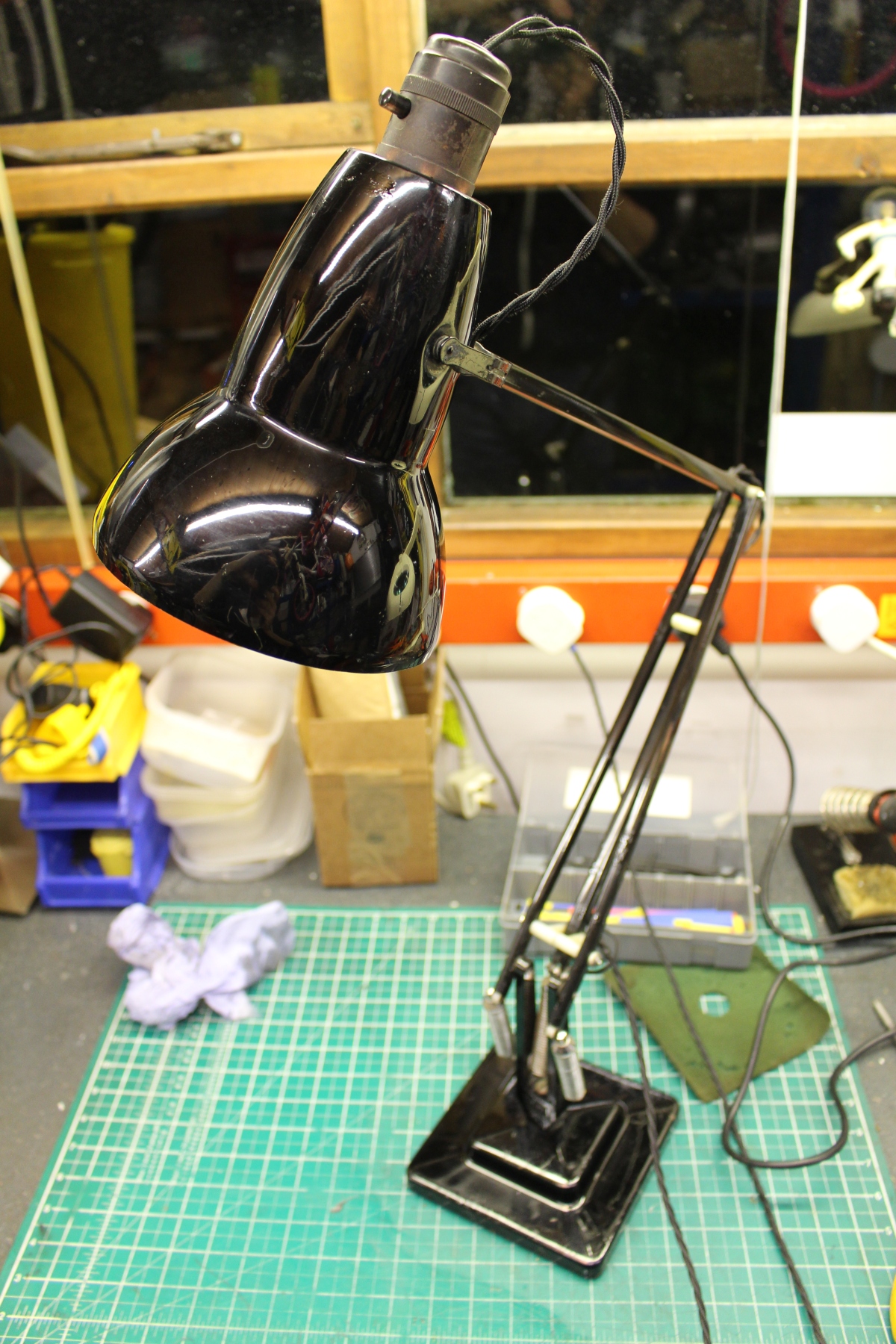
A Herbert Terry 1227 lamp gets a light make over in the workshop.
This lamp needs no introduction. Herbert Terry Ltd first produced ‘Anglepoise’ lamps in England from 1934 and this 1227 model is instantly recognisable, with its art-deco characteristics and perfect proportions. Some of those early examples have survived to today and are now very collectable.
Make and model: Herbert Terry 1227 ‘Anglepoise’ lamp
Fault reported: Wiring requires replacement
Cost of replacement machine: £80.00 -£300.00 for an equivalent
Manufacturer support (in the UK): 8/10
Cost of parts (for this repair): £20.00
My time spent on the repair: 1.5 hours
Tools needed: Small knife, pliers, small screwdrivers, soldering iron, cutters, scissors
FixItWorkshop, Worthing, Lamp in the workshop, Nov’21.FixItWorkshop, Worthing, Dodgy wiring, Nov’21.FixItWorkshop, Worthing, don’t plug in yet, Nov’21.FixItWorkshop, Worthing, lamp holder, Nov’21.FixItWorkshop, Worthing, old wiring, Nov’21.FixItWorkshop, Worthing, new felt needed, Nov’21.FixItWorkshop, Worthing, Lampholder in pieces, Nov’21.FixItWorkshop, Worthing, connections, Nov’21.FixItWorkshop, Worthing, Lamp fettling, Nov’21.FixItWorkshop, Worthing, ready for new cable, Nov’21.FixItWorkshop, Worthing, careful routing, Nov’21.FixItWorkshop, Worthing, lamp springs, Nov’21.FixItWorkshop, Worthing, polished and paint repaired, Nov’21.FixItWorkshop, Worthing, base awaiting new felt, Nov’21.
My customer contacted me to ask if I could overhaul his family’s Anglepoise lamp and had told me that it was in daily use, but they all felt that the wiring was getting on a bit, and therefore they’d lost confidence in it. In other words, they were worried about a small fire or electrocution.
That’s the trouble with old, well-made stuff like this. Often, on the outside, it all looks fine and sturdy with a quick clean up, and it’s easy to forget that some things are as old as they are. But, one has to bear in mind that after all that time here on earth, things like plastics, rubber grommets and wire insulation break down with age and can be damn right dangerous.
At 70 years old, this lamp was not in mint condition, but had been well looked after. It was still complete, with its original Bakelite bayonet bulb holder and switch, which is a rarity as they often crack. Over time, they get replaced with ‘B&Q special’ items, which never look right. Sadly, the original lamp holders are no longer available, but there are good alternatives out there, which will do the match well, if you know where to look. No issues with this one as it was all in very good order.
So to the brief; give it clean up, remove some rust, replace the worn-out felt base and re-wire, without over-restoring it. After all, it was wearing its age well, and a total re-spray would have removed all the ‘patina’.
Only a basic tool kit was required with this job, nothing fancy but with things like this, I tend to use a penetrating oil on all metal moving parts as rust and fatigue can make some fixings fragile. After all, I don’t want to add unnecessary cost to the job and while the oil is doing its thing, I can always have another brew, so there’s really no excuse not to do this. Only fools rush in and all that.
After I stripped all the old wire out, paying attention to the correct cable routes, I cleaned up anything previously covered up by the old cable. New modern fabric-covered plastic flex is available at a reasonable price, so that’s what I used and while there, I took the time to earth the frame of the lamp as a ‘Class One’ device. Technically, with a plastic/ Bakelite bulb holder, this isn’t required, but as I had some three cored cable, I decided to earth the metal base as a precaution. It couldn’t do any harm.
Normally I like to preserve as much as I can of the original parts, but in the case of the felt base, it was knackered. I could have just glued it back on, but that wouldn’t have done it justice. So, after a little raid of my daughter’s craft kit (which is full of off-cuts and felt) I had the perfect green felt, ready to be cut to size and glued in place. No one wants a scratchy base and once set, no one would ever know that the thing I’d just made, wasn’t a stock item. I was quite pleased with it.
A new LED bayonet 40W (equivalent), some light polishing, and a PAT (test) and this lamp was ready to be used daily, once again.
This month in Tales from the Workshop, I want to talk about three sensitive subjects that are not often discussed in repair circles, and readers of a nervous eco-disposition are advised to look away now!
Controversy Inside The Workshop
Repair Cafes and campaign groups such as Restart.org and Repair.eu are working hard to defend our repair rights and offer support to local communities, by providing empowering repair skills. It’s all good stuff. But I’m often asked to fix things which are not viable because the damage or wear is so great or the time required to do the fix will take many months, that I can’t offer. And that’s all before we’ve discussed parts availability, cost and other materials. So, this month, I thought I’d consider the case against repair. Have I gone quite mad?
One
Sometimes, it just isn’t worth repairing stuff, sometimes a broken thing should just be thrown out at the appropriate recycling facility, of course… or scavenged for usable spares in my case!
It’s no coincidence that popular TV series The Repair Shop majors on pre-1980 cherished items. Older items, made from quality materials, conceived before manufacturers built-in precise planned mechanical and electronic obsolescence, usually stand a chance of being repaired by crafts people, as that’s how they might have been made in the first place.
FixItWorkshop, Worthing, April 2022 – an over-complicated Kitchenaid kettle with too many electronic parts… luckily, not all kettles are made this way.
You see, a child’s toy or home printer manufactured today, on a sophisticated plastic moulding machine with sealed-in electronics will be almost impossible to repair without destroying the outer casing first. And even if you could get to the faulty battery or printed circuit board, it would be virtually impossible to repair at a reasonable cost, assuming the spares were available. Believe me, I’ve tried. When asked to take on certain repairs, I must be honest and frank with would-be customers about the chances of success and likely time a repair will take, which isn’t a conversation I like having, but it’s essential. Those conversations are not TV friendly.
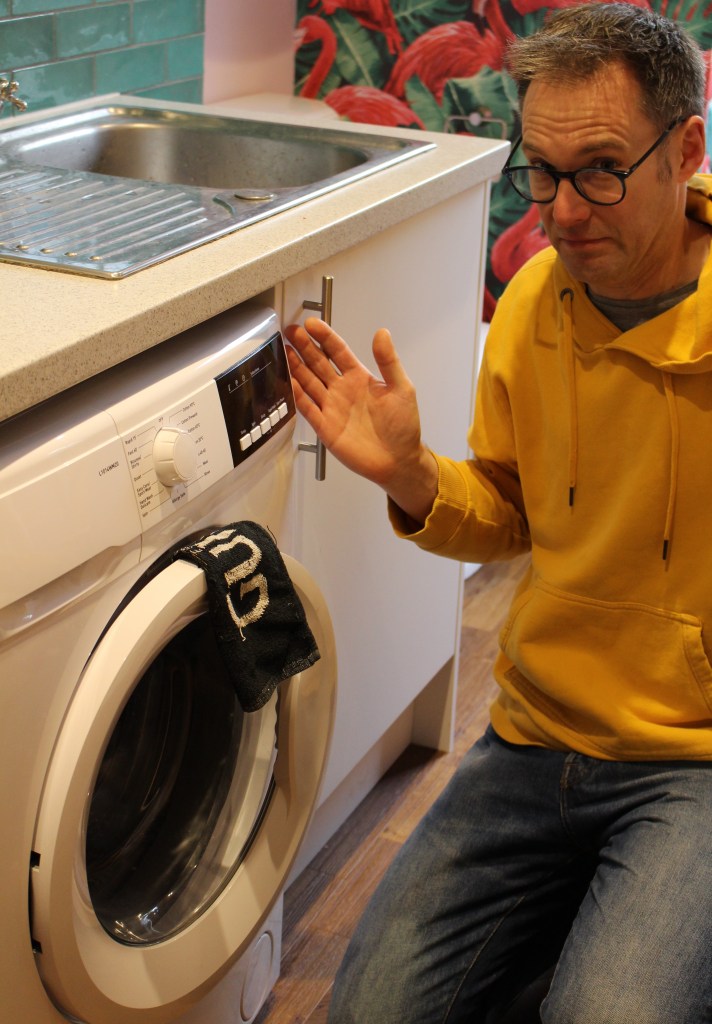
FixItWorkshop, Worthing, April 2022 – Matt with a washing machine.
Years ago, and I generalise here, people repaired things as it was usually cheaper to patch things up to get more wear out of the item. Whether clothing, cars or kettles, repair kits and local engineers were always available and usually cheaper than buying new.
But take a modern washing machine, and parts prices are often not economic to buy, especially when you factor-in an engineer’s time for the repair Its often easier and cheaper to replace the whole thing anyway with next day delivery, just a click away on your phone with interest free credit. And that’s a mighty tempting prospect when the family’s washing is piling up on the floor.
Two
On to my second controversial point; repair is now the reserve of the reasonably well-heeled. As a general observation, most of my customers are reasonably affluent, women coincidentally, and have a historic connection with the faulty item which they want repaired. It could be a favourite family toy or food mixer that needs a little TLC. To bring it back to life, it will need care, parts, experience and (usually lots of) time. All things that must cost money. The results will hopefully bring joy to the customer, which is all part of the experience. It’s why The Repair Shop works so well.
FixItWorkshop, Worthing, April 2022, A classic Anglepoise lamp in the workshop for some ‘light’ restoration.
Repair is definitely a discretionary purchase now and if you’re a bit brassic, and your microwave oven goes kaput, are you going to spend £100 getting your old machine repaired? No, you’ll do the sensible thing and buy a new one from Amazon for £40 delivered next day, as you need to feed your family.
Three
New appliances are sometimes more efficient and perform better. Take a domestic fridge. Modern ones could use as much as half the energy than those made 30 years ago, and offer more features as standard.
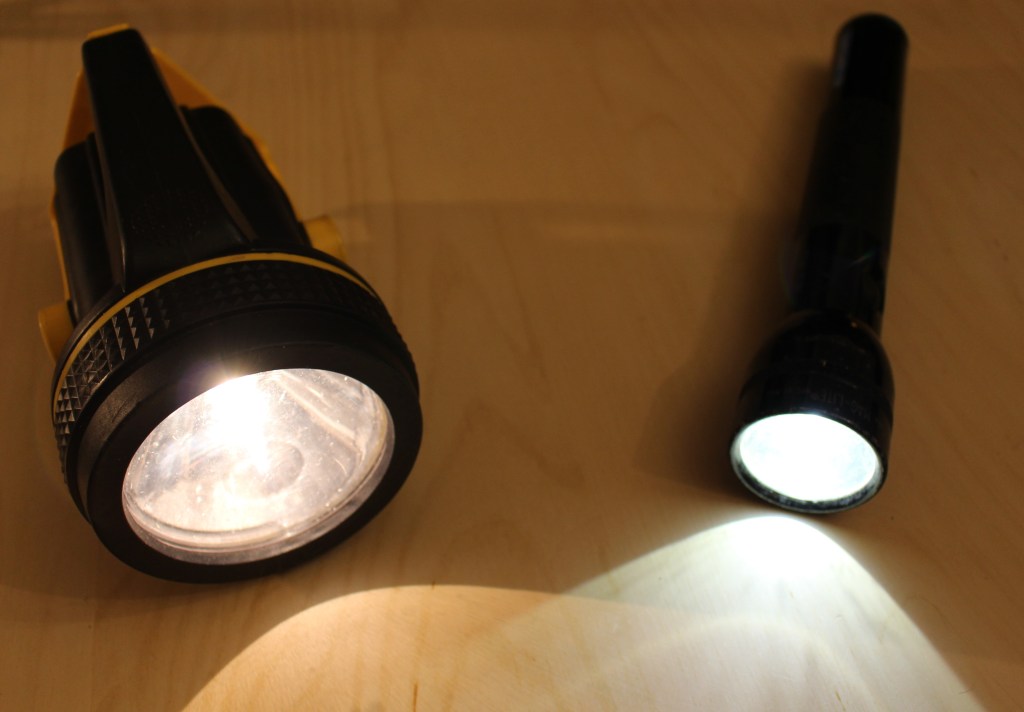
FixItWorkshop, Worthing, April 2022, torches old and older – but one has a modern CREE LED bulb that will burn retinas.
Compare a modern household torch made recently with one made 15 years ago and it will be like comparing a tea light with the sun. Technology never stops marching on, and we can all benefit from replacing some creaking appliances with something up to date sometimes. But all this comes with a big health warning.
You might be wondering if I’ve lost the plot, knocked the shed down and chucked out my screwdrivers. Not a bit of it. It’s usually more environmentally beneficial to keep something running as long as possible by spreading the manufacturing and shipping impact over a long functional life. And I don’t know about you, but I dislike the thought that someone else has already booked the death day for something I own!
I mean, just by looking at carbon-offsetting alone, consider this: Replacing a domestic kettle every three years, which has been shipped from China, made with complicated materials and electronics with no hope of repair, is not as environmentally kind as a simpler one that lasts for 9 years. Sadly, those kettles just don’t exist any more and if they did, I suspect that they would be far too expensive to be a mass-market product.
It’s such a complicated conundrum to solve, it’s just not possible to do in these hallowed pages alone. But I can leave you with a simple piece of advice; look after your things, buy quality items if you can and consider second-hand at all times to make the Pound (or insert your chosen currency here) in your pocket go further, all very sensible in these uncertain times.
*** Stop press! Feedback from FixIt Clinic in the U.S. ***
One of the great things about keeping a blog is the engagement with readers. Over the years, I’ve built up a network and contact base with fellow fixers, around the world; from all over the U.K., Europe, North America and Australia. We are certainly not alone!
Following my light article on reasons why one might not repair something, my friend Peter Mui from FixIt Clinic in the U.S. got in touch to share his thoughts. I liked his letter so much that I thought I’d share it. And since you’re here and obviously interested in this subject, why not check out their website? http://www.fixitclinic.org
Hi Matt:
I’m compelled to drop everything and to respond to your three cases against repair:
One:
Agreed: many things these days are overly complex relative to their core functionality (the KitchenAid kettle is a good example) and I would totally support a return to simpler designs generally.
Currently there’s a “race to the bottom” where the dominant factor in design for manufacturing (DFM) is to lower manufacturing cost in ways imperceptible to the [purchaser user owner] until the item is out-of-warranty. That’s why Fixit Clinic hosts through colleges and universities: to inform up and coming design and engineering practitioners to design for [durability maintainability serviceability repairability] from the very start using open source designs.
– Totally agreed, Peter. It IS a race to the bottom and agree wholeheartedly with your point – Matt.
How can we get (return?) to a situation where most things can be cost-effectively repaired?
There might be an alternative future where the design and engineering of durable goods discourages “manufacture on sophisticated plastic moulding (sic) machines with sealed-in electronics that are impossible to repair without destroying the outer casing first”, instead: spare parts are readily available at low cost from multiple sources and are easily interchangeable.
Two:
(First: I believe you intended to write “well-heeled” not “well-healed”)
– thanks for the spot Peter – Corrected! – Matt.
Agreed: there’s a component of economic privilege in repair at the moment: ironically it’s more expensive to repair than to buy a replacement.
If the end-consumer / owner is sufficiently motivated to be willing to assume (most of) the research and labor for an item that can often change the calculus in favor of repair; that’s why Fixit Clinic emphasizes conveying generalizable skills over “free” repair or repair as a service. But only the well-heeled have the precious time to undertake repair; your average consumer / average user, factoring in the time and uncertainty of the outcome, makes a reasonable economic calculation against repair and just buys a new item.
Additionally, there’s the perception and widely held assumption that “new” is always better than “used” or “repaired”.
I don’t have a good solution here either: the true full cost of modern durable goods is not reflected in the price paid at the moment of purchase; until the myriad of upstream and downstream costs of an item are added into the moment-of-purchase price this is going to be a hard nut to crack.
Three:
See “They Used To Last 50 Years” https://ryanfinlay.medium.com/they-used-to-last-50-years-c3383ff28a8e which makes the case that if you factor in the embodied energy in their manufacture and their shorter durability, new appliances may not be as ideal as keeping less efficient appliances in service for as long as possible. And I submit that the LED lighting vs. incandescent lighting example is cherry-picked: lighting technology is a category where the energy savings through technology advancement is particularly visible (wink.) The vast majority of new items or features marketed as “advancements” are incremental or even retrograde; my (admittedly also cherry-picked) counter example is 3D TV: do the people who upgraded to pricey 3D TVs feel they got good long-term value? Probably not.
Anyway, thanks for keeping me engaged into the wee hours of the morning.




 Fix It Workshop