Dinner will be served in a flash…

A Tulip A350T Electric Rice Cooker is repaired

IMG_2609
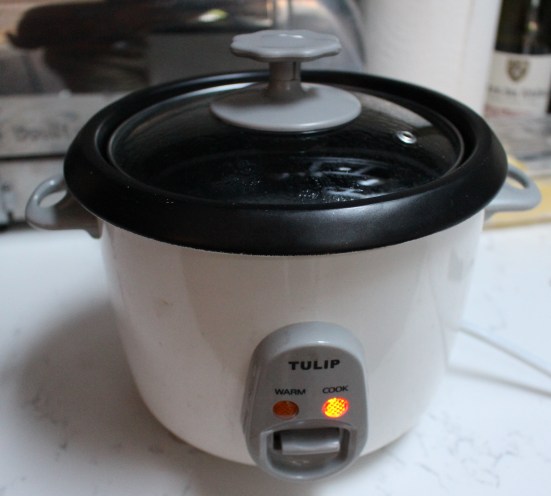
FixItWorkshop, Worthing, June’20, Tulip A350T 12Y1EI (to be exact).

I particularly enjoy receiving something to fix that I’ve never come across before.  Indeed, I’d never used an electric rice cooker, let alone heard of Tulip, the manufacturer of this example.  To be frank, I haven’t often thought about the popularity of electric rice cookers in general as an additional labour-saving device in the kitchen.  Clearly, I must be slipping.

This actual machine was a family treasure, which had moved around a bit and had originally been purchased in Holland and had since been converted from using a standard Euro plug to IEC/ kettle UK mains plug at some point.  All very interesting you say (maybe), but how did it end up in my workshop?

Make and model: Tulip A350T Electric Rice Cooker

Fault reported: Not working

Cost of replacement: £30

Manufacturer support:  0/10

Cost of parts: £2.00

Hours spent on repair: 1 hour

Tools needed: Screwdrivers, test meter, heat shrink, looped crimps etc

Sundry items: Cleaning materials

Repair difficulty: 3/10

Cups of tea: 2

Biscuits: Custard Cream X 2

After many years of reliable service, poor old ‘Tulip’ decided it had had enough of boiling up pilau rice and assorted vegetables and conked out.  When the owner tried to switch the cooker on, nothing happened, no light, no heat, no hope.

Most people would then usually have thrown in the towel, reached for their phone and within a couple of clicks, bought a new one on Amazon to be delivered the next day.

Perhaps it was the thought of poor old Tulip being crushed in the scrap metal pile at the tip which made the owner go online and find my website of strange domestic appliance tales instead of Amazon*…  But I’m glad they did.  *other online electrical retailers are available!

The machine is basically a large kettle with a removable bowl that holds whatever you wish to cook.  It has a thermostat for temperature regulation, a switch to change modes (cook/warm) and a safety cut-out mechanism, should something go wrong.  It was this safety system which had operated and caused the machine to fail-safe.

The design of the machine is quite simple, dare I say crude in places.  Within a few minutes, I had removed the base, exposing the wiring, switch, thermostat and other gubbins.

The earth bonding cable had melted which was the first alarm bell to ring.  Digging a little closer, the main issue revealed itself.  The heat-proof insulation on the ‘over heat’ one-shot thermal fuse had shorted out via a cracked piece of wiring on the metal casing of the unit.  Surprisingly, this had not overloaded the main plug fuse, but had heated the thermal fuse and had blown that instead.  Flash-bang, kaput.

The cooker’s switch, thermostat, element and other wiring checked out OK, so it was now worth fixing the failed system.

After purchasing a suitable replacement thermal fuse for a couple of quid, I set about installing this in place of the failed one, taking the time to upgrade the wiring harness with heat shrink to avoid a short again in future.  I removed the damaged earth and replaced it with fresh wire, securing it on to a better earth-bonded location and after some careful wire re-routing and fettling, the base of the machine was ready to be re-attached, ready for testing.  With the cooking bowl full of water and power applied, the ‘cook’ light lit up and the machine started to work.  Utter joy.  After a few cycles of heating and warming, I was satisfied that my work was done.

This slideshow requires JavaScript.

Even though this device wasn’t marked as such, it’s a metal bodied Class One device here in the UK and ideally required a thorough integrety test of the safety system.  Using my newly-acquired Megger PAT150 tester, I was able to prove that the machine was compliant with current UK legislation for Portable Appliance Testing.  Ricely done.



Fetch me a coffee Parker… Yes Milady!

A Gaggia Milady gets unblocked

Despite various warning labels and advice from manufacturers, sometimes it’s better to ignore official advice and just dive in, especially if something has stopped working altogether.  Gaggia coffee machines of this vintage are well supported by various online parts suppliers, so when your machine stops making the perfect brew, the chances are that it can be sorted out with a little know-how…

Parker
FixItWorkshop, Worthing, June’20 Aloysius Parker from Thunderbirds (picture from Wikipedia)
IMG_20200525_181240
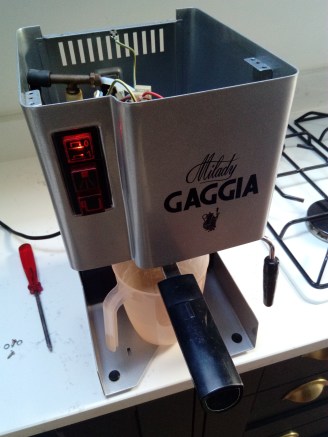
FixItWorkshop, Worthing, June’20, Gaggia Milady.

I couldn’t resist a reference to one of my favourite childhood programs…

Make and model: Gaggia Milady Coffee Machine

Fault reported: No coffee/ blocked group head

Cost of replacement: £300 (approx.)

Manufacturer support:  3/10

Cost of parts:  £0, inc. carriage

Hours spent on repair: 1 hour

Hours spent on finding parts: 0 hours

Tools needed: Screwdrivers, spanner, pliers, drill, tap set

Sundry items: Silicone spray, WD-40, water safe silicone lube, cleaning materials

Repair difficulty: 4/10

Cups of tea:  X 2 (and one coffee for testing purposes)

Biscuits: None (Ice Cream X 1)

Someone got in touch to see if I could repair their much loved Gaggia Milady, after receiving some unhelpful advice from the UK distributor.  A new Gaggia had already been purchased, but the owner was missing the ‘solidness’ of his original machine and wanted it back working again.

Fault reported:  Heater working, pump running, no water at all at the group head, therefore no coffee.

Opening the machine’s lid reveals lots of cables and pipes, so if you’re attempting this repair yourself, I recommend making notes and taking photos, carefully marking the location of all the positions.

I suspected a blockage from the boiler to the group head, as sometimes happens with older machines, as scale builds up on the inside.  In cases like this, de-scaler is usually no good and more drastic action is required.

Removing the boiler on this model is similar to many other Gaggia machines, the only variant differences usually being cosmetic.  Just four screws usually hold the boiler to the cabinet.  I suspected that there was a blockage between the boiler area and valve to group head ‘jet’ and in order to access it, a few layers of metal work needed to be removed.


This slideshow requires JavaScript.

Just one screw holds the strainer, but removing the head involves removing two bolts, which secure two halves of the group head.  The trouble is that over the years, corrosion makes the two halves ‘weld’ together and the only way to split them is to use a little ingenuity.  Fortunately, there are four water holes in the head which make ideal leverage points and with a small M5 tap, those holes become anchor points for the two bolts holding the head together.  Winding those bolts into the new threaded holes forces the two halves apart…

…Revealing the brass valve base.  Using a 10mm spanner releases the valve’s spring and valve rubber.  In this case, it was full of scale and debris.  A thorough clean using WD40, wire brushes and wire wool and the group head was ready for reassembly.

All surfaces scrubbed, all rubber seals cleaned and treated to some water-safe lubricant, the group head back together, the boiler was ready to be re-installed into the machine.  After some careful re-plumbing and re-connecting, the machine was ready for testing.

Just one more job.  Make the coffee for Milady!

Another machine dodges the tip with only a small tin of elbow grease used. F.A.B!